Play a Game to Develop Awesome Leadership Skills

In previous posts, we’ve explored how being a Dungeon Master (DM) in Dungeons & Dragons (D&D) offers a unique opportunity to develop leadership skills. However, stepping into the role of a player can be just as valuable in learning and practicing leadership. While you may not be the one guiding the story or setting the stage for encounters, the choices you make as a player can be purposeful in enhancing your leadership abilities. Here are three tips for leveraging your D&D player experience to develop leadership skills.

Using Your Persona to Explore Different Leadership Models

Playing a character in D&D offers the perfect opportunity to experiment with different leadership styles. Including those you might not naturally gravitate toward. A player’s character can be purposefully designed or role-played to embody various leadership models, such as:

  • Situational Leadership: Depending on the needs of the moment, does your character adopt a directive, coaching, or supportive style? Perhaps in battle, they take charge with authority, but when solving puzzles or negotiating with NPCs, they lead through collaboration and encouragement.
  • Transformational Leadership: Maybe your character focuses on inspiring and motivating others by developing a vision or goal that everyone can rally behind. These could include completing a shared quest or fighting injustice.

D&D lets you experiment with these styles and reflect on how different approaches can inspire or challenge your party. Being purposeful with different styles let’s you work out your own way of leading. Use each session to practice a leadership model that you can later apply in real-world settings.
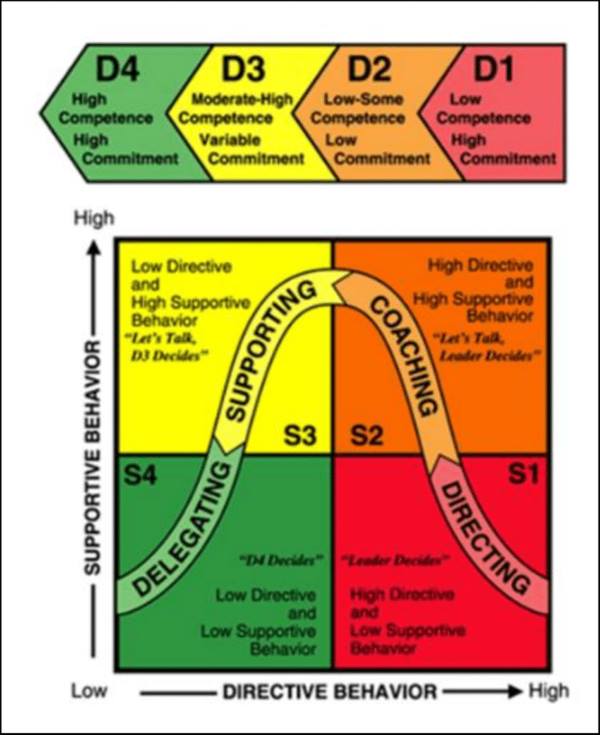
Situational leadership, one of the many models you can use to develop leadership skills

Creating Cohesion Within the Team

A strong D&D group relies on collaboration and trust, much like an effective team in the workplace. As a player, you can take a leadership role by focusing on team cohesion. Instead of leading from the front you take the initiative in getting the players to bond as a group. Here are a few ways to foster unity:

  • Encouraging Participation: Ensure that everyone at the table has a chance to contribute. Sometimes quieter players may hesitate to speak up. As a player, you can encourage them by drawing them into the conversation or seeking their advice in-game.
  • Resolving Conflicts: When disagreements arise within the party (or even between players), step up as a mediator. This not only keeps the game moving forward but also helps you hone your conflict resolution skills, a crucial aspect of leadership.
  • Celebrating Successes: Recognition is an often overlooked aspect of leadership. Whether it’s a particularly clever move in battle or the solving of a tough puzzle, take the time to acknowledge the contributions of others. This builds morale and reinforces the idea that everyone plays a vital role.

Developing Emotional Intelligence

Being a leader isn’t just about decision-making; it’s also about understanding and managing interpersonal dynamics. D&D, as an inherently social game, offers ample opportunities to develop emotional intelligence, a core trait of effective leaders. Paying attention to how your actions, both in-game and at the table, affects others helps hone this skill.

  • Practice Empathy: Whether in character or during role-play, try to understand your fellow players’ motivations and emotions. This can help you build stronger relationships within your group, as well as improve your ability to lead with empathy in the workplace.
  • Adaptability: In both leadership and D&D, things don’t always go as planned. Use your playtime to practice staying calm under pressure, adjusting your strategies when necessary, and being flexible when new ideas are presented.

Final Thoughts

When I play D&D as a player I find great satisfaction in practicing and understanding different leadership principles during the session. I wrote about a great example of a player led mutiny here. I love it when the group are put under pressure and have to try an win against insurmountable odds. Post-game I often think about how we dealt with the stress as a team, what worked, and of course, what didn’t.

Playing Dungeons & Dragons as a player offers an incredible platform to explore and refine leadership skills in a low-stakes, highly creative environment. Using your character to explore different facets let’s you translate these in game lessons to real-world leadership scenarios. Next time you sit down for a session, think about how you can be purposefulto develop leadership—not just for your character’s growth, but for your own.

How New Workers Learn Teamwork: From Group Projects to Dungeons & Dragons

While we all know that teamwork is a critical skill in the workplace, it’s not something that comes naturally to everyone. People entering the workforce for the first time often arrive with varying degrees of experience in collaborative environments. The ability to work in a team is developed through a range of experiences. These can range from group projects in school and college to participating in team sports and clubs. But what if there was a more engaging, dynamic way to learn teamwork skills? Enter Dungeons & Dragons (D&D)—a game that not only entertains but also teaches essential teamwork skills in a way few other activities can.

Group Projects in School

For many, school group projects are their first significant taste of teamwork. These projects often involve a diverse mix of randomly assigned individuals. All of whom must come together to achieve a common goal—completing an assignment or presentation. Both of my kids are going through this at the moment. Interestingly, their understanding of how teams work (and don’t) is already beginning to form.

  • Experience: Students learn to divide tasks, manage time, and communicate effectively to ensure the project is completed on time.
  • Challenges: Conflicts can arise when some members contribute less or when communication breaks down. In fact, these challenges provide valuable lessons in conflict resolution, leadership, and compromise.

Team Sports

Participation in team sports is a well known way to learn teamwork. Whether it’s soccer, ice hockey, or volleyball, team sports teach players the importance of trust, communication, and working together towards a shared objective. With my own kids sports teams, it has been a joy to watch them progress from a bunch of individuals to a group that works as a team.

  • Experience: Athletes quickly learn that individual talent is not enough; the team must function as a cohesive unit. Success comes from understanding each other’s strengths and weaknesses and playing to those strengths.
  • Challenges: The fast-paced nature of sports often requires split-second decisions that affect the entire team, reinforcing the need for clear communication and trust in one another’s abilities.

Club Participation

Clubs offer a different flavor of teamwork, often centered around shared interests or goals. Whether it’s a debate club, drama society, or environmental group, clubs provide a structured yet flexible environment for teamwork. Usually clubs have a strong purpose, which gives the group direction.

  • Experience: Members often take on specific roles that contribute to the club’s overall success, such as organizing events, managing finances, or leading discussions.
  • Challenges: Balancing individual initiative with group consensus is a common challenge, teaching members how to negotiate and collaborate effectively.
learn teamwork with D&D
The ultimate way to learn teamwork, D&D?

The Ultimate Way to Learn Teamwork: Dungeons & Dragons

While group projects, sports, and clubs all provide valuable teamwork experience, there’s another activity that really stands out: Dungeons & Dragons. This tabletop role-playing game might seem like just a game to outsiders. But, it’s a powerhouse for building teamwork skills. Here’s why:

  1. Collaborative Storytelling: In D&D, players create a shared narrative, with each person contributing to the story’s direction. Success is rarely achieved alone. Players work together solving problems, overcoming obstacles, and achieving their goals. This collaborative aspect mirrors real-world team dynamics, where success often depends on effective communication and mutual support.
  2. Role Differentiation and Cooperation: Every character in D&D has unique abilities and strengths, just like members of a workplace team. Players must understand their own role and how it complements others in the group. This dynamic teaches the importance of role differentiation, cooperation, and leveraging individual strengths for the benefit of the team.
  3. Problem-Solving Under Pressure: D&D scenarios often present complex challenges that require quick thinking and teamwork to resolve. The pressure to make decisions that affect the entire group, combined with the unpredictable nature of the game, mirrors the problem-solving demands of a fast-paced work environment.

RPGs in Graduate Programs

Given the immense benefits of roleplaying games like Dungeons & Dragons, incorporating them into graduate programs can provide unparalleled teamwork experiences. While new to the workforce, graduates are expected to collaborate on complex projects, manage time effectively, and navigate high-pressure situations. These are skills that are directly honed through playing RPGs.

By introducing D&D type sessions into your organizations graduate programs, students gain a unique opportunity to develop and refine their teamwork abilities. Teamwork under pressure is simulated in a dynamic, engaging, and ultimately, low-risk environment. These games encourage creativity, foster deep communication, and build strong, trust-based relationships among participants. Qualities that are invaluable in any professional setting.

Additionally, scenarios can be created that reflect common leadership issues faced by your organization. Albeit wrapped in a different genre.

While traditional activities like group projects, team sports, and clubs provide essential building blocks for teamwork, Dungeons & Dragons offers a uniquely powerful way to cultivate these skills. By embracing the collaborative and immersive nature of RPGs, new workers and students alike can learn the art of teamwork in a way that’s both fun and profoundly impactful.

All you leaders out there, why not talk to your learning and development team about incorporating D&D into your graduate program?

The Magic of Emergent Play: Crafting Encounters Without Set Solutions

When we think of a classic Dungeons & Dragons session, it’s easy to imagine meticulously planned encounters, intricate puzzles with specific solutions, and a dungeon master (DM) who knows every twist and turn in advance. However, there’s a different approach that can lead to some of the most memorable and dynamic gameplay: emergent play.

If you’ve been following this blog for a while you will know that I am a serious fan of this type of play. In fact, I design all my adventures with emergent play in mind.

Emergent play embraces the unpredictable nature of collaborative storytelling, allowing both players and the DM to experience genuine surprises. By designing encounters and puzzles without a predetermined solution, you create an environment where creativity flourishes, and every decision matters. In this article, we’ll explore how to incorporate emergent play into your D&D sessions and offer ideas for encounters tailored to a work-based D&D group.

What is Emergent Play?

Emergent play refers to a style of gameplay where outcomes are not entirely scripted, allowing new and unexpected possibilities to arise from the interactions between players, the environment, and the rules of the game. In D&D, this means creating scenarios where the players’ actions and decisions directly shape the story, often in ways that even the DM couldn’t have anticipated.

This requires a shift in mindset: rather than guiding players toward a specific outcome, the DM sets the stage and lets the players’ creativity lead the way. The result is a dynamic (chaotic), organic narrative that can evolve in real-time, keeping everyone at the table on their toes.

The Art of Writing Encounters with No Set Solution

Designing encounters and puzzles without predetermined solutions can be challenging, but it’s also incredibly rewarding. I believe that it’s actually significantly more satisfying than developing an adventure with everything though out. Here’s how you can do it:

Focus on the Situation, Not the Outcome

When crafting an encounter, begin by imagining a compelling and exciting situation rather than a specific end result. For example, instead of creating a puzzle with a single correct answer, think of a scenario that presents a problem the players need to solve. This problem can have multiple solutions, each depending on the players’ ingenuity. For me, the joy comes from the players creativity, rather than from my own perceived cleverness.

Example: The players stumble upon a village suffering from a mysterious curse. The curse could be lifted by several means: finding and destroying a cursed artifact, negotiating with a local spirit, or even making a difficult moral choice. The key is to avoid designing the “correct” solution in advance—let the players discover their own path.

Leverage the Players’ Skills and Backgrounds

Encourage players to use their characters’ unique skills and backgrounds to interact with the environment. When players feel that their choices and character traits genuinely impact the story, they’re more likely to engage deeply with the game.

Example: If the party includes a bard with a talent for persuasion, a fighter with a deep knowledge of military tactics, and a druid connected to nature, create scenarios where these skills can shine. The players might convince a rival faction to join forces, devise a clever ambush, or call upon local wildlife for help—all valid and rewarding solutions.

Introduce Dynamic Elements

Consider adding elements to the encounter that change based on the players’ actions or even based on random rolls. This can create a sense of unpredictability that keeps the session exciting.

Example: The players are attempting to navigate a treacherous mountain pass during a storm. The storm’s intensity could be both randomized and influenced by the players’ actions, such as using magic to calm the winds or making a risky decision to push forward despite the danger. The environment itself becomes a living, reactive part of the encounter.

Embrace Improvisation

By its very nature emergent play thrives on improvisation. As a DM, you have to be open to ideas and solutions that you hadn’t anticipated. Listen to your players, build on their suggestions, and use your improv skills to keep the story flowing. Often I create puzzles or encounters with absolutely no preconceived notions of how they might be solved. Instead, relying on improvisation alone to find the solution based on the reactions of the players.

Example: The players might decide to solve a puzzle by using an item or spell in a completely unexpected way. Instead of shutting down their idea because it wasn’t part of your plan, consider how it might work in the context of the game world. This approach not only rewards creative thinking but also reinforces the collaborative nature of D&D.

For some advice on improving your improv skills in a DnD context check out this video by Bob WorldBuilder.

Improvised DnD, essential for emergent play!

Emergent Encounter Ideas for a Work-Based D&D Group

Given the nature of this blog I want to tie in some thoughts about using these concepts in a work-based D&D group. Here, you often have players with diverse levels of experience and varying amounts of time to dedicate to the game. Perhaps the normal tropes of the game aren’t apparent to the participants. Here are a couple of emergent encounter ideas that can engage everyone, regardless of their familiarity with D&D:

The Office Heist

The party is tasked with retrieving a critical piece of information from a well-guarded office building. The twist? Each player is assigned a different role within the company (e.g., security, HR, IT) and must use their “workplace skills” to navigate the environment. There’s no set way to achieve the goal—players can collaborate to come up with a plan that leverages their “professional expertise.”

The Corporate Rivalry

Two powerful companies are vying for control over a lucrative contract. The players must decide whether to sabotage the rival, broker a deal, or come up with a third option that benefits both parties. The encounter evolves based on the players’ decisions, alliances, and even office politics. To make this even more emergent, why not have the rival company played by an accomplice. This would give the negotiations an air of realism, while adding additional unpredictability to the encounter.

The Joy of the Unexpected

Emergent play in D&D transforms the game into a living, breathing narrative where anything can happen. By designing encounters without a fixed solution, you invite players to take the reins of the story, leading to unforgettable moments of creativity, collaboration, and surprise.

For work-based D&D groups, this approach can make sessions more inclusive. Also, engaging players at all skill levels and allowing them to contribute in unique ways. Whether you’re navigating a corporate heist or negotiating a corporate rivalry, the possibilities are endless when you let the story emerge naturally.

So next time you sit down to plan a session, consider leaving a few loose ends. Where will the adventure take you? You might just find that the best stories are the ones you never planned!