Transforming Plots from Books and Movies into Exciting D&D Adventures

Alien movie poster

How often do you watch a movie or read a book, and think, this would make an awesome D&D adventure? If you are like me, all the time! The rich narratives found in books and movies offer a treasure trove of inspiration for creating compelling adventures. By adapting these stories into the D&D adventure framework, Dungeon Masters (DMs) can craft adventures that resonate with players, offering familiar yet novel experiences. Let’s explore how to convert the plots of the movie Alien and the book Sharpe’s Rifles into engaging D&D adventures.

The Movie: Alien

My favorite movie of all time. I remember watching it as a 16 year old on a rocking chair in my parents house. I kept the lights off, which coupled with the creaking of the old house added to the scary atmosphere. The bleak industrial sci fi, kick ass heroine and beleaguered crew had a big impact on me. Despite the fact there is an Alien RPG and others like Mothership and Those Dark Places I’ve always though that Alien is also great fodder for a D&D adventure.

Synopsis: In Alien, a spaceship crew responds to a distress signal on a distant planet, only to encounter a deadly extraterrestrial creature that picks them off one by one.

Conversion into a D&D Adventure

  • Setting the Stage: The adventure begins with the party receiving a distress call from a remote outpost or a derelict ship. The setting could be a mystical planes jumping vessel, a forgotten temple, or an ancient dungeon.
  • Initial Exploration: As the party investigates, they discover signs of an unknown threat—strange symbols, remnants of battles, or cryptic messages left by the previous inhabitants.
  • The Threat: Introduce a powerful, terrifying creature that stalks the party. This could be a homebrew monster or an adaptation of an existing creature like a mind flayer or a remorhaz.
  • Survival and Escape: The focus of the adventure shifts to survival. The party must use their wits and resources to outmaneuver the creature. The tension rises as they realize direct confrontation might not be the best option.
  • Climactic Escape: The adventure culminates in a high-stakes escape, where the party must make critical decisions to ensure their survival while sealing or destroying the creature to prevent further harm.

I can already picture the experience at the table. Slow dawning dread as they uncover the clues. Followed by a frenetic, time pressured escape. I want to play this already! In fact I will be including this in my regular campaign at some point in the future. So if any of my players are reading this, you better beware when you come across that ancient temple…

Bernard Cornwell’s books have plenty of D&D adventure inspiration

The Book: Sharpe’s Rifles

As a boy/adolescent in the 1990’s the Sharpe books and subsequent TV movies were a staple part of my media diet. Tales of derring-do aplenty with lots of inspiration for D&D shenanigans.

Synopsis: Sharpe’s Rifles follows Richard Sharpe, a soldier in the British Army during the Peninsular War. After a series of setbacks, Sharpe takes command of a group of riflemen and leads them on a daring mission to rally Spanish allies and defeat a superior French force.

Conversion into a D&D Adventure

  • Setting the Stage: Place the party in a war-torn region where they are part of a larger conflict. They are separated from their main force and must navigate enemy territory to regroup with allies. The enemies could be anything from a chaotic orc horde to well disciplined Drow.
  • Leadership Challenge: One of the party members (or a trusted NPC) must step into a leadership role, rallying a group of local militia or refugees. The focus here is on building trust and cohesion within the group.
  • Skirmishes and Guerrilla Warfare: The adventure includes a series of skirmishes against enemy patrols. The party must employ guerrilla tactics, using the terrain and local knowledge to outsmart a superior force.
  • Rallying Allies: The party seeks out local leaders or resistance fighters to bolster their numbers. This involves diplomacy, persuasion, and perhaps a daring rescue or theft.
  • Final Battle: The adventure culminates in a strategic battle where the party and their allies confront the enemy. The players’ earlier choices affect the strength and morale of their forces, adding weight to the final confrontation.

I envisage this adventure being played in the sandbox style. The players are provided with a map of the area. Potential ally and enemy locations are detailed. Now the party must decide where to rally allied troops and where to enact guerilla actions. The final battle could be at the key strategic location being held by the villains. Perhaps a cross roads, bridge over a chasm or a magical portal. Played as a short campaign this gives plenty of opportunity for player dilemmas and cinematic scenes. I know exactly where this sort of adventure can fit into my current campaign.

Final Thoughts

Adapting plots from books and movies into D&D adventures allows DMs to introduce players to thrilling, narrative-rich experiences. By drawing on the suspense of Alien or the military strategy of Sharpe’s Rifles, DMs can create adventures that challenge players in new and exciting ways. The key is to capture the essence of the original story while allowing for the flexibility and creativity that makes D&D unique. By thinking about the inspirations above I now have two potentially awesome adventures to run my players through. I cant wait.

Where are your go to sources of inspiration for your D&D adventures?
Competitive D&D: Is it for you?

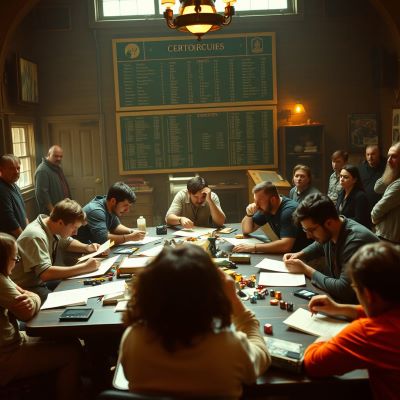
competitive D&D in action

Just after Christmas, some friends and I had the exhilarating experience of participating in a Dungeons & Dragons competition. But by their nature roleplaying games aren’t a competition, I hear you say. Normally, I would agree. However, we thought we’d give it a go. You don’t get many opportunities to pit your D&D skill against other parties. After reading this you may see some merit in competitive D&D.

The tournament saw multiple groups navigating through the legendary Gary Gygax adventure: The Lost Caverns of Tsojconth. Although we missed the official tournament sign-up, our friend Rich, who was DMing at the event, graciously agreed to run a separate session for us. The event was organized by the local group DnD Fremantle, who have done a fantastic job fostering a vibrant D&D community in our local area.

The Challenge

The competition was structured in two intense 2-hour blocks, requiring rapid decision-making and strategic thinking. Initially, we struggled with the limited time to familiarize ourselves with our character sheets, spells, and abilities—only 15 minutes! It was a challenging start, but we quickly adapted to the fast-paced environment.

Rich, our DM, used a scoring system to evaluate our progress, awarding points for achieving specific goals in each encounter. The objective was to traverse as much of the adventure as possible within the 4-hour limit. In the real tournament 5 groups all ran through the adventure at the same time and their scores totaled at the end to determine the winning team.

The Party

From memory, we had 6 pre-generated characters to choose from: monk, wizard, warlock, fighter, cleric and rogue. As mentioned above, we had 15 mins to choose our characters and understand how they worked. Our final party comprised four level 9 adventurers:

  • Ethelrede, a stalwart human fighter
  • Cathartic, a devoted human cleric
  • Weslocke, a cunning Tiefling warlock
  • Dunil, a resourceful halfling rogue

There should have been five, but unfortunately one of our players was ill on the day.

Key Encounters

The adventure was very “old-school”, with seemingly random creatures dotted around an underground cave system. It did mean that you never quite knew what was around the corner. Some of our memorable encounters included:

  • The Mud Golem: Early in the adventure, we faced a formidable mud golem guarding a magical sword. This creature could only be damaged by magical means, which significantly limited our options. It was a close call, especially for my character, Dunil, who nearly perished in the encounter (only 2hp left).
  • Gem-Hauling Statue Faces: We successfully navigated a trap-laden room filled with gem-inlaid statues, managing to extract the gems without losing any limbs.
  • Friendly Pechs: In a refreshing twist, we encountered Pechs—goblin-like creatures who turned out to be friendly allies. This encounter provided a brief respite from the relentless dungeon hazards.
  • Chuuls’ Deadly Ambush: Crossing a river proved fatal as we were ambushed by paralyzing crab-like creatures, the Chuuls. This encounter ended in a total party kill (TPK), forcing us to restart. It was a humbling experience but one that bonded our team.
  • Fierce Formian Battle: Our session concluded with a fierce battle against Formians, ugly ogre like creatures with sinister eyes. This encounter tested our combat strategies and teamwork to the limit.
The incredible trophy made for the actual tournament!!

Lessons Learned

  1. Pre-Game Planning: It’s crucial to allocate more time for character selection and understanding character abilities. Knowing who will play which type of character and having a strategy for dungeon interaction can save valuable time.
  2. Team Urgency: The competition format instilled a heightened sense of urgency. Quick decision-making and effective communication became our focus, improving our overall gameplay.
  3. Adaptation: Adapting to the competition’s fast pace was challenging but ultimately rewarding. By the second half, we found our rhythm, coordinating efficiently as we navigated the labyrinthine caverns.

We ended the adventure with a score of 8 points, which included a -5 penalty for the TPK. While this might seem modest compared to the winning team’s 18 points, we considered it a solid performance for our first competitive run. More importantly, the experience was incredibly fun, thanks to Rich’s masterful DMing.

More Competitive D&D?

This competition has whetted our appetite for more. We’re already planning to enter the next tournament with lessons learned and a renewed sense of strategy. If you’re considering a competitive D&D experience, we highly recommend teaming up with friends and diving into the challenge. It’s an unforgettable way to test your skills and deepen your love for the game.

See you in the next adventure!

Can Roleplaying be Used as a Powerful Forecasting Tool?

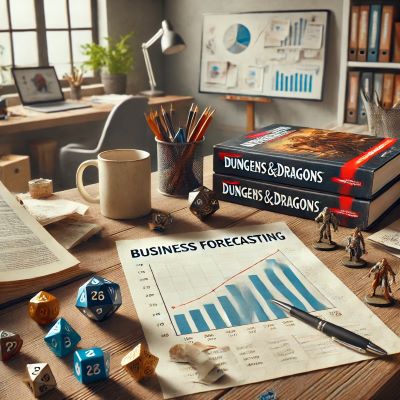
using roleplaying as a forecasting tool

I came across this paper titled “Role Playing: A Method to Forecast Decisions” by J Scot Armstrong (2001) a couple of years ago and thought it was worth sharing here. Armstrong’s paper discusses the effectiveness of using role-playing simulations to forecast decisions in various real-world scenarios. It presents five situations where interactions between two parties significantly impact the outcomes. These include labor negotiations, lobbying efforts, product design changes, legal defense strategies, and contract negotiations. The paper argues that using role-playing simulations can help accurately forecasting decisions and their consequences in these complex, interaction focused situations.

It highlights the importance of accurately forecasting the decisions of other parties involved, citing historical examples where inaccurate predictions led to detrimental outcomes. One such example was the failed stock sale of the British-owned Falkland Islands Company to an Argentine consortium in 1975, which ultimately led to the Falkland’s war. Accurate forecasting of each other’s decisions might have prevented the conflict, instead resulting in mutual benefits. The author suggests that role-playing simulations can help improve decision-making accuracy by simulating interactions between parties and predicting their responses to different scenarios.

In many ways this is similar to the concept of Red Teaming. This involves running a simulation with a real opposition force (red team) to test a companies strategies and contingencies. I wrote about Red Teaming and roleplaying games in a previous article here.

Running a Roleplaying Simulation

The paper outlines the basic elements of creating these role-playing simulations. Including realistic casting, clear role instructions, accurate situation descriptions, active participation, and thorough coding of results. It also emphasizes the need for multiple sessions with different scenarios to obtain reliable predictions.

When to Run a Forecasting Simulation

Of course using roleplaying simulations for forecasting does not work for every situation. The paper suggests ideal conditions include: involving conflicts, large changes, or interactions between a few parties. Most important is the need for faction interactions to have a large influence on the outcome.

Is Roleplaying as a Forecasting Tool A Valid Method?

Finally, the paper provides evidence on the value of role-playing simulations, including studies demonstrating their face validity, predictive validity in contrived situations, and effectiveness in predicting decisions in actual situations. It concludes that role-playing simulations offer a valuable method for forecasting decisions and improving decision-making processes in complex scenarios.

An example of a crisis focused forecasting simulation

Final Thoughts

This paper was an interesting read and I could immediately draw parallels with Red Teaming and Megagames in the way the suggested simulations would work. But are companies and other organizations using this methodology? Unfortunately, that is not made clear in the paper. Though we do know that the military do use roleplaying in some of their wargames.

Given the suggested ideal situations and the cost associated with running a roleplaying forecast simulation implies that this methodology would only really be viable for larger organizations. For example, companies like Airbus, Richemont, and HSBC have participated in crisis simulation exercises that involve role-playing to improve decision-making under stress. In fact there is an existing industry providing such services.

Unfortunately, it seems clear that this sort of activity would be of limited use for the small to medium enterprise.

Nonetheless, an interesting journey into another avenue of roleplaying and its use within an organizational setting. Has your company used roleplaying as a forecasting tool?