
How to Persuade Your Boss to Play Dungeons & Dragons

Team bonding activities have become an essential part of modern workplace culture. They foster camaraderie, improve communication, and boost morale. While traditional team-building exercises like trust falls and icebreakers have their merits. There’s a new player in town that can level up your team’s cohesion: Dungeons & Dragons (D&D). Are you eager to introduce D&D to your team but need to persuade your boss? Read on to discover the tangible benefits, cost-effectiveness, and problem-solving potential that this legendary tabletop game offers.

Tangible Benefits for a Team to Play D&D

Dungeons & Dragons, a role-playing game set in a fantasy world, may seem like an unusual choice for team bonding, but it offers numerous tangible benefits to the open-minded team:

  1. Improved Communication: D&D requires players to work together, communicate effectively, and strategize as a team. It encourages creativity in problem-solving and collaboration in decision-making, all of which are transferable skills in the workplace.
  2. Enhanced Problem-Solving: Players must overcome various challenges and puzzles within the game, encouraging critical thinking and innovative solutions. Of course, this translates seamlessly to addressing real-world issues faced by your team.
  3. Building Trust: D&D promotes trust among team members, as players rely on each other to achieve common goals. As we know, trust is the cornerstone of a productive and harmonious work environment.
  4. Conflict Resolution: The game provides a safe space for addressing conflicts and making decisions, helping your team practice resolving issues constructively.

Low Cost Compared to Other Team Bonding Activities

One of the most compelling reasons to suggest D&D to your boss as a team bonding activity is its cost-effectiveness. Traditional team-building events can be expensive, often involving off-site venues, facilitators, and equipment rentals. In contrast, D&D requires minimal investment:

  1. Affordable Materials: The basic materials needed for a D&D session are relatively inexpensive, including rulebooks, character sheets, and dice. Many resources are available online for free.
  2. No Travel Expenses: D&D can be played in the office or remotely, eliminating the need for costly off-site trips.
  3. Long-Lasting Benefits: Unlike one-off team-building events, D&D can become an ongoing tradition, providing ongoing value for your team without recurring expenses.

D&D really is a low cost alternative to pricey team building activities.

Option to Tailor the Game to Specific Problems Faced by the Team

Perhaps the best reason to introduce D&D to your team is its adaptability. You can tailor the game to address specific challenges or problems your team is facing:

  1. Custom Scenarios: The Dungeon Master (DM) can create scenarios that mimic real workplace challenges, allowing team members to practice problem-solving in a fun and low-pressure environment.
  2. Skill Development: D&D characters have various skills and abilities that can mirror your team’s skillset. By designing encounters around these skills, you can help your team hone their strengths.
  3. Feedback Mechanism: Including debrief sessions in your D&D sessions allows team members to share insights and feedback on how they approached in-game challenges. Before discussing their application to real-world issues.

How to Approach Your Boss

Now that you understand the compelling case for using D&D as a team bonding activity, it’s time to approach your boss. Here’s a step-by-step guide:

  1. Research and Prepare: Gather information about D&D, its benefits, and how it can be customized to address your team’s specific needs.
  2. Schedule a Meeting: Request a one-on-one meeting with your boss to discuss your proposal. Be sure to emphasize that it won’t take up much of their time.
  3. Highlight Benefits: Present the tangible benefits of D&D, including improved communication, cost-effectiveness, and its potential to address specific problems.
  4. Customization: Explain how D&D can be tailored to your team’s needs and provide examples of scenarios that could be beneficial.
  5. Address Concerns: Be prepared to address any concerns your boss may have, such as the time commitment or the perceived frivolity of the game.
  6. Offer a Trial Run: Suggest starting with a trial session to gauge interest and gather feedback.
  7. Follow Up: After the meeting, send a follow-up email summarizing your proposal and thanking your boss for their time.

With the right approach and a well-reasoned argument, you can persuade your boss to see the potential of D&D as a team bonding activity that will benefit your team and the organization as a whole. Tailoring the message and scenarios to your teams situation and any particular challenges they face would make the proposition very compelling. Why not do your prep and get that meeting with the boss. It’s time to level up your team’s cohesion and problem-solving skills with the power of imagination and collaboration that Dungeons & Dragons provides.

If you’re not sure where to start or which scenarios to suggest do not hesitate to get in touch for a quick discussion.

Unlock Critical Thinking with the Power of Dungeons and Dragons

Dungeons and Dragons (D&D) is a role-playing game that has been enjoyed by millions of players worldwide for decades. It is a game that allows players to immerse themselves in a fantasy world filled with adventure, magic, and mystery. But beyond the entertainment value, I believe D&D to be an effective tool for developing critical thinking skills that can be applied to the world of work.

Playing The Skills

One of the most significant benefits of playing D&D is that it allows players to practice problem-solving and critical thinking skills. In the game, players are presented with various challenges and obstacles that they must overcome to succeed. These challenges often require players to work together as a team and to think creatively to find solutions. This type of problem-solving is essential in the business world, where employees must often work together to find solutions to conflicts both inside and outside of the immediate team.

Another benefit of playing D&D is that it allows players to practice communication and negotiation skills. In the game, players must often work together to achieve a common goal. They must communicate effectively and negotiate with the game world and each other to make decisions that will benefit the group as a whole. These communication and negotiation skills are essential in the business world. Helping employees interact with each other, clients and stakeholders.

Playing D&D can let you mirror real life experiences, helping you upskill your critical thinking

Mirroring the Challenges

An interesting way in which playing D&D can help resolve conflicts is through mirroring the game difficulties and challenges with those found in real life. In the game, players often have to face difficult situations such as conflicting interests, limited resources, and unexpected challenges. These situations are similar to those found in the real world, and by experiencing them in a safe and controlled environment, players can learn how to handle these situations in a more effective way.

For example, in the game, players may have to negotiate with a powerful dragon to gain access to a powerful magical item. Using critical thinking and negotiation skills the players have to work out what the dragons wants. Before negotiating a mutually beneficial resolution. This type of situation is similar to negotiating with a difficult client in the business world. Where the same critical thinking and negotiation skills can be used to great effect. By practicing these skills in the game, players can develop the necessary skills to handle these situations in real life.

Final Thoughts on critical thinking in D&D

Ultimately, playing Dungeons and Dragons can be a valuable tool in resolving conflicts and negotiations. The game allows players to practice problem-solving, critical thinking, and communication skills. Additionally, the game difficulties and challenges can mirror those found in real life. As a result the game provides players with a safe and controlled environment to learn how to handle these situations. As a result, playing D&D can be an effective tool for anyone looking to develop their skills in the business world.

Think on Your Feet: Agility in D&D and Business

The ability to think on your feet is crucial for success in all facets of life. In this post, we explore the parallels between thinking on your feet as a player in D&D and as a leader in the business world. With particular emphasis on the application of the OODA decision loop. We discuss the importance of agility, situational awareness, decision-making, and adaptation in both realms.

Agility and Adaptability: Thriving in Dynamic Environments

In D&D, players often encounter unexpected challenges, requiring them to quickly adapt their strategies and actions. Perhaps their camp is ambushed by evil gnolls, or they face betrayal by a long time ally. The players are expected to absorb the changes and respond. If the DM is doing their job well, they should have to make a decision fast. No time to make careful plans.

When running a game of D&D the DM plans the session, including encounters, adversaries and challenges. For me, one of the joys of the game comes from the players responses to these. Nine out of ten times the players will react in a completely unexpected and unplanned for way. As such, the DM has to quickly adapt to what they are doing. Done well, this requires quick thinking and agility.

Similarly, the world of business is filled with rapidly changing market conditions, evolving customer needs, and emerging technologies. Leaders need to make decisions quickly, with limited information at their disposal. Players who excel in D&D and successful business professionals must possess agility and adaptability to adjust their plans and responses swiftly, seizing opportunities and overcoming obstacles.

You don’t get more extreme than the agile decision making of fighter pilots!

Situational Awareness: Understanding the Landscape:

In D&D, situational awareness is critical for making informed decisions. Players must assess their surroundings, understand the capabilities of their allies and adversaries, and gather relevant information to devise effective strategies. This takes much more than knowing the rules of the game. It’s about curiosity, asking questions, learning what makes up the imaginary landscape. This let’s you respond from a place of knowledge. For example, not only do you know where the treasure chest is located, but also placement of monsters, hazards and likely escape routes.

In the business world, professionals need to have a keen understanding of the market, competition, customer preferences, and internal dynamics. By staying informed and aware, leaders can make well-informed decisions and take advantage of emerging trends. Having a sense of curiosity beyond the walls of your business gives more context around your products services and operations, letting you react faster and with better accuracy.

Of course, in both D&D and business you will never have all the information. Much of what you learn will be imperfect and misleading. However, getting in the habit of practicing situational awareness in the game and real life will let you sort through what’s useful and what is not faster.

The OODA Decision Loop: A Framework for Rapid Decision-Making

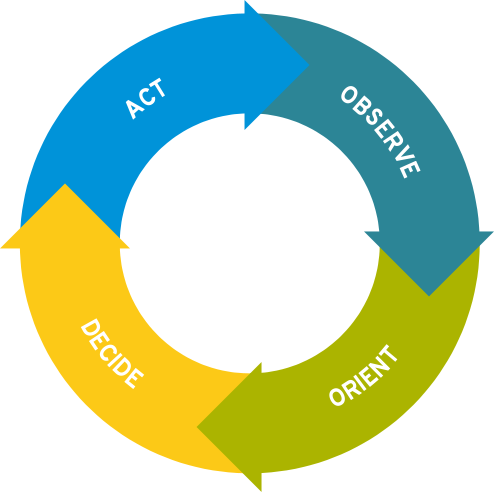
The OODA decision loop, coined by military strategist John Boyd, stands for Observe, Orient, Decide, and Act. It provides a framework for rapid decision-making in dynamic environments. An extreme example of its use is by fighter jet pilots in the USA Navy. Pilots use the model for all aspects of flying including during the stress of dogfights.

Using this framework is a great way to frame decisions in a fast moving environment. Simply, Observe what is going on around you. Orient this information into the context of your situation. Based on that information Decide what course of action to take. Before finally Act, take that action.

D&D is the perfect place to practice using the OODA loop. players constantly cycle through the OODA loop, analyzing the situation, orienting themselves to new information, making decisions, and taking action. In business, professionals can apply the OODA loop to make quick and effective decisions by gathering relevant data, analyzing the context, making informed choices, and executing their plans promptly.

OODA Loop - Observe - Act - Orient - Decide - Act
OODA Loop

Decision-Making Under Pressure: Assessing Risks and Rewards

In D&D, players often face high-pressure situations where split-second decisions can have significant consequences. They must weigh the risks and rewards of different actions and make choices under pressure. If the DM is running the game well they will leave very little time for procrastination and planning. Putting this sort of time pressure on the players will let them practice this quick decision making and an ideal place to put the OODA loop to the test. Of course, making the wrong decision might get your character killed, it has limited ramifications in the real world. Making it a safe space to make mistakes.

Similarly, professionals in the business world encounter critical decision points where risks must be assessed, potential outcomes evaluated, and choices made promptly. Again time, competitors and environments may all be working against you. Making decision making stressful, especially when the outcomes involve the potential for financial loss.

By practicing decision-making under pressure in D&D, players can develop valuable skills that can be transferred to real-life business scenarios. Effectively giving people experience of decision making stress to better prepare them for real life scenarios.

Final Thoughts

Thinking on your feet is a vital skill in both Dungeons and Dragons and the business world. The ability to quickly adapt, exhibit situational awareness, leverage the OODA decision loop, make decisions under pressure, and embrace continuous learning leads to success in dynamic environments. By applying the lessons learned in D&D to real-life business scenarios, professionals can navigate uncertainties, seize opportunities, and achieve remarkable results. Developing agility and critical thinking skills enables individuals to thrive in both realms, making them effective problem solvers and valuable assets to their teams and organizations.

What better way to practice than in the safe environment of a dungeons and dragons game.