
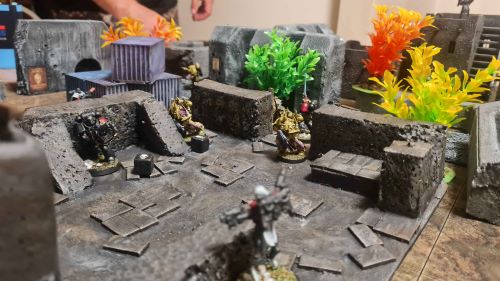
Saints Fate: A Three Player Skirmish Report

In last weeks post I described a recent three player skirmish scenario I designed. You can check out the details here. A couple of friends and I played it through one evening the other week to see how it actually worked. In short, it was amazing fun. But I’m always interested in what I can learn from the experience to take into future games.

The Scenario

A miraculous manifestation has occurred on the planet of Helios Magna. A Saint touched by the power of the God Emperor, has manifested among the ranks of the Adepta Sororitas, but her fate is uncertain. The Inquisition, ever wary of uncontrolled power, has dispatched a team of Lancet Hereticus Space Marines to capture her for interrogation. Meanwhile, a force of Chaos Plague Marines, the Ferrymen, seeks to claim the Saint for a dark ritual, hoping to summon a daemon of the Warp into realspace.

The Sisters of Battle, unaware of what forces are closing in, have fortified their shrine compound to protect the Saint. What follows is a brutal three-way battle where each faction must act quickly to achieve victory.

The protagonists included:

Order of the Veiled Light: crack team of battle sisters tasked with protecting the Saint at all costs. Comprised battle sister and flying assault troops. (Played by Marty)

Lancet Hereticus: Inquisition sponsored space marine fire team sent to capture the Saint to check for heresy and research. Comprised regular marines and a heavy weapons specialist. (Played by Sean)

Ferrymen: Small plague marine raider unit intent on capturing the Saint for the nefarious aims of the ruinous powers. Comprised plague marines and a mutated brother twisted by the rot of Nurgle. (Played by me)
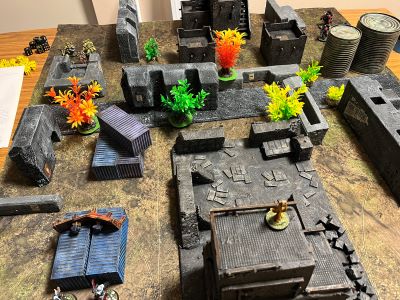
The battlefield from the Battle Sisters side of the table.

How it Played Out

The aim of the three player skirmish scenario was to get the action happening quickly and make sure all three players were engaged throughout. All three factions entered the fray on turn one with frantic positioning as well as shots being exchanged. Initial casualties were quite light.

There was some difficult decision making for all players around how aggressively to go after the scenario objective vs protecting your team. Excitingly, all three factions had control of the Saint at one point in the game only to lose her to an opponent. This meant that the outcome of the game was always in question.

A cinematic brawl involving all three leaders culminated in the Ferryman captain sneaking the Saint away at the last minute to claim victory at the start of turn 6. A win for the nefarious forces of chaos!
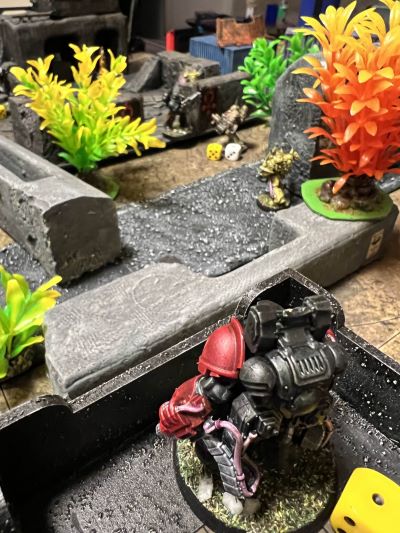
Lancet Hereticus gunner observes the battlefield.

What Worked?

We used the One Page Rules skirmish ruleset: Grimdark Firefight, and it worked a treat. Fast, simple gameplay that had all three of us in the swing of things after the first move. With each player taking it in turns to activate a model this kept the game moving fast with no downtime for participants.

The victory conditions and time limit forced all three factions to engage with the objective pretty much immediately. It also kept each player battling on two fronts, no one was left out or ganged up on.

Finally, emergent play. All three players have some understanding of the 40K lore and got behind their faction and it’s aims. This definitely added to the immersion and I think colored some of the decision making as well. The cinematic three way duel by the captains at the end occurred completely emergently adding an awesome conclusion to the battle.
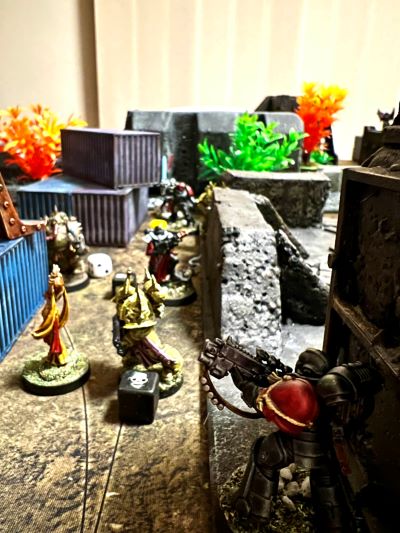
Mad scramble to secure the Saint in the alley next to the shrine compound. Marines, Plague Brothers and Battle Sisters all in attendance.

What Could Have Gone Better?

To be honest, not much. The battle flowed well and kept everyone engaged. The one thing I could have explained better at the start was the victory condition. There was a little confusion about how we achieved the win. We smoothed it out after turn 1, but clarity on this before we started would have helped.

Final Thoughts on Three Player Skirmish

All in all I succeeded in my goal of creating a fun, engaging, equal sided three-person skirmish scenario. The most important part was that we had fun playing. But I’ll be looking to see if I can come up with more three player scenarios in the future.

Of course, this battle now forms part of the Mordax Prime canon, my narrative setting for my 40K inspired gaming. With this victory for the ruinous powers, how will the Imperium authorities react? Will they mount a rescue mission? Or will the Saint become a tool of Chaos? We’ll find out in the next instalment…
The Joy of Designing an Engaging Three Player Skirmish Scenario

Three-player skirmish games can be very tricky to design. Without careful planning, you risk two players ganging up on the third, one player getting stuck waiting for the others to resolve their turns, or the action becoming lopsided. In this scenario, set in the grim darkness of the 41st millennium, I aimed to create a balanced and engaging experience where all three players remained in the thick of the action.

The Scenario: “The Saint’s Fate”

As you probably know, I love adding narrative flavor to my games. Whether D&D or Warhammer an engaging narrative creates much more opportunity for emergent play. I’ve recently developed a loose setting for my 40K inspired games as a way to develop an interesting and ongoing narrative. Consequently, I wanted to set this scenario in the same setting. For more information on Mordax Prime follow the link here. As for the scenario…

A miraculous manifestation has occurred. A Saint touched by the power of the God Emperor, has manifested among the ranks of the Adepta Sororitas, but her fate is uncertain. The Inquisition, ever wary of uncontrolled power, has dispatched a team of Lancet Hereticus Space Marines to capture her for interrogation. Meanwhile, a force of Chaos Plague Marines, the Ferrymen, seeks to claim the Saint for a dark ritual, hoping to summon a daemon of the Warp into realspace.

The Sisters of Battle, unaware of what forces are closing in, have fortified their shrine compound to protect the Saint. What follows is a brutal three-way battle where each faction must act quickly to achieve victory.

Board Setup

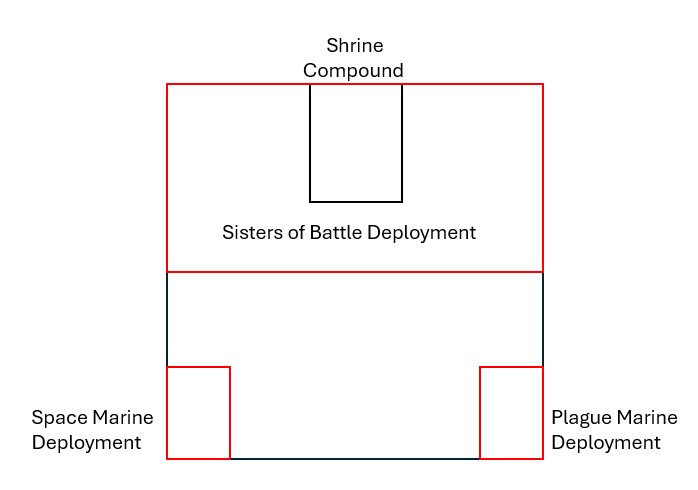
  • Board Size: 3ft x 3ft
  • The Saint: Begins inside the shrine compound, positioned on one half of the board.
  • Deployment:
    • Sisters of Battle are entrenched in and around the shrine compound.
    • The Lancet Hereticus Space Marines deploy in one corner opposite the shrine.
    • The Chaos Plague Marines deploy in the other opposite corner.
Table deployment map

Victory Conditions

  • At the start of Turn 4, an escape shuttle may arrive at the compound on a roll of 5 or 6.
  • Each turn after that, the roll threshold decreases (4+ on Turn 5, 3+ on Turn 6, etc.).
  • The player who has control of the Saint and gets her to the escape shuttle wins the game.

Note that the Saint begins in the possession of the Sisters of Battle.

Key Design Features

1. Balanced Start & Player Equality

  • The two marine factions begin an equal distance from the objective (the Saint in the shrine), ensuring no player has an immediate advantage.
  • Sisters of Battle start in a strong defensive position but must react to two incoming threats.
  • Both invading forces must contend with the Sisters and each other.

2. Quick Action & Continuous Engagement

  • The short board size (3ft x 3ft) ensures combat starts early, preventing long movement phases where nothing happens.
  • The Sisters’ defensive position means they will likely be fighting by Turn 1.
  • Since the Saint is stationary at the beginning, players must maneuver aggressively and fight over control.
  • The time limit ensures that all players must take action in order to win.

3. Preventing “Two vs. One” Situations

  • Both the Inquisition and Chaos forces have competing objectives, preventing an easy alliance.
  • The victory condition forces all players to engage—hoarding forces in a corner will not secure a win.
  • The randomized escape shuttle arrival means players must remain flexible; camping a spot isn’t a viable strategy.

Final Thoughts on the Three Player Scenario

This three player scenario creates a dynamic battlefield where all players are constantly engaged. It prevents downtime, discourages ganging up, and forces strategic decision-making. The next blog post will explore how this scenario played out in actual gameplay—did it live up to expectations, or were there unexpected twists? Stay tuned!

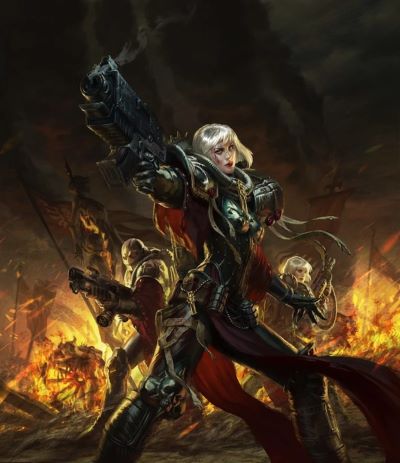
Title image is Sister of Battle by Anna Steinbauer. For more of her awesome art visit her site here.

The Significant Power of the Moral Dilemma

Roleplaying games (RPGs) have long been a haven for storytelling, strategic thinking, and escapism. But beneath the layers of dice rolls and character sheets lies an opportunity for deeper engagement—the moral dilemma. I love these conundrums in my games, both as a player and DM. These moments of ethical uncertainty transform a game from a casual pastime into an unforgettable experience. The same is true in leadership training, where presenting trainees with morally complex scenarios forces them to grapple with the consequences of their decisions. They also take trainees away from the black and white course content to the grey examples of real life. In both cases, moral dilemmas create engagement and challenge in ways that are uniquely impactful.

The Core of a Moral Dilemma

A good moral dilemma places players in situations where every choice carries significant consequences. In RPGs, these moments can range from choosing between saving a village or preserving an ally’s life, to deciding whether to betray a trusted NPC for personal gain. In leadership training, dilemmas often revolve around issues like resource allocation, interpersonal conflict, competing stakeholder outcomes, or the balance between individual and organizational values and goals.

The key is that there are no “right” answers. Instead, players or trainees must weigh their values, priorities, and the potential fallout of their decisions, creating a tension that lingers long after the choice is made.

Why a Moral Dilemma Enhances Engagement

  1. Emotional Investment
    When faced with a moral dilemma, players become emotionally invested in the story. They’re no longer just rolling dice or following a script; they’re making deeply personal choices that define their characters—or their leadership style. This emotional engagement ensures that the experience feels both meaningful and memorable.
  2. Immersive Storytelling
    A moral dilemma forces players to think beyond scenario mechanics and immerse themselves in the narrative. Instead of focusing on optimization, they start asking, “What would my character do?” or “What kind of leader do I want to be?” This leads to richer storytelling and more profound connections between players and their roles.
  3. Collaboration and Conflict
    In both RPGs and leadership scenarios, dilemmas can lead to heated discussions among team members. Differing values and priorities come to the forefront, sparking debates that can either strengthen the group’s bonds or test its resilience. These moments of collaboration or conflict mimic real-world dynamics, making the experience feel authentic.
  4. Growth Through Challenge
    Struggling with tough decisions builds resilience and critical thinking. In RPGs, players learn to accept the consequences of their actions and adapt to the evolving story. In leadership training, participants develop decision-making skills and gain insights into their own values and ethics.
The “it depends” arrow is where the most challenge comes from.

Crafting Effective Moral Dilemmas

To create a compelling moral dilemma in either a D&D adventure or a leadership training module, consider the following:

  1. High Stakes
    The decision should matter. Players should feel that their choice will significantly impact the game world or the people around them.
  2. Ambiguity
    Avoid clear-cut solutions. Each option should have both positive and negative outcomes, forcing players to wrestle with uncertainty.
  3. Relevance
    Tailor the dilemma to the characters’ or trainees’ goals and values. The more personal the choice feels, the more impactful it will be.
  4. Lasting Consequences
    Decisions should ripple through the story. Whether it’s a betrayed ally seeking revenge or a workforce demoralized by a tough call, consequences make choices feel real and meaningful.

Bringing It All Together

Imagine a leadership training session where participants roleplay the leaders of a company facing a crisis. A natural disaster has struck, and resources are limited. They must decide whether to prioritize aid for employees or allocate resources to the wider community. Each choice has implications for morale, public relations, and long-term stability. The discussions and debates that follow are rich with insights into team dynamics and individual values.

Similarly, in an RPG, the adventuring party might stumble upon a town cursed by a powerful artifact. Destroying the artifact will save the town but doom the adventurers’ quest to stop a greater evil. Do they sacrifice their mission to save innocent lives, or press on and let the town perish? These choices push players to think deeply about their characters and their place in the story.

Final Thoughts

Moral dilemmas are more than just storytelling tools; they’re catalysts for growth and engagement. Whether you’re running an RPG or designing a leadership workshop, introducing ethical challenges forces participants to think critically, act decisively, and reflect deeply on their values. The result is an experience that’s not just engaging but transformative—one that players and trainees alike will carry with them long after the session ends.

So, the next time you’re crafting an encounter or a scenario, don’t shy away from the grey areas. Embrace the complexity, and watch your players or trainees rise to the challenge.