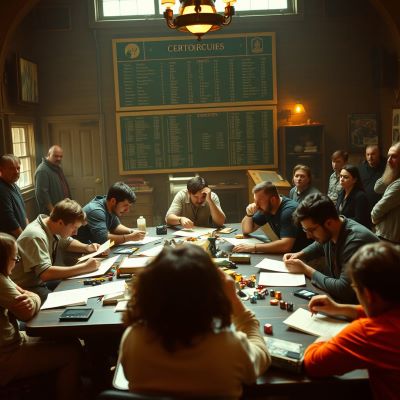
Just after Christmas, some friends and I had the exhilarating experience of participating in a Dungeons & Dragons competition. But by their nature roleplaying games aren’t a competition, I hear you say. Normally, I would agree. However, we thought we’d give it a go. You don’t get many opportunities to pit your D&D skill against other parties. After reading this you may see some merit in competitive D&D.
The tournament saw multiple groups navigating through the legendary Gary Gygax adventure: The Lost Caverns of Tsojconth. Although we missed the official tournament sign-up, our friend Rich, who was DMing at the event, graciously agreed to run a separate session for us. The event was organized by the local group DnD Fremantle, who have done a fantastic job fostering a vibrant D&D community in our local area.
The Challenge
The competition was structured in two intense 2-hour blocks, requiring rapid decision-making and strategic thinking. Initially, we struggled with the limited time to familiarize ourselves with our character sheets, spells, and abilities—only 15 minutes! It was a challenging start, but we quickly adapted to the fast-paced environment.
Rich, our DM, used a scoring system to evaluate our progress, awarding points for achieving specific goals in each encounter. The objective was to traverse as much of the adventure as possible within the 4-hour limit. In the real tournament 5 groups all ran through the adventure at the same time and their scores totaled at the end to determine the winning team.
The Party
From memory, we had 6 pre-generated characters to choose from: monk, wizard, warlock, fighter, cleric and rogue. As mentioned above, we had 15 mins to choose our characters and understand how they worked. Our final party comprised four level 9 adventurers:
Ethelrede, a stalwart human fighter
Cathartic, a devoted human cleric
Weslocke, a cunning Tiefling warlock
Dunil, a resourceful halfling rogue
There should have been five, but unfortunately one of our players was ill on the day.
Key Encounters
The adventure was very “old-school”, with seemingly random creatures dotted around an underground cave system. It did mean that you never quite knew what was around the corner. Some of our memorable encounters included:
The Mud Golem: Early in the adventure, we faced a formidable mud golem guarding a magical sword. This creature could only be damaged by magical means, which significantly limited our options. It was a close call, especially for my character, Dunil, who nearly perished in the encounter (only 2hp left).
Gem-Hauling Statue Faces: We successfully navigated a trap-laden room filled with gem-inlaid statues, managing to extract the gems without losing any limbs.
Friendly Pechs: In a refreshing twist, we encountered Pechs—goblin-like creatures who turned out to be friendly allies. This encounter provided a brief respite from the relentless dungeon hazards.
Chuuls’ Deadly Ambush: Crossing a river proved fatal as we were ambushed by paralyzing crab-like creatures, the Chuuls. This encounter ended in a total party kill (TPK), forcing us to restart. It was a humbling experience but one that bonded our team.
Fierce Formian Battle: Our session concluded with a fierce battle against Formians, ugly ogre like creatures with sinister eyes. This encounter tested our combat strategies and teamwork to the limit.
The incredible trophy made for the actual tournament!!
Lessons Learned
Pre-Game Planning: It’s crucial to allocate more time for character selection and understanding character abilities. Knowing who will play which type of character and having a strategy for dungeon interaction can save valuable time.
Team Urgency: The competition format instilled a heightened sense of urgency. Quick decision-making and effective communication became our focus, improving our overall gameplay.
Adaptation: Adapting to the competition’s fast pace was challenging but ultimately rewarding. By the second half, we found our rhythm, coordinating efficiently as we navigated the labyrinthine caverns.
We ended the adventure with a score of 8 points, which included a -5 penalty for the TPK. While this might seem modest compared to the winning team’s 18 points, we considered it a solid performance for our first competitive run. More importantly, the experience was incredibly fun, thanks to Rich’s masterful DMing.
More Competitive D&D?
This competition has whetted our appetite for more. We’re already planning to enter the next tournament with lessons learned and a renewed sense of strategy. If you’re considering a competitive D&D experience, we highly recommend teaming up with friends and diving into the challenge. It’s an unforgettable way to test your skills and deepen your love for the game.
I came across this paper titled “Role Playing: A Method to Forecast Decisions” by J Scot Armstrong (2001) a couple of years ago and thought it was worth sharing here. Armstrong’s paper discusses the effectiveness of using role-playing simulations to forecast decisions in various real-world scenarios. It presents five situations where interactions between two parties significantly impact the outcomes. These include labor negotiations, lobbying efforts, product design changes, legal defense strategies, and contract negotiations. The paper argues that using role-playing simulations can help accurately forecasting decisions and their consequences in these complex, interaction focused situations.
It highlights the importance of accurately forecasting the decisions of other parties involved, citing historical examples where inaccurate predictions led to detrimental outcomes. One such example was the failed stock sale of the British-owned Falkland Islands Company to an Argentine consortium in 1975, which ultimately led to the Falkland’s war. Accurate forecasting of each other’s decisions might have prevented the conflict, instead resulting in mutual benefits. The author suggests that role-playing simulations can help improve decision-making accuracy by simulating interactions between parties and predicting their responses to different scenarios.
In many ways this is similar to the concept of Red Teaming. This involves running a simulation with a real opposition force (red team) to test a companies strategies and contingencies. I wrote about Red Teaming and roleplaying games in a previous article here.
Running a Roleplaying Simulation
The paper outlines the basic elements of creating these role-playing simulations. Including realistic casting, clear role instructions, accurate situation descriptions, active participation, and thorough coding of results. It also emphasizes the need for multiple sessions with different scenarios to obtain reliable predictions.
realistic casting: where possible roles should be played by people who are similar to those they represent.
clear role instructions: the role players should read and understand their roles before reading the situation details. Players should be asked to improvise but to remain firmly in their role.
accurate situation descriptions: describe the situation as clearly as possible, and provide realistic surroundings where possible.
active participation: Ask players to act out their responses and try to keep their decision making as realistic as possible.
coding of results: all players should write their view of their decisions
When to Run a Forecasting Simulation
Of course using roleplaying simulations for forecasting does not work for every situation. The paper suggests ideal conditions include: involving conflicts, large changes, or interactions between a few parties. Most important is the need for faction interactions to have a large influence on the outcome.
Is Roleplaying as a Forecasting Tool A Valid Method?
Finally, the paper provides evidence on the value of role-playing simulations, including studies demonstrating their face validity, predictive validity in contrived situations, and effectiveness in predicting decisions in actual situations. It concludes that role-playing simulations offer a valuable method for forecasting decisions and improving decision-making processes in complex scenarios.
An example of a crisis focused forecasting simulation
Final Thoughts
This paper was an interesting read and I could immediately draw parallels with Red Teaming and Megagames in the way the suggested simulations would work. But are companies and other organizations using this methodology? Unfortunately, that is not made clear in the paper. Though we do know that the military do use roleplaying in some of their wargames.
Given the suggested ideal situations and the cost associated with running a roleplaying forecast simulation implies that this methodology would only really be viable for larger organizations. For example, companies like Airbus, Richemont, and HSBC have participated in crisis simulation exercises that involve role-playing to improve decision-making under stress. In fact there is an existing industry providing such services.
Unfortunately, it seems clear that this sort of activity would be of limited use for the small to medium enterprise.
Nonetheless, an interesting journey into another avenue of roleplaying and its use within an organizational setting. Has your company used roleplaying as a forecasting tool?
One of things I love about Dungeons and Dragons campaigns is the worldbuilding. Particularly when the world advances and changes through the player actions and creativity. My long standing Salkire campaign evolved from a ruined city to a huge world with kingdoms, factions and villains vying for attention. All formed through gameplay and collaboration between my players and me, as DM. Over the last couple of years I have rediscovered sci fi wargaming with a particular focus on Warhammer 40K lore. I discovered the incredible Corvus Cluster, a long running blog tying together a groups games into one long running and immersive campaign. Ultimately, not too dissimilar to a long term D&D campaign really. Using this as inspiration I wanted to do similar worldbuilding for my own 40K inspired games. Mordax Prime is the result.
What is Mordax Prime
Mordax Prime a sector of space in the Warhammer 40K universe that I have developed as a narrative backdrop for my 40K inspired games. While I have retrofitted some of my previous games into this Sector, future games will be informed by and change the setting. My hope is that the setting begins to take a life of it’s own. Dictated by the outcomes of games and player actions. As mentioned previously this is narrative focused, providing colour and setting to our games. Players will know that game outcomes will have impact and I hope that this will add flavour not present in a normal game.
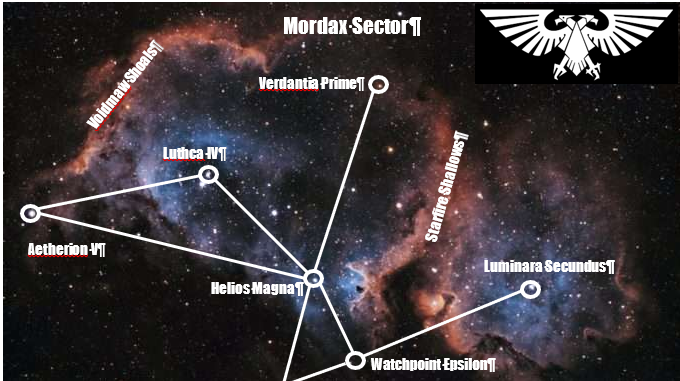
Star chart of Mordax Prime. A good starting place.
The Mordax Sector begins the campaign under Imperial control. Of course, this is likely to change as the narrative progresses.
Current Worlds
These were easy to develop using AI prompts as well as additions from my own imagination. I knew that I needed Luthca IV and a jungle death world, based on previous skirmish games I’d run. Other than that I was open to other 40K tropes like the forge and hive worlds. The last addition was the navy watch station. As I’d had pirate captain Mad Claw make an appearance in a game I want to explore this narrative a bit more. An Imperial naval port is exactly the location needed to help it play out in an exciting way.
So far, Mordax Prime comprises the following worlds. Of course new worlds and clusters may appear over time as the narrative dictates. As you can see from the descriptions below there is plenty of scope for conflict already.
Helios Magna (Hive World and Sector capital)
Description: A sprawling, industrial hive world teeming with millions of souls and the Administratum center for the system. Its vast manufactorums supply weapons and armor for the Imperial Guard. The towering spires of the hive cities are hotspots for intrigue and rebellion, making it a critical point of interest for both Imperial and Chaos forces.
Strategic Importance: Helios Magna’s output is vital for sustaining Imperial war efforts. Control of this planet secures supply lines and access to vast manpower resources.
Challenges: Frequent underhive uprisings and the ever-present threat of Genestealer Cult infiltration.
Verdantia Prime (Death World)
Description: A lush, verdant world filled with dangerous flora and fauna. The thick jungles are a perfect hiding place for renegades and xenos. It’s rumored to be home to ancient artifacts of great power.
Strategic Importance: Control of Verdantia Prime offers access to rare resources and strategic defensive positions. It’s also a key site for potential xeno-archaeological discoveries. Thought to house a top secret Dark Angels training facility.
Challenges: Navigating treacherous terrain and dealing with constant ambushes from Tyranid bioforms or feral Chaos cultists.
Aetherion V (Forge World)
Description: A heavily fortified forge world, Aetherion V is known for its production of advanced weaponry and vehicles. It is a linchpin in the sector’s defenses, equipped with formidable orbital platforms and ground-based macro-cannons.
Strategic Importance: Control of Aetherion V ensures a steady flow of high-quality wargear and defensive capabilities. It’s also a prime target for sabotage by the Chaos Space Marines.
Challenges: Infiltration by Chaos cults and the risk of large-scale conflicts breaking out in its production facilities.
Luthca IV (Industrial World)
Description: Highly productive factorium world built over ancient ruins. Supplies nearby sectors with manufacturing and agricultural machinery. Caches of archaeotech are thought to lie hidden deep within the Cinder Desert and in the roots of the hive cities.
Strategic Importance: While of lower manufacturing importance than Luminara Secundus, Luthca IV is the focus of many expeditions looking for ancient artefacts thought to provide great power..
Challenges: Both Chaos cults and Xenos vie with Imperial and Mechanicus agents in the search for forbidden tech. It is also rumoured that a Chaos gate lies buried deep beneath Hive Secundo.
Watchpoint Epsilon (Imperial Port)
Description: Key naval station providing patrols of nearby warp lanes.
Strategic Importance: Home of Watchfleet Epsilon, key in the defense of the Sector and nearby warp lanes.
Challenges: Seen as a backwater posting has led to dissatisfaction and potential heresy amongst some of the officer cadre.
Luminara Secundus (Pleasure World/Trade Hub)
Description: Known for its beautiful landscapes and luxury, Luminara Secundus serves as a retreat for the sector’s elite and a bustling trade hub. Its relative tranquility makes it an ideal location for diplomacy or covert operations.
Strategic Importance: Though less militarized, control of Luminara Secundus provides economic leverage and a base for Rogue Traders. It also serves as a critical node for intelligence gathering.
Challenges: The planet’s affluence attracts both political machinations from Imperial Nobles and covert infiltration by Chaos agents.
Active Factions
A number of factions are thought to be active within Mordax Prime. These are listed below with significant personalities coming from previous games and player invention.
Inquisition: Rooting out heresy and maintaining order.
Inquisitor Jaegermann: Ordo Hereticus seeking out daemonic influences with the Imperial hierarchy.
Rogue Traders: Seeking profit and ancient relics.
Benedictus Sixtus: notorious Rogue Trader known to play all sides. Fond of tall tales.
Imperial Nobles: Defending their estates and political power.
The Duchess: Leader of the most powerful family on Helios Magna.
Sisters of Battle: Purging heretics and xenos.
Enclave of the Veiled Light: Located on Helios Magna.
Space Marines: Responding to major threats with precision strikes.
Dark Angels: Secret training base in the jungles of Verdantia Prime.
Lancet Hereticus: Elements of this Inquisition controlled chapter thought to be active in this sector.
Imperial Guard: Garrisoning key locations and mounting large-scale defenses.
Tyranids: Emerging from hidden bio-ships, consuming everything in their path.
Possibly identified on Verdantia Prime. Thought to be connected to the researches of the late radical Inquisitor Tiberious Glaze.
Genestealer Cult: Sowing rebellion from within.
Heralds of the Star Children: active on Luthca IV, threat level high. Currently being investigated by Dark Angels and agents of the Inquisition.
Forces of Chaos: Undermining Imperial control and seeking to bring the sector into the warp.
Acolytes of the Red Mist: active on Luthca IV threat level unknown.
Mad Claw Crew: notorious pirate currently working from a secret location in the Starfire Shallows.
Plenty of scope for interesting battles, with room enough for additional factions as play progresses.
Current Campaign Log
This was a really fun part of the worldbuilding for me. Placing past games into the sector started uncovering links between factions and planets. Consequently, Mordax Prime is beginning to feel more than a map with some planet names. Life has been breathed into it.
356.658.M41 Unrest on Luthca IV
During a period of unrest on Luthca IV an Inquisitor, Enforcers, Planetary Guard, Acolytes of the Red Mist, Mining Guild and Infractionist gangs fought a vicious skirmish. Each group was making the most of the unrest to pursue their own agendas. Ultimately, Inquisitor Jaegermans retinue won the firefight retrieving the infamous Chaos artefact “Belial Goblet”.
Gangers face off in the streets of Luthca IV
357.020.M41 Echoes of Xenos
Located in the nearby Lupin Sector, Rogue Trader Benedictus Sixtus competed with various Inquisitors and Adeptus Mechanicus to retrieve heretical research of the late Ordo Xenos Inquisitor Tiberious Glaze. The battle raged over a number of sectors and moons as the warbands pursued the trail of clues. Despite battling an emergent Xenos threat Sixtus escaped with the research and fled to the Mordax Sector intent on finding a buyer.
Gun servitor covers an Inquisitor as he explores the depths of an orbital gun platform
357.125.M41 Jungle Hunt
Imperial troopers of the navy and guard pursued the downed vessel of the notorious pirate captain Mad Claw into the jungles of the death world Verdantia Prime. A vicious firefight broke out between the renegades and the brave Imperial patrol. The noise of the firefight awoke some xenos terrors of the jungle, who grabbed combatants from both sides from the leafy darkness. Those lost were never seen again. Unfortunately, Mad Claw and his allies applied superior tactics and fought their way to freedom. The Captain and his crew are thought to be hiding in the Starfire Shallows nursing their hunger for revenge.
It is rumoured that some of the research uncovered by Benedictus Sixtus has made its way to the planet surface. But how or why is unknown.
A brave naval trooper hides as a xenos monster stalks the jungle
357.450.M41 Potential Heresy on Helios Magna
A small but lethal force of suspected Dark Angel space marines assaulted an Ecclesiarchy compound on Helios Magna. The garrison of Adepta Sororitas (Order of the Veiled Light) scrambled quickly to defend. However, could not match the firepower of the marines and their formidable dreadnought. By the time reinforcements arrived the Dark Angels had disappeared as mysteriously as they had appeared, their objective unknown.
Dark Angels capture the objective under the heavy yet ineffective fire from the Sisters of Battle
357.556.M41 The Heist: Luthca IV
On the edge of Hive Secundo a multitude of gangs competed to retrieve a dangerous xenos artefact from the convoy of a Mechanicus expedition. What started as a tense standoff erupted into extreme violence as the hivers made and broke alliances while mercilessly blasting one another. Before order could be restored the artefact was opened releasing a powerful daemonic entity onto the planet. Few survivors lived to tell the tale. Yet, the Planetary Governor has requested aid to eliminate the creature.
Tense standoff before the firefight erupted
The warp daemon materializes causing mass panic!
357.790.M41 Verdantia Prime Ambush
A Dark Angels patrol was ambushed by an unidentified xenos threat whilst on a training exercise in an abandoned outpost on Verdantia Prime. The space marines fought with characteristic courage obliterating the opposing force. Needless to say, agents of the Inquisition are currently investigating the source of this surprising incursion. It is rumoured amongst those who know that the xenos threat is connected to the research purloined by Benedictus Sixtus and his crew. This incident has been linked to the Xenos discovered during the pursuit of Mad Claw and his gang.
A group of unidentified xenos approach the Dark Angel position
357.800.M41 Heralds of the Star Children Bomb threat
Local enforcers on Luthca IV uncovered a plot to destroy the primary administratum building on Hive Primus. Members of the Heralds of the Star Children placed a large explosive device with the vicinity. Fortunately, it wasn’t set properly giving a small Dark Angels detachment the chance to intercept.
A vicious firefight erupted within the shadowed streets below the administratum. The Heralds employed a psyker of note giving the space marines a difficult time of things. Fortunately, the heroes of the Imperium killed wiped out the xenos heretics and diffused the bomb, saving the Hive from a terrible fate. Inquisitor Mattias Criese has been assigned the investigation of the rogue psyker and this cult, which are both now more than just minor annoyances.
Children of the Star Children advance through the empty streets intent on reaching the bomb first
357.850.M41 Xenos Hunt
Following the recent thwarted bomb threat on Luthca IV by Dark Angels Forces, Inquisitor Criese has been actively investigating the Heralds of the Star Children. In an effort to prevent any further insurrection the Inquisitor has dispatched a crack team of agents to take out Magos Drevender the revered leader of the cult.
The kill team tracked him down into the depths of Hive Primus. But before they could raid the xenos cult an unseen sentry alerted the Magos. Cult members frenziedly assaulted the agents trying to buy time for their illustrious leader to escape. However, Drevender couldn’t quite get there. Instead, he was gunned down by two agents in a hail of bolter shells.
So ended the uprising of the Star Children. The next battle will explore a different narrative from Mordax Prime.
Drevender flees round the corner towards a battle hardened agent of the inquisition, and ultimately his own doom!
Final thoughts on Worldbuilding
This exercise in worldbuilding has been a lot of fun. Tying together the battles into a narrative was much easier than expected and the sector began to take on a life of its own. Are the remnants of the Star Children thirsting for revenge? Will teh Sisters of Battle start investigating the Dark Angels? Where will Mad Claw and his pirates raid next? Is the chaos gate open and what came through? Will the Tyranid presence on Verdantia Prime summon a larger invasion fleet? So many options for exciting games ahead.
Spending a bit of time developing a campaign world for your games is a fun exercise and adds a fantastic narrative aspect to your games. I highly recommend.
How have you had success developing campaign backgrounds?
Dungeons & Dragons (D&D) is loved by players across the globe, but like any pastime, it’s not without its critics. From claims that it’s a waste of time to concerns about its complexity, some people perceive D&D as more trouble than it’s worth. I’ve had friends and family members throw both of these aspersions my way over the years. Though to be fair, more than a few have since shown curiosity about the hobby. But let’s take a closer look. Many of these perceived negatives of Dungeons & Dragons are either misconceptions or actually opportunities in disguise. Here’s a breakdown of the common criticisms—and why they don’t hold up.
D&D Takes Too Much Time
Between creating characters, preparing campaigns, and playing sessions that can last several hours, D&D can feel like a massive time investment. This is particularly true if you are the DM. Yes, there is no denying it, D&D takes time. But so does any meaningful hobby. To get good at video games, martial arts or jewelry making, all take significant time commitments. The difference is that D&D offers a unique combination of creativity, social connection, and skill-building.
Bonding Time: Unlike scrolling social media or binge-watching TV, D&D sessions are deeply social, bringing people together in a way few other activities can.
Creative Outlet: Crafting stories and characters isn’t wasted time—it’s an opportunity to flex your imagination.
Customizable Commitment: You don’t have to play a 10-hour marathon every weekend. Shorter sessions, pre-made adventures, or even one-shot games can fit into a busy schedule.
Think of D&D not as a drain on time but as an investment in fun, creativity, and relationships.
It’s Too Complicated
With its hefty rulebooks and huge array of character options, D&D can seem overwhelming, especially to newcomers. Walking into a games store and seeing the rows of books, campaign and starter sets, not to mention blisters of miniatures, is a lot to take in. While D&D does have a learning curve it is not actually that steep. You don’t need to memorize every rule to play and enjoy the game. In fact you only need one rulebook to get started.
Start Simple: Beginners can stick to the basics—there’s no need to dive into advanced mechanics right away. There is a popular movement to play simplified versions of the game, like Five Torches Deep.
Collaborative Learning: By it’s very design D&D is played in groups, meaning that there’s always someone to guide you and answer questions.
Emphasis on Storytelling: At its core, D&D is about the story, not the rules. Many tables, my own included, bend or ignore rules to keep the narrative flowing.
What seems like complexity is really depth—offering endless opportunities to grow and explore once you’re ready.
It’s Too Nerdy
When I was growing up D&D was stereotyped as the domain of geeks and outcasts, leading many to dismiss it as uncool. Thankfully, while D&D’s roots are undeniably nerdy, it has recently evolved into a widely celebrated cultural phenomenon.
Mainstream Appeal: Shows like Stranger Things and Critical Role, as well as a plethora of celebrity players, have brought D&D into the spotlight, making it cooler than ever.
Inclusive Community: The game has grown to include players from all walks of life, fostering a welcoming and diverse community.
Confidence Builder: Role-playing can help players embrace their unique quirks and express themselves, turning perceived “nerdiness” into a superpower.
What was once a niche hobby has now evolved into a badge of creativity and individuality.
It’s Expensive
Between buying rulebooks, dice, miniatures, and maps, the cost of playing D&D can add up quickly. However, you don’t actually need all these things to play. As a player, a pencil, set of dice and printed character sheet are enough to fully enjoy the hobby.
Free Resources: Wizards of the Coast offers free basic rules online, and community-generated content is abundant.
One of the negatives of Dungeons & Dragons is that some worry that it is so engaging it can take over your life, pushing other responsibilities to the side. This was highlighted in the notorious Tom Hanks film Mazes and Monsters.
Yes, D&D is captivating, but so are many other hobbies. The key is finding balance.
Healthy Escapism: D&D offers a productive way to unwind and recharge, which can enhance your overall well-being.
Time Management: Scheduling regular game nights helps you enjoy the hobby without letting it interfere with other priorities.
Fostering Connections: Unlike solitary pastimes, D&D keeps you socially engaged, making it a healthier form of entertainment than many alternatives.
The joy and connection D&D provides outweigh the risks of overindulgence, especially with a little moderation.
It’s Not Productive
Critics argue that D&D doesn’t contribute to career or personal development and is purely for fun. However, if you’ve been reading this blog for any length of time you’ll know that D&D is far from unproductive. It builds skills that are invaluable in both personal and professional contexts.
Problem-Solving and Creativity: Designing solutions to in-game challenges hones your creative and analytical thinking.
Teamwork and Leadership: Collaborating with others during gameplay improves your ability to work as part of a team.
Emotional Intelligence: Role-playing develops empathy and understanding, key traits in any relationship or career.
D&D is fun, yes—but it’s also a stealthy way to grow as a person.
Final Thoughts on the Negatives of Dungeons & Dragons
Every hobby has its criticisms, and our hobby is no exception. But when you dig a little deeper, many of the so-called negatives of Dungeons and Dragons actually reveal themselves to be strengths in disguise.
Rather than being a “waste of time”, D&D offers a chance to connect with others, build valuable skills, and immerse yourself in creativity. So, roll the dice, join a party, and embrace the adventure—because D&D is more than just a game. It’s an opportunity.
Tabletop hobbies like Dungeons & Dragons (D&D) and Warhammer often come with a reputation for being pricey. Between rulebooks, miniatures, dice, paints, and accessories, it’s easy to see why. But how does the cost of D&D and Warhammer stack up against other pastimes? More importantly, are they really as expensive as they seem when you consider the value they provide?
Let’s break it down and explore why these hobbies might just give you the best bang for your buck.
That Initial Sticker Shock
When you’re starting out, the cost of D&D and Warhammer can feel like a big investment:
Warhammer: A starter set can range from $100–$200, and paints, brushes, and additional miniatures can easily push your spend to $500 or higher.
That’s no small sum. But let’s compare this to other popular leisure activities.
Cost Comparisons: Hobby vs. Entertainment
1. Cinema Nights
A single movie ticket averages around $15. Add popcorn, a drink, and maybe a snack, and you’re looking at $25–$30 for about two hours of entertainment.
Annual Cost: If you go to the cinema twice a month, that’s $600+ a year.
Value: While a great movie is enjoyable, the experience is fleeting, and you leave with nothing tangible.
2. Video Games
A new video game costs about $60, and you might buy 3–4 games a year. Factor in subscriptions like Xbox Game Pass or PlayStation Plus ($120/year), and your annual expense can climb to $300–$400.
Value: Video games can provide dozens of hours of entertainment, but they’re often solo experiences and offer limited creative engagement.
3. Sports and Fitness
Joining a gym or a fitness class can cost over $100 per month, depending on where you live. That’s in excess of $1,200 a year. If you play a team sport, equipment and league fees can add hundreds more.
Value: Great for health and social interaction, but the cost often doesn’t include tools for creative or intellectual growth.
D&D and Warhammer are actually good bang for your buck!
The Bang-for-Your-Buck Advantage of D&D and Warhammer
Dungeons & Dragons
Initial Cost: $150–$200 for core books and dice.
Recurring Costs: Minimal. Many players stick with the same materials for years, and free resources (like online tools and community content) reduce the need for further purchases.
Hours of Fun: A single campaign can last months or even years, with weekly sessions that provide hours of entertainment.
The Math: If your group plays weekly for a year (50 sessions), and your setup cost is $200, that’s $4 per session. Compare that to a $15 movie ticket for just two hours!
Reduce your Costs: As a player the cost of D&D can be minimized. You can get away with buying only the players handbook and some dice. There are always second hand versions available reducing the initial cost even more.
Warhammer
Initial Cost: $300 for a starter set, paints, and brushes.
Recurring Costs: New miniatures and paints can add to the cost, but many players focus on building their collection gradually over time.
Hours of Fun: Painting and customizing models alone can provide dozens of hours of creative enjoyment, not to mention the hours spent playing battles with friends.
The Math: If you spend 50 hours painting and 50 hours playing in a year, a $300 investment works out to just $3 per hour. That’s incredible value for a hobby that combines art, strategy, and social interaction.
Reduce your Costs: Of course there is a thriving second hand market for all things Warhammer. Facebook market place and Ebay have huge discounts on pre-loved armies and units. Another way to reduce cost is to start with a smaller game like Kill Team. This skirmish game needs only 10-12 models for an army reducing the initial set up to below $80.
What You Get That Other Hobbies Don’t
1. Creative Engagement
Both D&D and Warhammer are deeply creative hobbies. Writing campaigns, role-playing characters, painting miniatures, and designing battle strategies engage your mind in ways passive entertainment simply can’t.
2. Social Connection
These hobbies are built around shared experiences. Whether it’s laughing with friends at the gaming table or bonding over a close-fought battle, the social value is immense.
3. Lifelong Skills
D&D: Enhances storytelling, improvisation, teamwork, and leadership.
Warhammer: Builds patience, artistic skills, and strategic thinking.
4. Tangible Rewards
When you finish painting a miniature or complete a campaign journal, you have something to show for your time—something you created with your own hands and imagination. There aren’t many (if any) mainstream entertainment activities that can give you that.
Finding Value on Any Budget
You don’t need to break the bank to enjoy these hobbies. Ways you can further reduce your costs include:
For D&D: Free rules are available online, and many campaigns can be played with just a few dice and a borrowed handbook. Theater-of-the-mind play eliminates the need for minis or maps.
For Warhammer: Start small with a single squad or box of miniatures. Community groups often trade or sell models, and plenty of budget-friendly paints and tools are available.
The True Value of Hobby Time
Yes, the cost of D&D and Warhammer can be expensive up front. But when you break it down, the cost per hour of enjoyment is actually incredibly low compared to other forms of entertainment. Even better, these hobbies offer something that movies, video games, and gym memberships can’t: a blend of creativity, community, and personal growth.
So, next time someone raises an eyebrow at the price of a rulebook or a box of miniatures, remind them of this: the value of a hobby isn’t just in dollars spent—it’s in the countless hours of joy, connection, and self-expression you get in return.