The Choices That Matter: Why Meaningful Decisions Make RPGs Powerful

I’ve been thinking about how to design adventures for the CMM conference in June next year. Part of the secret that makes playing RPGs so much fun is when, as a player, you have to make a meaningful decision. Of course, this can include tricky moral dilemmas, but doesn’t need to. Knowing that your decisions at the table have consequences really elevates the experience.

Do you open the mysterious door or keep walking? Will you trust that suspicious stranger? Save the villagers or pursue the villain?

A meaningful decision is not simply a decision between two options. It is a choice where the outcome matters, there has to be something to lose, and where neither option is obviously correct.

Choices are the engine of roleplaying

A roleplaying game without meaningful choices is essentially a guided tour. The players may roll dice, fight monsters and explore interesting locations, but if their decisions don’t meaningfully affect what happens, they are passengers rather than participants.

When designing adventures create situations where players have agency. The players decide what their characters do, and the world responds accordingly.

Homlet Village is under attack by a gang of Bugbears, led by their arch nemesis Greyneck. Do the players attack the Bugbears? Perhaps they open negotiations with the dastardly Greyneck. Instead the adventurers sneak into the village to spirit the inhabitants away before the enemy break down the gates. If Greyneck has something the characters desperately need, it opens up even more possibilities.

The important thing is that the players get to decide. And the decision has consequences. This is what makes an RPG feel alive.

The power of the dilemma

The most memorable RPG decisions are rarely between good and bad. They are between good and good. Or, better yet, between bad and worse.

Imagine a party discover that the Realms ruler is actually an imposter. He killed the real King years ago. The problem is that he is a fair and just ruler and his subjects love him. They can bring this imposter to justice where he will surely be executed, potentially causing a civil war. Alternatively, they can keep quiet and let the “King” continue as is, knowing that he is a murderer.

There isn’t a perfect answer.

Now the players have something to talk about around the table. “What should we do?” The dilemma creates tension because the players care about the outcome. They debate, argue and negotiate. They make their case.

When eventually someone says: “Right. We’re doing it.” it creates an incredibly important moment. Ultimately, the story now belongs to the players.
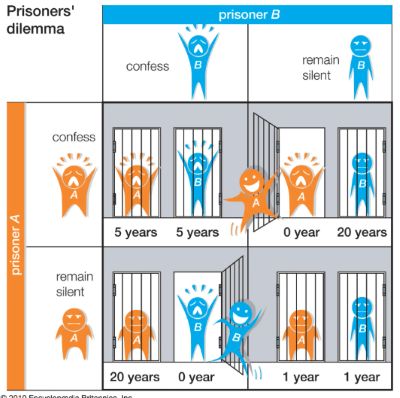
The Prisoners Dilemma is a classic for a reason.

A choice without consequences isn’t really a choice

RPGs also demonstrate an important distinction between choice and meaningful choice.

A player might be offered three doors.

  • Behind door one is a monster.
  • Behind door two is treasure.
  • Behind door three is another monster.

Technically, the player has choices. But if the doors are essentially arbitrary, the decision has little meaning. Instead, contrast it with:

  • Door one: Save the captured villagers, but allow the villain to escape.
  • Door two: Pursue the villain, but leave the villagers to their fate.
  • Door three: Attempt to do both, knowing there is a strong chance of failing at both.

Now the choice has weight and the player has to decide what matters. Meaningful decisions like this force the players to reveal their priorities.

Meaning comes from having something at stake

Think about the stories we remember from playing RPGs. We rarely remember the encounter where the party fought six identical goblins, lost no hit points and collected 14 gold pieces. No, we remember the moment when the party had one spell slot left, the cleric was unconscious and someone had to decide whether to run or stay and save their friend good friend Vesperian.

We remember the difficult choices. And we remember them because something was at stake.

If I want to make these hour long adventures mean something then there must be something serious hanging in the balance. The players need to know that their decision, regardless of what it is, has consequences.

  • They are hunting a monster that has been persecuted by the villagers
  • A prophecy has identified the Chosen One who will save the land. The King wants to execute her, rebels hide her away. Her death will stop the ravenous horde of the dead
  • The Grand Magical Library is burning down. Doo you save the loyal librarians or magical tomes that might hold the secret of immortality

Using the meaningful decision

As i work on these adventures, I am going to make sure that each has a meaningful decision at it’s core. Then as part of the session debrief we can explore the ways that the players reached agreement (or not) around how to approach it. i really believe that this will help create a memorable experience for those signing up for the games. And that is ultimately what I want to achieve. Creating an impression of D&D that they will remember long after they have left the conference.

In addition, I’m going to be a bit more purposeful about including these in my current Mythic Bastionland campaign. Often they come about in the moment, but I feel that a few well placed meaningful decision points might be a good way to lift the campaign.


Why Every Dungeon Master Should Consider Starting In Media Res

Most of us will have begun more than one Dungeons & Dragons adventure with a familiar scene: the party meets in a tavern, a mysterious stranger offers a quest, and the characters cautiously decide whether to accept. There is nothing wrong with this approach, in fact sometimes it can be a fun boost of nostalgia. However, there is another technique that can inject immediate energy into a game from the get go: starting in media res.

What is In Media Res?

The Latin phrase in media res translates to “into the middle of things.” Rather than beginning at the start of the story, the action begins while events are already underway. The characters are not discussing whether they should embark on an adventure. They are already in the thick of it and usually in immediate danger .

Imagine opening a session with:

“The wagon lurches violently as goblin arrows rain down from the trees. One horse collapses, screaming in terror. Smoke rises from the forest ahead. What are you going to do?”

The players immediately have questions. Why are they on this wagon? Where are they going? Who is attacking them? The answers can emerge naturally through play. The story begins with excitement rather than exposition.

For Dungeon Masters running convention games, conference one-shots, introductory sessions, or the opening of a new campaign, starting in media res can be an incredibly powerful way to engage the players straight away.

What Does In Media Res Look Like in D&D?

An in media res opening drops the players directly into a meaningful situation.

Some examples include:

  • The party is halfway through a desperate escape from a collapsing dungeon, a dragon on their heels.
  • The adventurers are defending a village that is already on fire and under attack.
  • A negotiation with a crime lord has gone catastrophically wrong.
  • The heroes awaken in chains aboard a slave ship and orc slavers are ready to throw them overboard.
  • The group is hanging from a rope bridge while harpies circle overhead.
  • A heist is underway, the alarm has just sounded and the vault door is closing.

In each case, the players are immediately making decisions rather than listening to explanations. The game starts with action.

Instant Engagement

One of the challenges facing any Dungeon Master, especially in one-shots, is getting players invested quickly. Traditional openings often require a period of scene setting, introductions, and explanation before players become fully engaged. In media res skips this entirely.

Of course, people naturally pay attention when something important is happening. A sword fight, a collapsing tunnel, a chase across rooftops, or a diplomatic disaster immediately focuses attention. Players begin asking questions, making decisions, and interacting with the world.

No need to earn engagement, you start with it.

The opening of Breaking Bad, a great example of In Media Res

Perfect for One-Shots

Convention and conference games live under a constant enemy: time. If you have a four-hour session, spending the first forty-five minutes introducing characters, explaining why they are together, and persuading them to pursue the adventure can feel wasteful. If you only have one or two hours this is an even bigger loss of time. Starting in media res allows you to get to the interesting part immediately.

Let’s consider two versions of the same adventure.

Traditional Opening

The players arrive in town. After talking to a few villagers they meet the mayor. They learn about the missing blacksmith. As a group the party moves from location to location gathering clues. Finally they decide to investigate the nearby ruins.

In Media Res Opening

The players are already inside the ruins. A dark ritual has begun led by a figure wearing a deer skull on its head. Distraught, the blacksmith hangs from chains above a blood stained sacrificial altar. Hooded cultists are chanting, working themselves into a frenzy. What do they do?

While of course I have gone a little over the top with these examples, which one has the most impact? With the second one I’m already picturing the scene and I’m thinking of ways to save the Blacksmith. And I’m not even playing the game.

For conference games, where players may never have met each other before and may only have a few hours available, this can dramatically improve the experience. In this case, every minute spent adventuring is a minute well spent.

Questions Instead Answers

As a Dungeon Master it’s easy to feel like you need to explain everything before play can begin. Give the players context to what is going on. Provide hints as to who the bad guys might be.

In reality though, curiosity is often more powerful than explanation. When players find themselves in the middle of a situation, they naturally want to understand how they got there. This encourages active engagement with the story.

Rather than saying:

“You are transporting the Holy Reliquary to the capital.”

You can begin with:

“The rune covered relic case slips from the back of the wagon and tumbles towards the cliff edge.”

The players immediately understand something important is happening. Details can emerge later through conversation, flashbacks, or discoveries.

Stronger Character Introductions

Many groups spend significant time introducing characters one at a time. I admit, I always make my players do this at the beginning of each campaign or one-shot. While this can work well, it often creates an awkward period where players describe their characters while everyone else waits.

An action-focused opening allows personalities to emerge through behaviour. You learn more about a character when:

  • The paladin dives into danger to protect civilians.
  • The rogue immediately looks for an escape route.
  • The wizard casts fireball in the small room.
  • The barbarian charges the enemy leader.

Players often discover who their characters truly are by playing them rather than describing them.

Building Momentum for a New Campaign

While in media res is excellent for one-shots, it can also be highly effective when launching a long-term campaign. Campaign openings carry a lot of responsibility. They must introduce the world, establish themes, and make players care about what happens next.

Starting with action provides immediate momentum. The opening scene becomes the spark that ignites the campaign. Perhaps the party survives a shipwreck that strands them on an unknown continent. Or they witness the assassination of a king. These events create shared experiences that bond the party together from the outset. Instead of beginning with a reason to adventure, the adventure itself creates the reason.

The Secret Advantage: Shared History

One challenge in roleplaying games is answering the question:

“Why are these characters working together?”

More often than not we hand wave this away. Or, create a convoluted reason for everyone to cooperate. An in media res opening can solve this problem elegantly.

Simply begin with the assumption that the characters have already accepted the mission. The details can be filled in later. This allows the group to establish a shared history almost immediately. After surviving a goblin ambush, escaping a prison, or stealing a magical artifact together, the party already has a common story. Nothing builds camaraderie like surviving a crisis.

A Useful Technique: Flashbacks

One concern DMs often have is that players may miss important background information. Flashbacks provide a simple solution.

Once the opening action has concluded, you can briefly jump backwards in time. Paint the Picture questions can really help with this.

“Three days earlier, how did each of you end up taking this job?”

“Before the heist began, what role did your character play in the planning?”

These short scenes allow players to contribute details to the story while preserving the excitement of the opening. You get all the benefits of backstory without sacrificing momentum.

A Word of Caution

Starting in media res works best when players still have meaningful choices. Avoid opening with long sequences where outcomes are predetermined.

For example:

“You are all captured. You cant escape. Now let me explain what happens next.”

This removes agency and can frustrate players. Railroading like this can really sour the game. Instead, place the characters in a difficult situation but allow their decisions to shape the outcome. The excitement comes from uncertainty.

Players should feel like protagonists, not passengers.

Final Thoughts

Starting a game in media res is one of the simplest ways to increase energy, engagement, and momentum at the table. For one-shots and convention games, it helps you make the most of limited time by getting players into the action immediately. For campaign launches, it creates memorable shared experiences that bind characters together and establish the tone of the adventure.

The next time you prepare a game, resist the temptation to begin with a lengthy briefing or a tavern conversation.

Instead, start with something exciting happening. Then look at your players and say the three words that every Dungeon Master loves to hear:

“What do you do?”

Following the Serpent: Communication Secrets of Dungeons & Dragons

I recently wrote about the Coordinated Management of Meaning in the context of D&D and wanted to look into this further. The image of Dungeons & Dragons portrays slaying dragons, exploring dungeons, and collecting treasure. And of course, rolling dice! While those things certainly happen, anyone who has ever played a long-running campaign knows that the real game takes place in the interactions between players. Every decision, every plan, every argument, and every heroic speech shapes what happens next. This idea sits at the heart of the Serpentine Model from the Coordinated Management of Meaning (CMM) framework.

The model suggests that communication is not a series of isolated messages. Instead, conversations form a winding path where each person’s response influences the next person’s action. Like a serpent slithering across the ground, communication twists and turns as people react to one another.

As you might imagine, D&D provides the perfect environment for observing this process in action.

Every Conversation Creates the Adventure

Imagine the party discovers a suspicious merchant selling magical artefacts. Much to the rest of the party’s consternation the fighter immediately accuses him of being a fraud. As a result the merchant becomes defensive. The rogue interprets the defensiveness as guilt and starts sneaking around the merchant’s wagon. He’s not as stealthy as she thought and the merchant’s guards notice. Weapons are drawn. Suddenly, the party is fighting for their lives.

At first glance, it might appear that the combat encounter happened because the merchant was suspicious. The Serpentine Model tells a different story. The encounter emerged from a chain of actions and reactions. Each participant responded to what came before, creating a conversational pathway that led to conflict.

The same encounter could have unfolded very differently.

Upon meeting the merchant our fighter asks polite questions. The merchant, initially cautious of the party relaxes. Naturally curious the Rogue starts looking though his wares. A bit more conversational digging and the party uncovers an ring of invisibility that will help them with the heist they are planning. Some friendly haggling and the Party are now well equipped for the next stage of their adventure.

The situation changed because the communication pattern changed.

This type of back and forth is highlighted really well in an in game negotiation that went wrong in my Gutter Rats campaign.

Using the Serpentine Model to Look Beyond Individual Decisions

One of the most useful aspects of the Serpentine Model is that it encourages us to look beyond individual actions and examine the sequence of interactions. This can be especially valuable when a gaming group experiences tension between the players rather than in the game itself.

Perhaps one player feels that another is dominating every discussion. While the dominant player may feel that nobody else contributes ideas. A couple of the quieter players feel there is no room to speak.

Viewed individually, everyone can justify their behaviour. However, looking through the Serpentine Model, a pattern emerges. Each person’s actions are influencing everyone else’s responses. Instead of asking, “Who is causing the problem?” the group can ask, “What conversational pattern are we creating together?”

By removing the avenue for accusations and defensive behaviour the question can lead to far more productive solutions.

The Dungeon Master as Pattern Weaver

Dungeon Masters frequently focus on world-building, story writing and encounter design. Actually some of the most important work a DM does involves managing communication patterns during play.

A skilled DM notices when conversations are spiralling toward frustration. Perhaps two players keep talking over each other. Or another player repeatedly has their ideas dismissed. Maybe the group continually defaults to the same leader even when others have useful contributions.

By recognising these patterns, the DM can introduce small interventions that change the flow of interaction. Ask a quieter player what their character thinks. Summarise competing viewpoints before a decision is made. Orchestrate situations where different characters have opportunities to lead.

Applying small changes in communication can produce dramatic changes in group dynamics.

Learning Leadership Through Play

As you’d expect, the Serpentine Model has applications far beyond the gaming table. In workplaces, leaders often focus on individual performance, decisions, and behaviours. Yet many organisational challenges emerge from interaction patterns rather than individual failings.

For example, a manager becomes more directive because staff seem disengaged. However, the staff become less engaged because the manager is more directive. The cycle reinforces itself.

D&D allows players to experience similar patterns in a safe environment. Players can see how trust develops, how misunderstandings escalate, and how collaborative problem-solving emerges through communication. Because the consequences are fictional, participants can experiment with different approaches and observe the results without real-world risk.

Changing the Story

One of the most powerful lessons of the Serpentine Model is that every conversational turn creates new possibilities. No matter how entrenched a pattern appears, the next response can alter the direction of the interaction.

A suspicious NPC can become an ally. That party disagreement can become a moment of understanding. Our reckless plan can become a collaborative strategy. Every response changes the path. We can help direct the conversation by being purposeful in the way respond. Spot the patterns and if necessary take steps to redirect them.

This is one reason Dungeons & Dragons remains such a powerful tool for learning teamwork and leadership. The game constantly reminds us that stories are not created by individuals acting alone. They emerge through countless interactions between people working together.

The adventure may begin with a dungeon map and a handful of dice, but the real journey follows a winding serpent of communication, twisting and turning through every conversation, every decision, and every shared moment at the table. How you respond can have very real impact.

Everyone has a Secret: Fun at the Murder Mystery Party

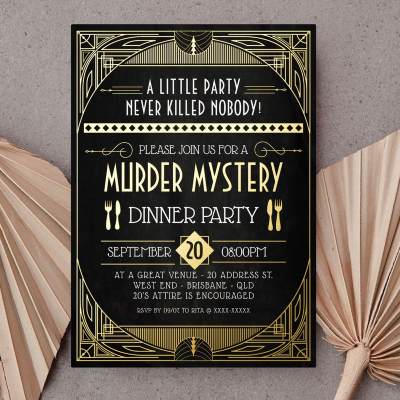
Not everyone is ready to sit down for a session of Dungeons & Dragons. In fact, while the game has never been more popular it is still a very niche hobby. Weirdly shaped dice, character sheets and strange rules can feel intimidating for people who have never played a roleplaying game before. But there is another doorway into the hobby that is far easier to step through. All you need is a crime, a few suspicious characters, and a room full of friends. What is this gateway I hear you ask. A murder mystery party of course!

The Perfect Gateway to Roleplaying

A murder mystery party is, at heart, a very light roleplaying game. For those who have never played, each guest receives a character with a background, motivations, and perhaps a secret or two. Throughout the evening everyone mingles, asks questions, uncovers clues, and slowly pieces together the truth behind a terrible crime. Usually over a delicious dinner.

There are no complicated rules. Just conversation, deduction, and a little bit of theatrical flair. For people who have never played an RPG before, it feels less like a game and more like stepping into a social drama. Before long, they may realise they have been roleplaying the whole time.

Costumes, Scandal, and Suspicion

My wife and I have hosted quite a few murder mystery parties over the years and attended a fair few more, and they are always without a doubt an absolute riot. Half the fun begins before the party even starts. Guests receive their characters in advance and start thinking about costumes. Your friends are no longer at the door. Instead your house fills with aristocrats, detectives, scandalous socialites, and disgraced cousins all with motives and secrets.

The scenario is read out. Usually someone of great wealth and power has been murdered. As such the characters have been brought together to fins the culprit, who is of course one of them. It’s all very Poirot.

Once everyone is in character, the game usually guides the action. Characters have specific questions to ask one another enabling secrets to be uncovered. By doing so the pieces of the puzzle begin to fit together. Scandalous accusations are thrown around and what seemed like a straight forward murder becomes enmeshed in a web of lies, deceit and multiple, very guilty looking suspects.

Someone insists they were in the garden when the murder occurred. Another guest swears they saw a suspicious figure leaving the study. Meanwhile the supposed victim has left a trail of grudges behind them. Add a little wine, a little gossip, and suddenly the whole evening becomes a delightful storm of outrageous scandal and suspicion.

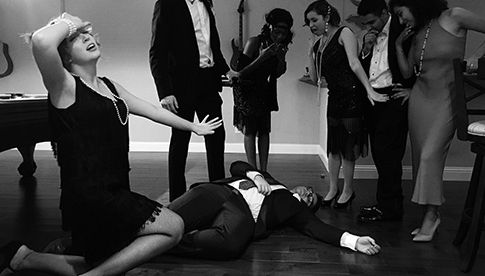
Costumes and a flair for the dramatic make the murder mystery party even more fun

When the Plot Thickens

Every good mystery unfolds in stages. More questions are asked and new clues appear. Alliances shift. People start realising that the quiet butler in the corner might know more than they are letting on. Eventually theories begin forming around the room.

Then comes the grand reveal.

Everyone must declare who they think the murderer is. The moment when the murderer is finally exposed is always glorious. Sometimes the room erupts in triumphant cheers. Sometimes the culprit confesses dramatically. More often than not the wrong person gets accused entirely, which is equally entertaining. The important thing is that everyone has been part of the story.

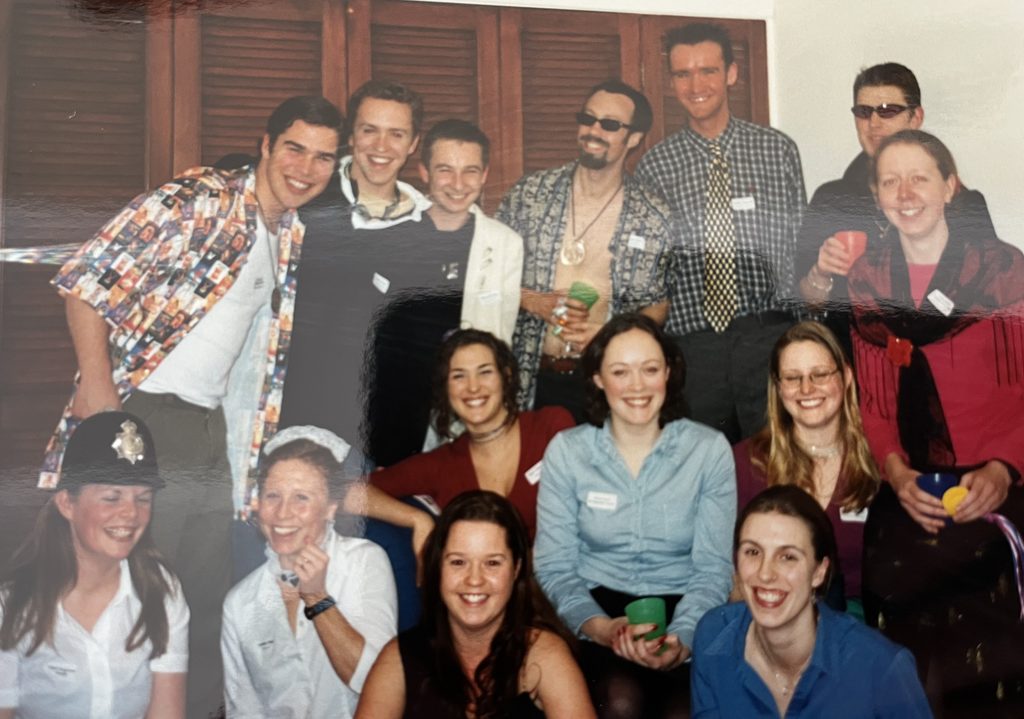
One of the first murder mystery parties I attended, back in my uni days. So much fun!

Marty’s Murder Mystery Party

Recently my friend Marty ran a murder mystery party for a group of us, and it reminded me just how much fun these evenings can be. It was a fantastic night. Everyone was dressed in 80’s finery and there were some amazing wigs. Plenty of intrigue, plenty of laughter, and more than a few wild theories about who had committed the crime.

The scene was set. We were all wealthy (or pretending to be) residents of an exclusive apartment block in London. The owner was dead and one of us had done it. Gasp. Was it the playboy, aerobic video star, cosmetics entrepreneur, tennis pro, aging rock star, not so naive nurse, heiress, pop princess or tech tycoon? We were set to find out.

Many of us were seasoned role players, but at least half had never touched a roleplaying game. Watching people these players slip into character and start interrogating each other was a delight.

My character was the philandering playboy with no money who was, if I remember right, trying to sleep his way into wealth. And that was one of the milder scandals. Someone had been seen up to no good with the murder victim behind a compost bin and another had collected a suspicious black eye (with very convincing makeup by the way). The aerobics video star was also right up to her neck in it all. It was so much fun.

Through all the laughter and 80’s inspired cocktails everyone was learning the core skills of roleplaying games. Improvisation, character interaction, storytelling, and a bit of dramatic performance all snuck in under the cover of a social gathering.

A Gateway to the Hobby

If you enjoy tabletop games and want to introduce friends to roleplaying, a murder mystery party is one of the easiest and most enjoyable ways to do it. There is no rulebook to study. No long campaign to commit to. Just one evening of costumes, conversation, and crime.

By the end of the night, your guests may not only have solved a murder. They may also discover they quite enjoy stepping into a character and helping tell a story. And once someone has tasted that experience, it is only a small step from a drawing-room mystery to the wider worlds of tabletop roleplaying.

Why not run a murder mystery party for your non-gamer friends. At the worst, you’ll have a fun memorable evening. Who knows, some of them might want to make the jump to becoming a player at your table.

If you really do want to run one, these guys look like they make some awesome games. In fact the cowboy themed pack looks like it might be right up my street.