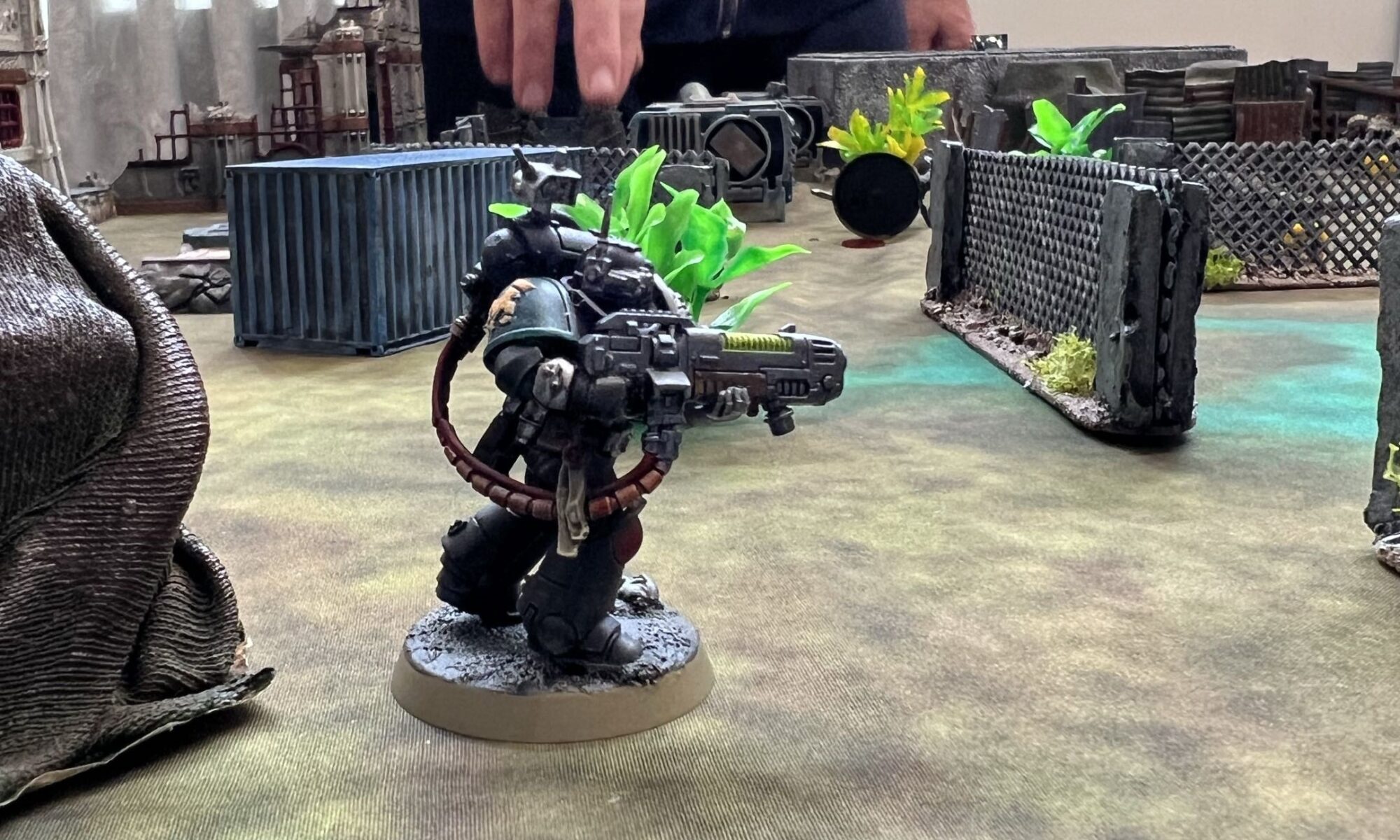
I run multiplayer games of Space Weirdos for six to nine of my friends at least twice a year. Usually I fill them with secret objectives, betrayals and other shenanigans. This time round though I wanted to focus on something different. Collaboration under pressure. So here it is my first foray into the collaborative game.
Drawing inspiration from Warhammer 40,000, the players took on the role of Deathwatch Space Marines deployed to a doomed Imperial world. A Tyranid invasion was sweeping across the planet, and their mission was clear.
First, prevent the Tyranid hordes from reaching the hive city long enough for the civilian population to evacuate. Second, fight their way to a communications array and call in an extraction. Finally, survive long enough to reach the dropship and escape.
Simple objectives on paper. In practice, there was a planet full of hungry Tyranids standing in the way.
Preparing for the Collaborative Game
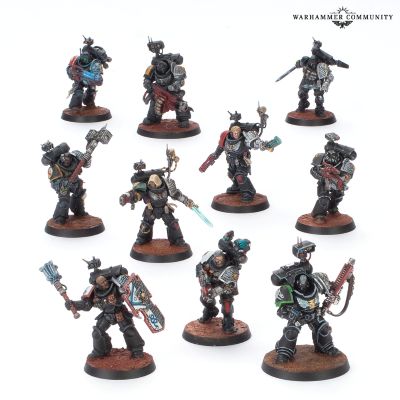
One of the motivations for running the game was finally getting some of my new miniatures onto the table. Last year I picked up Games Workshop’s Tomb World box set and painted the Deathwatch Kill Team (see picture above). I’d only managed to get a few games of Kill Team in with them. So I created individual character cards for each of the ten marines, attempting to match their equipment and battlefield roles as closely as possible.
The six players each selected a marine, based on coolness factor, to begin the mission.
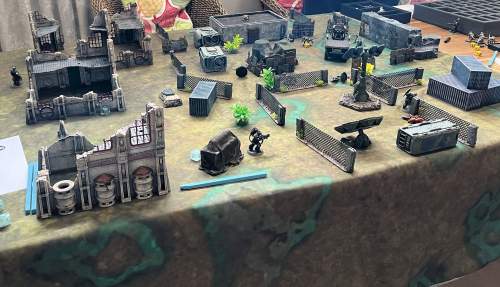
The battlefield itself was a roughly 4′ x 4′ urban warzone, packed with ruined buildings, fences, city debris and a crashed transport vehicle. The environment felt suitably desperate, as though the defenders had already lost most of the planet and were now fighting for the final survivors.
On the other side of the table, I had prepared six waves of Tyranids that would arrive turn by turn. Unfortunately, I managed to forget my Genestealers on the day, which would have added another nasty element to the invasion. Thankfully the Tyranid force was still varied, dangerous and more than capable of causing problems.
I did have a few other surprises up my sleeve. Wave five introduced a monstrous Psychophage and wave six a Tyranid Prime, basically claws and teeth with wings. Both were significantly tougher than anything the players had encountered up to that point and immediately changed the tone of the battle.
The Plan Meets Reality
Before the game began, I gave the players five minutes to discuss their strategy. To their credit, they quickly came up with a sensible plan and launched into action. Their first priority was reaching the communications array so they could call in extraction as early as possible.
Then the first wave arrived.
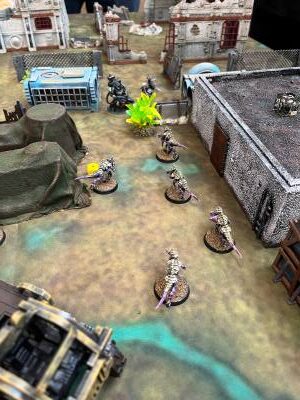
Seven Termagants entered the table. There were a few quiet groans around the group. Not because the termagants were tough opponents, but the fact that this was a first wave of many. If the first wave brought seven, what would the next waves bring?
The marines cut down the first wave with disciplined bolter fire, but every alien corpse simply became a stepping stone for the next wave. Wherever the players created a gap, more creatures poured through it. Much like the movie Aliens, the battlefield gradually transformed from a military operation into a desperate fighting retreat.
Collaboration Under Pressure
What made the game interesting wasn’t simply the combat. It was watching how the players worked together as the pressure increased. At the start of the mission there was plenty of discussion. Players coordinated firing lanes, covered one another’s movement and shared responsibility for achieving the objectives.
As casualties mounted, however, priorities began to shift.
Three marines were eventually killed in action. As a designer i was happy about this, it meant the danger of the scenario was very real. Each time, the player simply selected another Deathwatch marine and jumped back into the battle, ensuring everyone remained involved throughout the game.
Even so, the constant Tyranid pressure forced difficult decisions. Do you stay and support a teammate? Do you hold the line for one more turn? Or do you focus on reaching the extraction point before it is too late?
Having these dilemmas take shape on the table is a key ingredient in making collaborative games so memorable. There was no single player capable of carrying the mission alone. Success depended on the group acting together while balancing individual survival against team objectives.
A Hero Left Behind (Gasp)
Through player coordination they managed to get the dropship to arrive relatively quickly. After fighting through wave after wave of Tyranids, the players finally had a route off the planet. Then came the ultimate dilemma. While the surviving marines boarded the extraction craft and escaped, one marine did not.
Honour among the marines was forgotten. The five marines nearest the evacuation point managed to get away and the marksman covering them was left behind. In a fantastic emergent narrative that games like this produce, the lone Deathwatch operative was left behind as the dropship lifted off. While his comrades soared into orbit, he disappeared into the ruined city below, surrounded by an endless tide of Tyranids.
It was exactly the sort of grim, bittersweet ending that feels perfectly at home in the Warhammer 40,000 universe.
The mission was technically a success. The civilians were saved. But not everyone made it home.
Golden Aquilas for the Victorious
With the battle concluded, we tallied up the Tyranid kill counts and handed out Golden Aquila medals to recognise the most effective warriors, witht he best Marksman taking away the biggest Aquila. It was a small touch, but one that added a fun competitive element to an otherwise cooperative game.
More importantly, everyone left the table with a small memento and stories to tell.
The overwhelming Tyranid waves created constant pressure, the objectives forced players to make meaningful decisions, and the multiplayer format encouraged communication and teamwork throughout. Most of all, it demonstrated something I have found time and again in tabletop gaming. Collaboration becomes far more interesting when success is uncertain.
When resources are limited, enemies are overwhelming and the clock is ticking, players stop focusing on optimal solutions and start making real decisions together.
And sometimes those decisions result in medals, heroic last stands and one very unfortunate Space Marine being left to an uncertain fate on a doomed world.
If you’d like to get hold of my notes and Space Weirdos stats for the game you can get them here.