
Emergent Gameplay — Co-Creating Awesome Adventures with Your Players

emergent gameplay

If you’ve ever run a tabletop roleplaying game and watched a story unfold in ways you never expected, you’ve already experienced emergent gameplay—the joy of watching a narrative evolve not from a script, but from a conversation.

Few systems embrace this more fully than Dungeon World. Built on the Powered by the Apocalypse engine, Dungeon World encourages GMs and players alike to let go of control and lean into collaborative storytelling. At the heart of this approach is a powerful principle: the game world belongs to everyone at the table.

This article explores how Dungeon World’s GM advice promotes emergent play, highlights key techniques, and shows how these tools can shape rich, player-driven narratives.

What Is Emergent Gameplay?

Emergent gameplay is storytelling that arises during play, rather than being planned in advance. It’s what happens when players surprise the GM with clever choices, and the GM says “yes, and…” instead of redirecting. It’s the difference between following a script and building a story together. Dungeon World thrives on this. It asks GMs to prepare situations, not scripts, and to embrace the unexpected. The game’s core principles encourage openness, improvisation, and player input.

The Dungeon World GM Principles

Some of the key principles from Dungeon World that promote emergent storytelling include:

  • Ask questions and use the answers
  • Draw maps, leave blanks
  • Play to find out what happens
  • Make a move that follows

These aren’t just rules for Dungeon World—they’re tools for any GM who wants to co-create with their players.

Let’s look at one of the most powerful techniques: Paint the Picture questions.

“Paint the Picture” Questions

This is a technique where the GM prompts the player to help describe the world around them, often adding emotional, cultural, or sensory details.

Examples:

  • “You enter the ruined temple. What about it tells you that this place was once holy to your people?”
  • “As you step into the market square, what sound overwhelms you first?”
  • “What’s the one thing in the bandit leader’s camp that surprises you?”

These questions do more than build the setting. They:

  • Signal to players that their ideas shape the world
  • Tap into backstory, emotion, and personal stakes
  • Provide instant richness and depth with minimal prep

You’re not just running a game—you’re inviting players to become storytellers alongside you.

Co-Creation in Practice

In Dungeon World, players don’t just fill out a character sheet—they fill out the world. There are even paint the picture questions on the character sheets. When you ask a player, “Who rules this town, and why do you owe them a favour?” you’re inviting them to help shape the political landscape. When you ask, “Why do you fear the forest you grew up next to?” you’re creating lore together.

Some GMs are nervous about giving up control. But the truth is, player input doesn’t dilute your world—it enriches it. The players don’t need to invent major plot points. Even small contributions (a tavern name, a strange superstition, a former ally) add texture and depth.

The secret is to guide, not dictate—to build the skeleton and let the group add the muscles, skin, and spirit.

Making Emergence the Core (Or Just a Flavour)

This co-creative style can form the foundation of your game. A whole Dungeon World campaign might begin with just a few questions:

  • “What threat looms over this land?”
  • “Who among you has a connection to it?”
  • “Why is your party already in trouble?”

From those seeds, an entire world blossoms.

But you don’t have to go all-in. These techniques work just as well in a more traditional game like D&D or Pathfinder:

  • Use “Paint the Picture” questions to add local colour and culture
  • Let players invent small NPCs or towns they’ve visited
  • Ask what their character remembers about a place or why they hate a particular enemy

A few well-placed questions can shift players from passive participants to creative collaborators.

Final Thoughts on Emergent Gameplay

Dungeon World’s approach reminds us of something essential: roleplaying games are not individual performances—they’re involved conversations. When players feel like their ideas matter, the story becomes theirs. That ownership creates richer narratives, stronger investment, and more memorable moments.

Whether you use emergent techniques as your main style or just sprinkle them in for flavour, the result is the same: a world that feels alive, responsive, and uniquely yours. So next session, don’t ask what the players do. Ask them what they see. What they fear. What they hope for. Then let the adventure emerge.

I’ve compiled a two page emergent play prompt sheet full of paint the picture questions for you to use at your table. Visit the Play2Lead area from the top menu to download your copy.
Launching the Promethium Wars: Designing a Narrative Kill Team Campaign

Those who have been reading this blog for a while will know that I love the idea of stories emerging from game play. While this is obvious in games like D&D, I’m also interested in trying to create similar emergent experiences with other game systems. I’m a member of a local wargaming club where we play games of Kill Team and 40K on a weekly basis. I think there’s something special about a wargaming campaign that tells a story. Not one written in advance, but one that emerges—slowly, chaotically, gloriously—from the dice rolls, the table banter, and the narrative fragments players build together. With that in mind I volunteered to run a narrative campaign for the group. As a result, Promethium Wars, a narrative Kill Team campaign, was born.

I wanted something simple enough to run with minimal admin, but rich enough to spark real engagement amongst the participants. Something where a quick game on a weeknight could feel like part of a bigger war. Games would no longer be transactional affairs, but rather threads forming a larger narrative. And with twelve players already signed up—divided evenly across the Imperial, Chaos, and Xenos factions—it’s clear the idea has struck a chord.

Design Principles

Narrative and Emergent Storytelling were at the core of the campaign design. I didn’t want to script the campaign’s twists and turns. Instead, each week’s outcomes will steer the story. Players can dive in as much (or as little) as they want—whether that means writing full-blown battle reports, communicating in character or just rolling dice and watching the story evolve.

To keep things light and playable for everyone, I leaned into the principle of Limited Admin. No complicated map-tracking or bookkeeping for the campaign manager (me) or the players. Just clear weekly themes, short prompts, and a shared space for storytelling. Every game counts, but you don’t need to log three hours on a spreadsheet for it to matter. The minimum admin for each participant is to log game results and send them to me. Of course, if the players get really into the game the Discord server should begin to grow with narrative reports and banter, but it is not a requirement.

Each faction has its own win condition, giving players a reason to show up and push their agenda forward. The Chaos and Imperial factions want control of Pyrothis V and must win the most number of games. The Xenos faction, who can fight for either side, wants to grind both enemies down to an ineffective stalemate, wins if the Chaos and Imperial sides are effectively tied (two points difference). Regardless of the game mission being played, there’s always a motive. The stakes are casual but meaningful—exactly the balance I was aiming for.

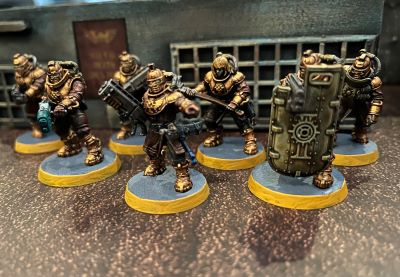
My Imperial Navy Breacher Team, ready to help rescue Pyrothis V.

Structure and Themes

The last principle was Short Campaign Length. I don’t want the campaign to fizzle out. Keeping it short ensures that the high energy at the start can be maintained. Short, sharp, explosive. I hope that this will keep the players coming back for more campaigns in the future.

Therefore, the campaign unfolds over four weeks, with a new theme each week to guide missions and inspire storytelling. These themes won’t constrain players—they’re meant to be narrative fuel. Players are encouraged to run games when and how they like, as long as it fits the week’s vibe. The four themes are:

  • Week 1: Infiltration and Sabotage
  • Week 2: Open Conflict
  • Week 3: Firestorms and Disaster
  • Week 4: Final Gambit

Once reports begin trickling in from the front lines, I’ll be putting together a short newsletter each week to highlight key developments, turning points, and of course, the faction scores.

For more detail on the background, win conditions and campaign set up, you can download the players pack below:

A Living, Breathing War

Perhaps the most exciting part of any narrative kill team campaign is the player energy. Already, folks are crafting characters, naming squads, and giving them relevant back stories. And while there’s no pressure to write stories, every player is invited to contribute. These tales—written, spoken, or just shared at the table—are what will give the campaign its true shape.

Ultimately, Promethium Wars is a story we’re writing together. And the pen happens to be shaped like a bolter.

Final Thoughts on Narrative Kill Team Campaign Design

The campaign is started mid April and will run to mid May. I’m aiming to learn from this experience to hone the opportunity for emergent narrative play and see what comes out. Depending on the actions of the players I’m considering running a multiplayer finale to cement the end of the campaign. But the fact that this is an emergent experience I guess I’ll have to wait and see how the whole thing pans out.

Once the campaign has finished, I’ll post the results along with any lessons learned from the experience.

To find out how the campaign went and to read the weekly journals check out my summary post here.