Succession War: Kill Team Campaign Design

Kill Team Campaign Design

Following the success of my last Kill Team narrative campaign at my local club I’ve decided to run another one. This time I want to incorporate some of the feedback from the participants in an attempt to heighten the narrative and increase engagement. Membership at the club has increased over the last few months so I’m hopeful we can have even more players than previous. But first I need to plan the narrative and scope. So read on for my Kill Team campaign design notes, to get my take on where this next event might take us.

Campaign Scope

While the last campaign was purposefully kept as simple as possible I want to increase the length and scope of this attempt without stretching myself or the players too thin. A couple of goals I’ve set myself includes:

  • Longer event without losing momentum. 7 week campaign this time round.
  • Engaging storyline that goes beyond the regular 40 faction divides of Chaos, Imperium and Xenos.
  • More opportunities for narrative.
  • Links to previous Promethium Wars event.
  • Include more than 12 players if possible.
  • Accessible to all play levels.
  • Multiplayer events.
  • Multiplayer grand finale.

Succession War Narrative

In an attempt to open up the alliances to multiple factions I’ve worked in a narrative based around the death of a Planetary Governor on an Imperial World. His offspring are fighting for the governorship supported by multiple factions. The plot will look something like this:

In the dying embers of the Forge World Velkira Prime, the great Steward Magus Regulus Thane lies on the edge of death. His three children—each bearing different visions for the planet’s future—prepare to seize power.

Amid their silent war of diplomacy, bribery, and sabotage, an external threat looms: Rhyskar the Unbound, a newly ascended Daemon Prince, seeks dominion of the system to prove his worth to the Chaos Pantheon. With Pyrothis V already in ruin, Velkira Prime is next.

The Imperium watches. The Xenos listen. And the Forge World burns with secrets.

Players take the role of shadow operatives, kill teams loyal to hidden masters. At the beginning of the campaign, each player secretly chooses a sibling to support. Each sibling also has one player assigned as their Captain—privy to deeper strategy and mission briefings.

Sibling Factions

The player base will be split across the three sibling factions regardless of whichever faction their Kill Team is aligned to. While each sibling is outwardly aligned to a particular faction they actually appeal to all three as described below.

Darian Thane – The Iron Heir

  • Loyalty: The Imperium
  • Vision: A brutal but stable militarized technocracy. Increased tithe to the Imperium to win political favor.
  • Theme: Order, sacrifice, grim determination.
  • Support: Militarum, Adeptus Mechanicus hardliners, conservative Space Marine chapters.

Darian Thane the Iron Heir

Chaos Support: Chaos-aligned factions view Darian’s rigid order as fertile ground for insidious infiltration. His obsessive devotion to law and productivity blinds him to the slow rot within.
Imperial Support: Darian is the traditionalist’s choice. He vows loyalty to the Imperium, pledges increased tithes, and promotes military strength and hierarchy.
Xenos Support: Pragmatic T’au or mercenary Kroot may ally with Darian via under-the-table deals with his logisticians, supplying rare resources or weapons in exchange for toleration.

Selene Thane – The Hidden Flame

  • Loyalty: Xenos sympathizer
  • Vision: Secret alliances with the T’au and Aeldari to boost production and evade Imperial taxes.
  • Theme: Innovation, progress, secrecy.
  • Support: Rogue Traders, T’au diplomats, Harlequin agents, Forge World fringe cults.

Selene Thane the Hidden Flame

Chaos Support: Chaos cults view Selene’s obsession with innovation and progress as an open door to Tzeentchian manipulation. Her radical reforms destabilize the status quo—perfect for seeding anarchy.
Imperial Support: Some elements in the Imperium (Inquisition radicals, free-thinking Magi, or certain Rogue Traders) see her ideas as necessary evils for survival on the frontier.
Xenos Support: Selene has already opened discreet trade lines with T’au diplomats and Aeldari seers. Her faction embraces alien tech, psychic insight, and fringe experimentation.

Kato Thane – The Pale Prophet

  • Loyalty: Chaos
  • Vision: A Forge World as a daemon-forge of flesh and steel. Secretly devoted to Nurgle and Tzeentch.
  • Theme: Corruption, mutation and progress.
  • Support: Cults, Traitor Astartes, Renegade Mechanicus, Genestealer remnants.

Kato Thane the Pale Prophet

Chaos Support: Kato is a willing servant of Chaos. His hidden cults grow daily, and his daemon-forges swell with unsanctioned warp energies. He dreams of apotheosis.
Imperial Support: Kato presents himself as a quiet, dutiful son. Loyalist factions that prefer a weak or pliable ruler may support him as a puppet candidate.
Xenos Support: Genestealer Cult remnants, radical Necron Crypteks, or even Ork Mekboyz might be amused by Kato’s grotesque tech-heresy. Some see his reign as inevitable—and profitable.

Player Distribution and Captains

In an effort to even up the teams players will be assigned based on rough skill level and experience. A captain will also be assigned with the aim of hyping up their team as well as dishing out specialist campaign equipment. The captains will also be tasked with encouraging the narrative within the campaign, creating rivalries and grudges etc.

Campaign Progression

Campaign progression will look something like the following:

Week ThemeCrit OpsNotes
1Fires of Ambition Secure – Capture Key industrial sites on Velkias Prime
2Silent Alliances Dead Drop – Deliver/collect coded intel across the mapTeam Captains will be given a selection of rare equipment to pass out to their team members.
3Saboteurs Unleashed Sabotage of key rival infrastructure2v2 Half teams multiplayer missions
4Assassination Assassination crit op targeting rival leadersThe sibling with the weakest control is assassinated and removed from the race. Lost faction players redistributed to the winners.
5Aftershocks Turf WarSeize and control disputed territoryCaptains given further assets to distribute to their teams.
6Final StrikeKill Op, wipe out the other teams2v2 Half teams multiplayer missions Adding double control points.
7ControlLarge multiplayer event set in the Governors PalacePlayers bring 1-2 operatives for a final show down. Which faction will control the winning Sibling?

Victory Conditions

A simple map of Velkaria Prime divided into 5 sectors will form the basis of the win condition. Each game (decided or rolled for by the players) will take place in a different sector and a win will create a control point in that location. Control of the planet will therefore take on a visual aspect as control of the different sectors changes hands.

Having a map came up a lot in the player feedback and will form a central unifying aspect of this Kill team campaign design.

A separate element will be the Champion. Each player will nominate a champion (not their leader). Each champion gets a point for every Kill they make. This will form a different leader board giving players another victory condition to work towards.
Final Thoughts on the Kill Team Campaign Design

With regards to this Kill Team campaign design, I’m hoping that the mix of factions and player captains and map will all serve to keep the players engaged. As well as the multiplayer events and shifts in the story arc.

While players will be assigned to factions, it will be important that they develop a narrative around why their team is supporting the given sibling and work changes in the plot.

While a little more complicated than the previous campaign, the administration is actually fairly limited for me as the Arbitrator (organiser). Having the captains help corral players will also be a big help.

Looking forward to getting the map, missions and player pack finalized and kicking it off in a couple of months.


How to Write a 1-Hour Workplace Adventure Using Play2Lead

If you’ve been following this blog for a while you’ll know that I consider D&D to be a powerful way to develop teamwork, communication, and leadership skills. There is a great opportunity to use games like D&D in the workplace to upskill your team. However, as the old adage suggests time is money. Finding time to run a workplace adventure can be difficult. So, when you only have an hour, structure really matters.

That’s where the Play2Lead ruleset shines. Designed to be fast, focused, and built around teamwork mechanics like the Team Dice Pool, it’s ideal for short, high-impact sessions. It is just a ruleset. Where it really shines is in the scenarios played. In this post, I’ll show you how to write a tight, engaging 1-hour workplace adventure using a three-encounter framework that encourages collaboration and leaves players excited for more.

The 1-Hour Workplace Adventure Framework

Here’s the structure:

  1. Opening Shots (In Media Res) – Drop the players right into the action.
  2. Team Puzzle / Challenge – Test communication, collaboration, and creative problem-solving.
  3. Exciting & Threatening Finale – Deliver a climactic moment with urgency and consequences.

This structure mirrors how stories are told in action-packed short fiction, and it works beautifully for limited time workplace sessions: start fast, build tension, finish big.

Key Design Goals

When designing adventures in the 1 Hour Framework consider the following design goals.

  • Limit to 3 Encounters – Focus is your friend. Three scenes is the sweet spot.
  • Use the Team Dice Pool – Give players moments to contribute, support each other, and spend shared dice to solve problems.
  • Theme Around Soft Skills – Use metaphors for leadership, trust, or crisis management.
  • Keep Time – Allocate about 15 minutes per scene and leave 10–15 minutes for debrief and reflection.

Some Example Workplace Adventures

Here are some examples to get you started. Leaning in to popular tropes can help players begin engaging with the game quicker. Everyone knows Zombies, superheroes or pulp adventures and what they entail. The more easily recognizable the faster players can understand what is needed from them.

Zombie Apocalypse Scenario

Title: “Extraction Point Echo”
Theme: Crisis leadership, teamwork under pressure

Inspiration: 28 Days later, Walking Dead, iZombie, Dawn of the Dead.

1. Opening Shots: “Trapped in the School”

  • The team is barricaded in a classroom as zombies break through the hallway.
  • One NPC survivor, a doctor, is injured, another panicking.
  • Team must decide: fight, flee, or rescue?
  • Team must coordinate escape strategies and save NPCs.
  • Dilemma: who will they save?

2. Team Puzzle: “The Blocked Gym Doors”

  • To reach the evacuation chopper, the team needs to open the sealed gym doors.
  • Puzzle includes a broken generator, a keypad lock, and zombies thudding at the fence.
  • Players must delegate tasks: repair, protect, decode.

3. Finale: “Last Stand at the Helipad”

  • The evac chopper is delayed, and a wave of zombies is closing in.
  • Team must defend the landing site, signal the chopper, or use environmental elements (fire, water hoses, barriers).
  • Keep the pressure on. When the chopper arrives it doesn’t have enough space for everyone…

Underwater Adventure Scenario

Title: “Pressure Protocol”
Theme: Decision-making under constraint, trust, clarity in communication

Inspiration: Abyss, The Poseidon Adventure, The Deep, Jaws, The Meg

1. Opening Shots: “Flooded Research Lab”

  • The team wakes up in a partially collapsed undersea lab after an earthquake.
  • Water is rising fast, oxygen is limited.
  • Decide what to salvage, who to carry, and how to reach the control hub.
  • In media res—start with klaxons blaring and lights flickering.
  • Provide too much equipment to be taken, some useful, some not. Each character can take one item. What will be left behind?

2. Team Puzzle: “The Pressure Doors”

  • The route to the escape sub is blocked by a malfunctioning pressure system.
  • One team member must navigate ducts, others solve a system override puzzle.
  • Split the team but encourage constant communication.

3. Finale: “The Cracking Dome”

  • Final room has the escape sub—but the lab’s glass dome is fracturing.
  • An injured NPC radios from another part of the station begging to be taken, but time is tight.
  • Players choose: who goes, who stays, what can be sacrificed.
  • High tension, high stakes. Let them spend the last team pool dice for one heroic effort.

Final Tips on Prepping a Workplace Adventure

  • Prep NPCs with distinct roles or emotions (coward, loyalist, idealist), making it clear who they are, to prompt team dynamics.
  • Track Time with a visible timer or countdown clock—it adds tension and keeps pacing sharp.
  • End with Reflection – Ask players what choices worked well, what they’d do differently, and how it connects to teamwork at work.

Why It Works

Using the Play2Lead ruleset in a 1-hour adventure is basically a leadership workshop disguised as a zombie movie or underwater thriller. It’s short enough to fit a lunch break or between learning sessions, structured enough to teach valuable skills, and fun enough to make people want to play again.

Three encounters. One hour. One story they’ll talk about all week.

Stealing Shadows: Designing a High Action Star Wars One-Shot

I’ve volunteered to run a one-shot adventure for my friend Andrews birthday. Usually we play D&D together, but I decided to mix things up with some good old fashioned Star Wars. This franchise is perfect for the one-shot style game. It’s popular and players know exactly what’s expected. After much navel gazing I decided that there’s nothing like a good heist give the one-shot a truly Star Wars feel. Not only that but it had top be set in the dark days before A New Hope, when the Rebel Alliance is a ragtag network of scattered cells and the Empire’s grip is tightening. One daring raid can turn the tide.

In this post, we’ll walk through designing a Star Wars-themed one-shot using:

  • The ICRPG ruleset (fast, flexible, cinematic)
  • Pre-generated characters with just enough customization for the players to make them their own.
  • The 5 Room Dungeon framework for tight adventure structure, we only have 3 hours to play the game.
  • A mission straight from the Rebel playbook: steal the prototype TIE Phantom before the Empire can unleash it on the rebellion…

Why ICRPG Works for Star Wars

I really needed a game system that would be at once familiar tot eh players and fast paced. Index Card RPG (by Runehammer Games) is a rules-light system based on the concepts of D&D but streamlined to keeps things moving. One roll target per scene, fast turns, minimal math—it’s all built for cinematic play. Players don’t need to learn a dozen subsystems. They just go. Whether it’s blasting stormtroopers, slicing into doors, or dodging TIE Fighters, ICRPG makes gameplay smooth, allowing the players to focus on the high-stakes of the scenario.

Pregens with Purpose

To keep the pace snappy, I have prepped prep a number of characters, each with a strong role. While statted out with a specialist skill and a couple of attribute points, my players can add a further 8 attribute points and put their own stamp on the character. I’ve included the following:

  • Old Jedi in hiding.
  • Smuggler
  • Repair droid able to take over machines
  • Pilot
  • Commando
  • Wookie Warrior
  • Spy
  • Rebel soldier

Each comes with ICRPG-style stats, starting gear, and a special skill. Enough depth to spark roleplaying, but not so much to overwhelm.

Stealing Shadows: The Mission

Rebel intelligence have learned that the Empire has secretly constructed a working prototype of the TIE Phantom—a cloaking starfighter that could change the course of the war. It’s hidden deep in a secure Imperial testing facility on the shattered moon of Harax, guarded by stormtroopers, officers, and harsh automated defenses. But there is hope, one of the technical specialists is thought to have Rebel sympathies. Perhaps he will help the war effort.

Your team has one shot to infiltrate, steal the fighter, and escape before the Empire realises what’s happening.

Let’s structure it using the 5 Room Dungeon method. If you haven’t checked out this effective method of adventure design I highly recommend you do. This is the perfect way to frame the adventure. It keeps things exciting and tight, giving the players a fun adventure with limited prep time.

1. Entrance and Guardian – Moonfall and Mayhem

With their shuttle malfunctioning the rebel team crash land onto Harax’s fractured surface during an ion storm. thrown straight into the action they must reach the facility perimeter undetected, but patrols are already combing the surface. A speeder patrol closes in. Do they ambush, sneak, or run?

ICRPG Notes:

  • Set a scene target of 12 to keep the introduction fairly straight forward. . Use effort rolls for stealth, slicing into doors, or ambushing troopers.
  • Provide a map of the facility, letting the players choose a way in.
  • Timer: Storm interference increases every round; failure draws more troops.
  • A squad of scout troopers on speeder bikes will close in on the party.
  • Keep the time pressure on here.

2. Puzzle or Roleplay Challenge – Slicing the Perimeter

The hangar is shielded and locked down. Players must disable the security grid without triggering alarms. Can they make contact with the sympathetic tech specialist to help—but only if convinced the Rebels are real.

ICRPG Notes:

  • Roleplay challenge: gain the defector’s trust.
  • Increase effort dice to 13.
  • Puzzle effort: disable power relays, match codes, or rewire a terminal.
  • The defector Technician Zander is scared needs to be calmed. Will lead PCs to the wrong location.
  • Stormtrooper patrols are an ever present threat.

3. Trick or Setback – It’s a Trap!

The TIE Phantom is here—but it’s also bait. An elite stormtrooper squad, led by an ISB Agent, has been watching. They knew someone would come for the prototype and hope to uncover the Rebel cell network. Suddenly, blast doors seal, and enemy troops swarm in.

ICRPG Notes:

  • Betrayal scene, make a big deal out of the trap. Maniacal laughter is a must!
  • Agent Ixil makes his appearance, calmly tells the party of his trap.
  • Effort Level of 14.
  • Treats: The hangar is full of tools and droids that can be utilized in their defense.
  • Timer: Countdown to more troops arriving. Must open the blast doors to the main hangar.

4. Climax, Big BattlePhantom Launch

The Rebels must fight their way to the TIE Phantom, power it up, and blast their way out. One player can pilot; others defend the hangar or sabotage remaining defenses. A shuttle is parked nearby to allow the other players the possibility of escape. Possibly a mid-flight dogfight to escape in orbit.

ICRPG Notes:

  • Split the party: pilot sequence vs. hangar defense, have both happening at the same time and cut between the two.
  • Effort level 15.
  • Stormtroopers, stormtroopers and more stormtroopers plus the scary Agent Ixil.
  • Use timers and effort for take-off time and incoming stormtroopers.
  • Cue dramatic sacrifices, cinematic blaster standoffs, or droid heroism.

5. Reward and Revelation – The Price of Hope

The Phantom is in Rebel hands… but at a cost. Did they all make it? Did the ISB Agent escape with intel on the Rebel organization? The fighter’s logs might reveal even more hidden Imperial projects and a planned raid on a nearby Rebel safe house. Investigation of the cloaking technology will show it to be of Sith origin.

Get the players to describe what their characters are doing a day, a week and a year after the adventure. This gives the one-shot game a great feeling of closure.

Tips to Capture the Star Wars Feel

This adventure is meant to be fully Star Wars. Nothing clever here. In an attempt to catpure the feel of the original films I’ll aim to include the following at different points throughout the game.

  • Stormtroopers die in droves, but leaders are scary. Keep troopers cinematic—bad shots, easy to mow down. But named officers and ISB agents should feel dangerous.
  • Use environment hazards. Star Wars battles are kinetic. Falling catwalks, explosive barrels, jammed blast doors—go big. I’ll create a list of these and add I go to keep the action high.
  • Moral choices matter. Give the Rebels real dilemmas: save the prisoner or steal the ship? Take the shot or protect your team? The tech specialist defector will definitely have a sad story, will the players save him?
  • Visual and musical cues. I’ll be playing the New Hope soundtrack during the session and provide plans of the secret TIE fighter test facility.
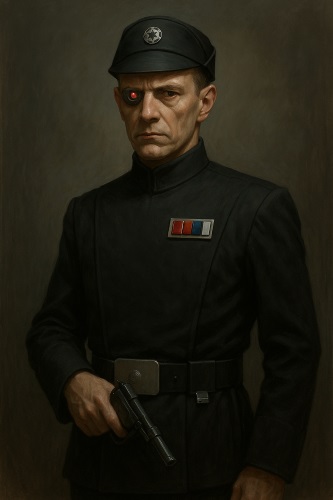
AI rendering of Agent Ixil the Villain of the adventure

The Villain

In an effort to make the villain memorable I developed him to be someone the players can hate. Introducing Agent Varn Ixil

Imperial Security Bureau – Counter-Insurgency Division

Description: Cold, calculating, and eerily calm under pressure, Agent Varn Ixil is a mid-ranking ISB operative known for using psychological tactics and traps rather than brute force. He wears pristine officer’s attire with his distinctive cream dress jacket. He carries a modified blaster pistol—rarely drawn, always lethal. His right eye has been replaced with an optical implant that constantly analyzes his surroundings, and he records every conversation for later dissection.

Memorable Trait: He never raises his voice. Even during combat, his commands are delivered in a chilling whisper. He refers to Rebels by their full names and known affiliations, as if reading from a classified file—making players feel like he already knows them.

Motivation: Not just to protect the TIE Phantom, but to capture the Rebel team alive and study them as part of a broader psychological warfare program. He wants to break the Rebellion, one mind at a time.

Catchphrase: “You think this is about a ship. No. This is about you. All of you. And the cost of believing in ghosts.”

I cant wait for the players to meet Agent Ixil!

Final Thoughts

A small Rebel team, a deadly prototype, stormtroopers in pursuit—it’s the recipe for a perfect Star Wars one-shot. With ICRPG’s easy-to-learn system and the tight 5 Room Dungeon structure, you can drop players straight into the action and deliver a cinematic, satisfying night of roleplay.

Let them steal the future from the Empire. Let them feel like heroes. It’s all here. I cant wait to run it!! And remember…..

Rebellions are built on hope.