
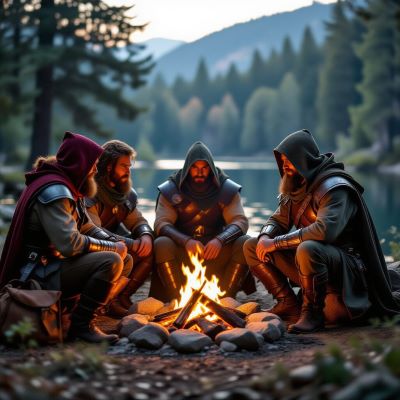
When people think about team building, they often picture ropes courses, awkward icebreakers, or nerve-wracking trust falls. But what if the most powerful tool for creating real team cohesion wasn’t physical activity or corporate exercises—but storytelling? Enter Dungeons & Dragons, a tabletop roleplaying game that thrives on shared storytelling. It’s a game where players build imaginary worlds together, solve problems as a group, and embody characters who grow, struggle, and triumph as a team. And while it might look like fantasy fun (and of course it is), D&D also offers a surprisingly deep model for how to build strong, psychologically safe, high-performing teams.
Let’s look at how D&D’s narrative structure creates team bonds—and how you can use these lessons in your workplace, classroom, or community group.
Shared Storytelling = Shared Ownership
In D&D, the story doesn’t belong to one person. Sure, the Dungeon Master (DM) might guide the world, but the plot evolves through the choices of everyone at the table. Players decide how to approach challenges, who to trust, and what kind of characters (or leaders) they want to become.
That shared narrative builds shared ownership. When a mission succeeds, the whole group feels it. When things go wrong (and they almost always do), the group adapts together. This sense of co-authorship is powerful: it creates a team culture where every voice matters.
In the workplace, this mirrors the difference between top-down directives and collaborative strategy. When the story is presented from the top, buy in can meet significant resistance. However, when team members help shape the story—of a product, a project, or a goal—they’re more invested, more creative, and much more committed.
Psychological Safety: Failure Is Part of the Game
One of the greatest strengths of D&D is how it normalizes failure. Characters miss attacks, fall into traps, or make poor decisions—and the story doesn’t end. It gets significantly more interesting. The consequences of failure become narrative fuel, not a source of shame.
This culture of playful risk-taking builds what Google’s research famously identified as the #1 trait of high-performing teams: psychological safety. In a psychologically safe team, people feel comfortable speaking up, taking risks, and being vulnerable without fear of ridicule or retribution. By playing D&D together, teams rehearse this kind of safety in a low-stakes setting. They learn that mistakes aren’t fatal—they’re part of the fun. And that mindset carries over into real work.
Building Empathy Through Character
In D&D, players take on personas that often differ wildly from their real-world identities. A quiet analyst might play a boisterous half-orc bard. An outspoken manager might become a timid elven healer. As they explore these characters, players inhabit new perspectives—and watch their teammates do the same.
This roleplaying builds empathy. It invites players to step into someone else’s shoes (or boots, or hooves), wrestle with emotional dilemmas, and support each other’s fictional struggles. And in doing so, it strengthens their emotional intelligence in real life.
Empathy isn’t a soft skill—it’s a critical leadership trait. D&D gives teams a safe way to build it naturally, through play.
Tips for Encouraging Shared Storytelling
You don’t need to be a master Dungeon Master to encourage better storytelling in your game. If you are running a game at work or using roleplaying to help impart experiential learning, consider using these tools to deepen the shared storytelling experience:
1. Paint the Scene Questions
Instead of describing everything yourself, invite players to contribute. Ask things like:
- “What does the ruined temple smell like?”
- “What’s the one thing about this town that makes it feel like home?”
- “What do you see on the battlefield that makes you hesitate?”
These questions invite creativity, distribute narrative control, and reinforce the idea that this world belongs to everyone.
2. Ask for Flashbacks
Let players add history to the world:
- “What memory does this cave bring back?”
- “Tell us about the last time you faced something like this.”
Flashbacks connect characters more deeply to the story and build emotional investment.
3. Spotlight Sharing
Make space for each player to shine. Don’t let loud voices dominate the session. Encourage quieter players by giving them openings:
- “Hey, Mira, what does your character think of this?”
- “You’ve been watching from the shadows—what do you notice?”
4. Celebrate Narrative Wins, Not Just Combat
Don’t let the game revolve around dice rolls alone. Praise creative problem-solving, emotional roleplay, and team synergy as much as battle strategy.
5. De-brief After the Game
After each session, take a few minutes to reflect:
- “What was your favourite moment tonight?”
- “What surprised you?”
- “What do you think your character learned?”
This builds reflection and reinforces shared memory—essential for team bonding.
Every Team Has a Story
Your team already has a story. The question is: are you telling it together, or is it being written without them? Dungeons & Dragons shows us that the act of co-creating a story builds connection, empathy, and trust. Whether you’re sitting around a game table or a boardroom, the principle holds: when people feel seen, heard, and included in the narrative, they give their best.
So maybe next time you’re planning a team-building session, skip the ropes course. Grab some dice. Sit around a table. And start telling a story—together.