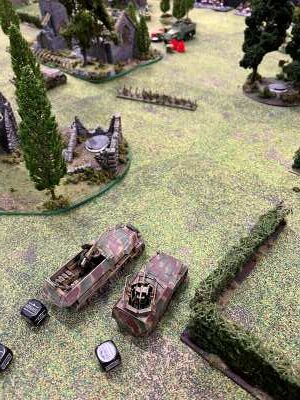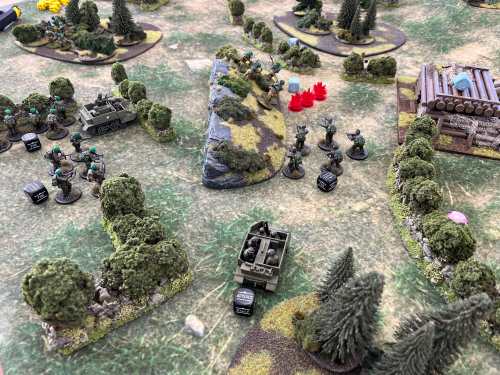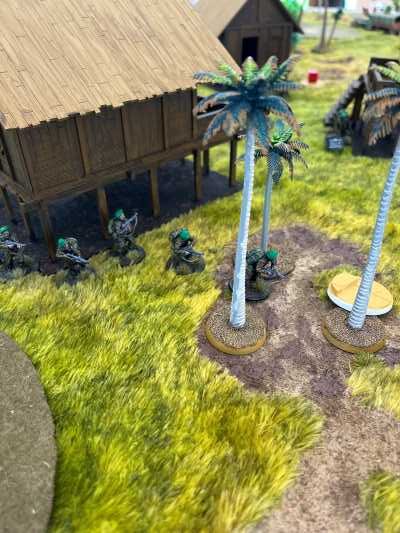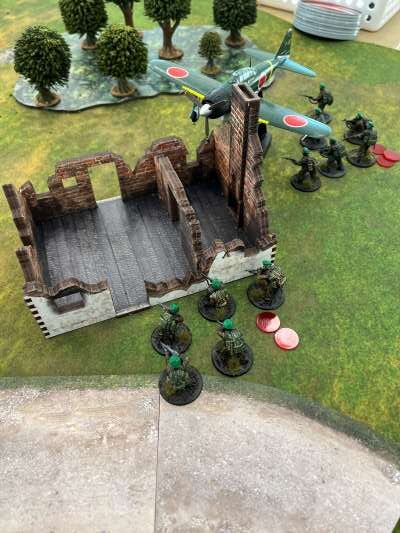
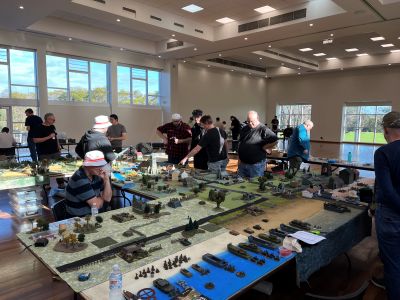
Last weekend I took part in one of the most ambitious and entertaining wargames I have ever experienced. This game of massive Bolt Action was based on Operation Sea Lion, Hitler’s planned invasion of Britain. This took place at Outpost 6030 and was organised by the cunning, deplorable and very organised Jackson and John. It brought together somewhere between 22 and 26 players (I lost count of how many due to in-game shenanigans) for a day of glorious confusion, desperate heroics and unexpected betrayals.
A Massive Battlefield
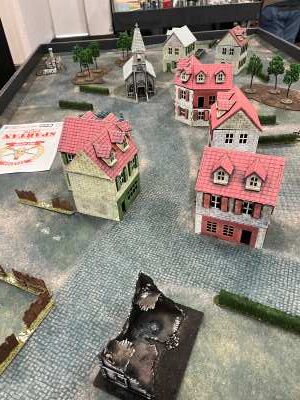
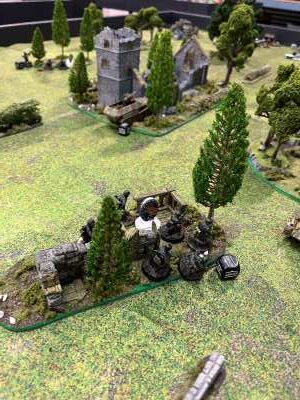
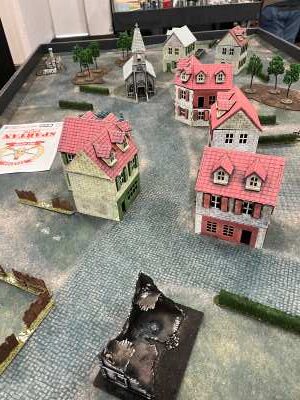
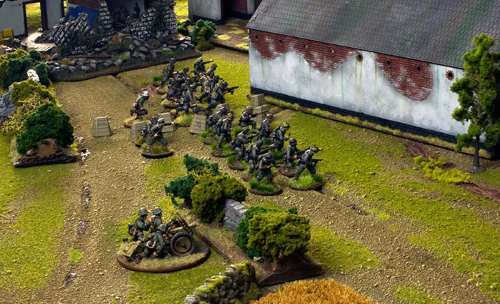
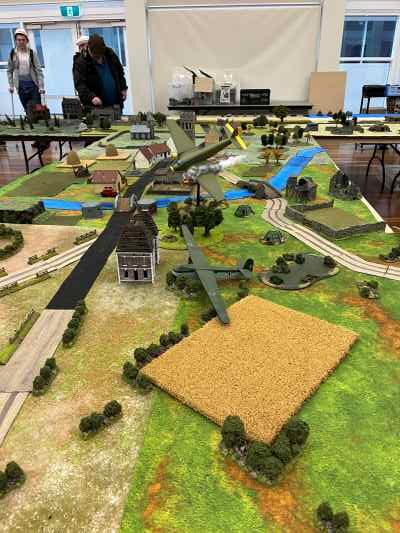
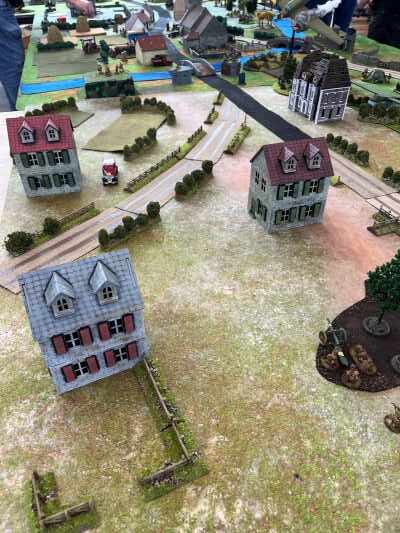
Firstly, the battlefield itself was a spectacle. A sprawling 12ft x 12ft table, arranged in an H-shape to allow players access, was packed with beautifully painted terrain. The board depicted a slice of rural England, complete with coastline, villages, rivers, bridges, roads, fields and woodland. Telephone boxes, signposts and even a suspicious-looking TARDIS added to the atmosphere. Every piece had been provided by the players, creating a stunning setting for the battle to unfold. I even managed to get my houses, hedges and fences to depict a corner of sunny England (soon to be occupied by a battery of French howitzers.
Game Set Up
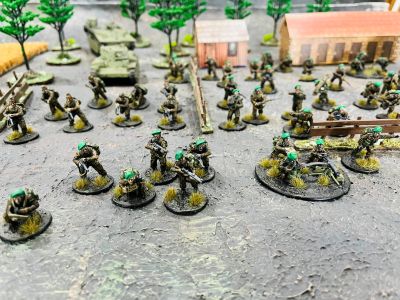
For the game, I dusted off my British Royal Marine Commandos to help defend our green and pleasant land. My force included a couple of mobile assault squads led by the legendary Gus March-Phillipps (depicted by Henry Caville in the recent film Ministry of Ungentlemanly Warfare), supported by additional commando sections and a command unit complete with a piper to keep morale high. If you’re going to defend Britain, you may as well do it in style.
The Allied team was ably commanded by our authentic cap-wearing Commander Jono and consisted of an eclectic mix of British Expeditionary Force troops, French forces, Home Guard and of course my commandos. We had plenty of artillery, lots of early-war infantry and precious little armour. We also had a cricket team, ready to knock Jerry for six, literally.
What made the scenario particularly interesting/confusing was that both the Allied and Axis teams were issued secret objectives. Nobody knew exactly what the other players were trying to achieve. Certain locations, landmarks and VIPs carried hidden importance, meaning that every move and every deployment could be part of a larger plan.
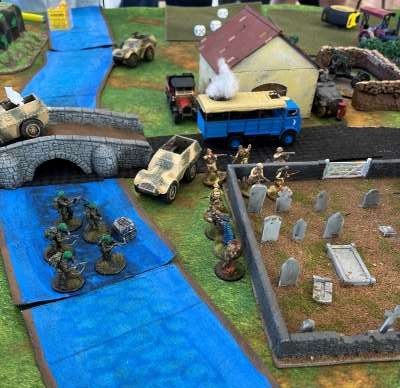
The Allies deployed first, spreading our forces across the battlefield. My Commandos took up position near a river and road network, ready to act as a rapid-response force. With rumours of German paratroopers and glider-borne troops potentially appearing anywhere, flexibility seemed the wisest course of action.
Then the first order dice was drawn and the madness began.
One Massive Bolt Action Battle
Objectives included bunkers, churches, schools, stately homes and a bewildering assortment of VIPs. Winston Churchill appeared in multiple locations, very much channeling the Eagle has Landed. The King was present. Thomas Shelby of Peaky Blinders fame was somehow involved. There was so much happening that I spent the first couple of activations feeling completely overwhelmed. My Commandos sat on ambush, waiting for the inevitable airborne assault while I tried to make sense of events unfolding around me.
Eventually I settled into the game, only to discover that understanding the situation was apparently against the scenario rules.
New factions kept appearing with their own agendas. American forces arrived and immediately started shooting at my troops. An Allied partisan force suddenly revealed itself as German paratroopers straight out of The Eagle Has Landed and made off with Churchill from under my nose. Hidden German troops concealed inside a stately home opened fire, devastating nearby Allied units and wiping out a section of my brave commandos.
Outrageously, the King himself was captured by the Italians. My Commandos rushed to the rescue, driving off his captors and preventing his abduction. It was a suitably heroic moment. Unfortunately, before we I could celebrate, IRA partisans emerged from nowhere and gunned him down. So much for that plan.
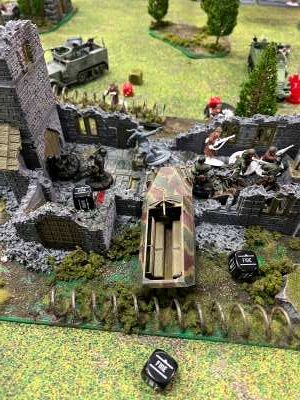
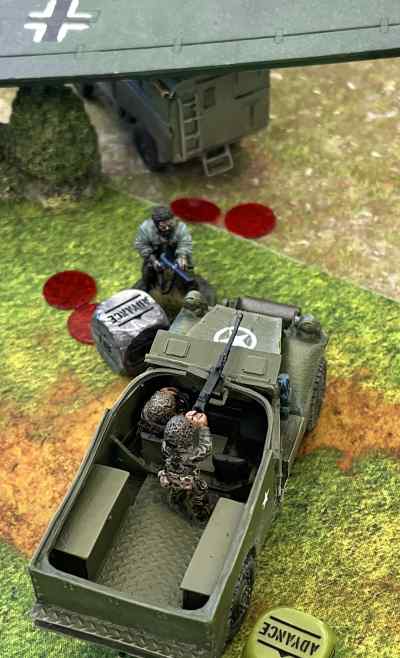
Elsewhere, Gus March-Phillipps and his assault team launched a daring attack against an American half-track, nearly destroying it before being cut down by supporting fire. It was a fittingly bold end for the Commandos, who spent much of the game charging towards trouble wherever it appeared.
The Bigger Picture
The remarkable thing was that all of the above happened within my relatively small section of the battlefield.
To my right, German forces were attempting a major beach assault. To my left, gliders and paratroopers were descending into Allied lines. Across the table, allegiance flexible partisan forces and the Americans were pursuing their own mysterious objectives. During the game I had almost no idea what was happening beyond my immediate area of operations. It was only afterwards, when players compared stories, that the full scale of the chaos became apparent.
By the end of the day, the results were dramatic. The King was dead. His brother Edward had been captured by the Americans, only to be blown up by the French. The Germans had been held on the beaches but had achieved enough of their secret objectives elsewhere to secure a convincing Axis victory.
For my part, I was betrayed by supposed allies on three separate occasions. And I loved every minute of it.
Emergent Story
If you’ve been following this blog for a while you’ll know that I love the concept of emergent play. This game really embraced the concept and ratcheted it up to 11. As mentioned above, secret objectives, multiple factions and of course the huge number of players meant that lots of stories unfolded on the table. I don’t believe that the organisers Jackson and John, quite knew how things were going to land. The stories evolved on their own. The battle for the King, dogfights overhead, desperate clashes on the beach. It felt like a hundred cinematic stories played out over the course of the day.
Final Thoughts on Massive Bolt Action
The Commandos acquitted themselves well, even if they ultimately failed to save the King. More importantly, every player embraced the spirit of the event. Nobody took things too seriously, everyone leaned into the narrative, and the result was a game full of memorable stories that will be talked about long after the final dice were packed away.
I’ve played a lot of wargames over the years, but I’ve never experienced anything quite like this. Though it did remind me of some of my multiplayer Space Weirdos games, albeit at a much grander scale. It felt less like a traditional tabletop battle and more like being dropped into an alternate-history war movie where nobody had been given the full script.
A huge thanks to the two organisers, Jackson and John, an amazing effort that resulted in a very fun and chaotic day!
Apparently next year’s big game is set to be Operation Crusader.
I’d better start shopping for some desert tanks.