My First Bolt Action Tournament

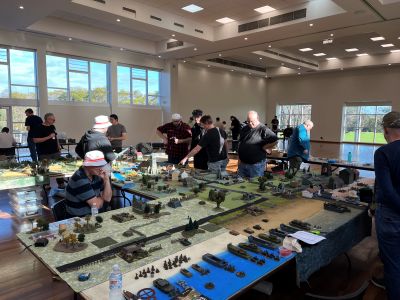
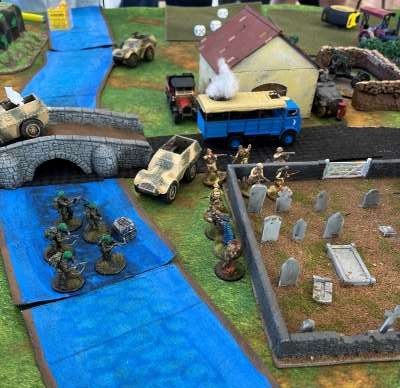
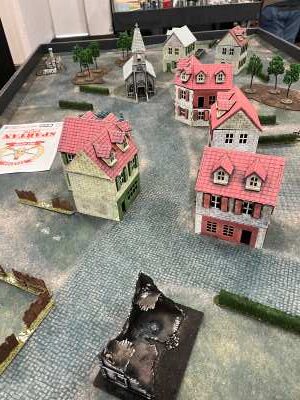
Bolt Action game in progress

I’ve recently got into Bolt Action a WW2 wargame and am absolutely loving it. Before too long I found out that one of the local Perth clubs, Outpost 6030, was hosting Bolt Action at it’s Skulls 2026 tournament in March. I’ve never been particularly competitive gamer, rather enjoying the stories at the table than the results. However, playing four games in a day and getting to meet the wider community was too good a chance to pass up.

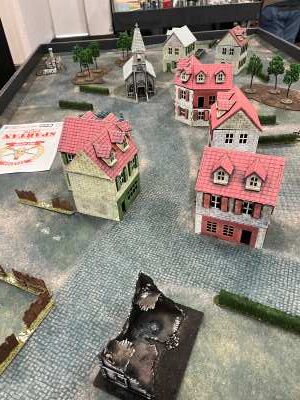
There is something nerve-wracking about your first tournament. You spend weeks painting models, tweaking lists, reading scenarios and imagining strategies. Then suddenly it is 0730 on a Sunday, you are standing in a hall full of strangers, ten beautifully laid out tables, 17 competitors, and your carefully assembled 1100 point force is waiting to march onto the battlefield.

I took a British Royal Marine Commando army with 12 order dice (not very many order dice as it turned out). I had spent plenty of time thinking about my list beforehand and honed it over a few practice games with Jake and Richard (thanks guys!). The event itself was run brilliantly by Dan. He kept everything moving smoothly, while maintaining a sunny disposition throughout. Four games between 0800 and 1700 is a proper marathon, but the day rattled along at a surprisingly fast pace.

Dan patrolled the tables answering rules queries and making sure we knew how much time we had left for each game. He also seemed to just love the atmosphere and getting into the hard fought games at each table. Every time he told me the time, I think a look of panic would cross my face. No poker faces in my side of the table.

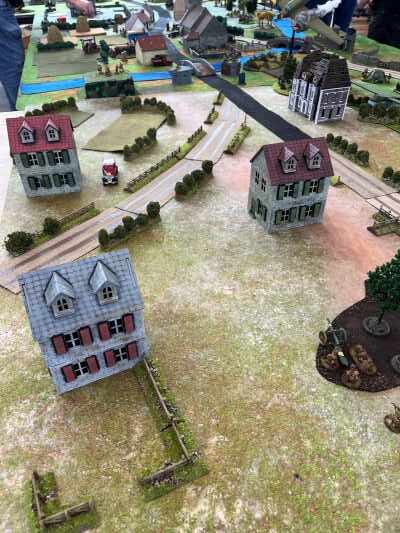
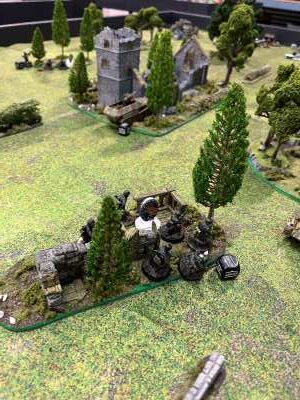
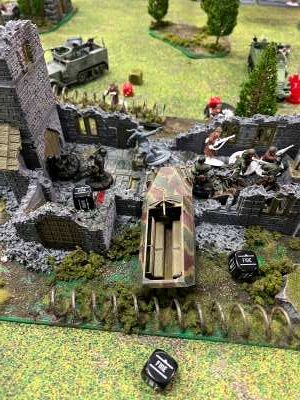
My commandos sneaking up to an objective

Game one was against Marco and his Japanese army. This was my first real lesson of the day. I played far too cautiously, sitting back and trying to preserve units instead of throwing myself into the objectives. The result was that the end score was very one sided. Marco wiped the floor with me. These games were moving fast, and with four games packed into one day you had to get yourself into a winning position within three turns or simply run out of time.

After that first match I realised I needed to change my approach. From that point on I became much more aggressive and mobile with my commandos.

Game two was against Mark and his American force. The scenario involved hunting an informant and I felt much sharper in this game. I had a clear plan, moved more decisively and generally played far more tactically than I had in game one. The strategy itself was sound, but the dice gods decided to laugh in my face. My reserves stubbornly refused to arrive and secure the left flank, which allowed Mark to roll up that side of the table and march away with the informant and a convincing win. A fun game, though and I really felt on the edge of my seat the whole way through.

Lunch was a classic sausage sizzle and a quick chat, talking tactics and straight back into it.

Game three was against Martin and, yes, another Japanese army. By this point I was starting to wonder if every Japanese player in the state had decided to attend. This scenario focused on destroying objectives rather than simply shooting each other. It created a very different sort of game because instead of trading fire across the table, both of us were racing to damage key targets.

Martin had a very rough run of luck with his dice, while my army stuck to my plan nicely. My commandos moved quickly, focused on the objectives and managed to take out most of them. At last, my first tournament win. It may not have been the most heroic battle of the day, but it felt great to get one on the board.

The final game was against Dave and, somehow, yet another Japanese force. The scenario focused on eliminating a specific unit. I made a few mistakes early, lost momentum and Dave completely outplayed me. I couldn’t get anywhere near his unit while his airstrike and mortars battered my army from turn one.

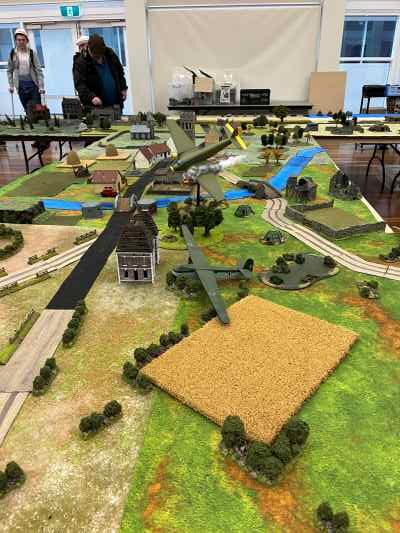
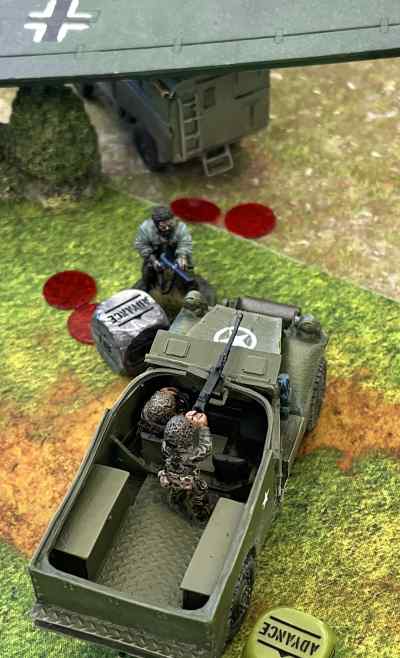
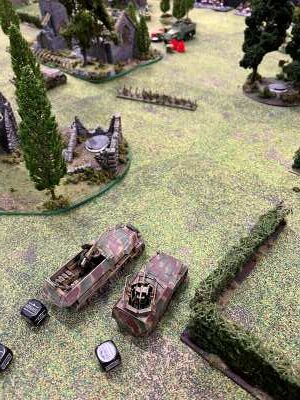
My brave commandos being strafed by an enemy fighter

One thing that really helped me through the day was preparation. Before the tournament I had printed out the scenario pack and written a rough strategy for each mission. That turned out to be incredibly useful. Instead of staring blankly at the table trying to invent a plan on the spot, I already had a basic framework in mind. It freed up brain space for reacting to what my opponent was doing and kept me focused on the scenario.

Perhaps the biggest takeaway from the day was not the result, but the people. Every opponent I played was an absolute gentleman. Everyone played fairly, kept things friendly and had a good laugh along the way. I also had some great conversations with the other players between rounds. The WA Bolt Action community felt very welcoming, which makes a huge difference when you are walking nervously into your first event.

At the end of the day there was a prize giving. I think I finished 11th out of 17, which I was pretty happy with for a first event. I also won some extra order dice and an exclusive Gus March-Phillipps model, which felt like a proper little treasure chest at the end of the day.

Most importantly, I came away with four fun games, a better understanding of how tournament Bolt Action works and a few offers for future games. Not a bad haul for one Sunday. One thing’s for certain, I’ll be signing up for the next one as soon as I can.

I Don’t Like Phones: Why I Ditched Them from D&D

phone on fire

I don’t like phones at the game table.

There. I’ve said it. Phones are a distraction, they fracture attention, and they undermine the very thing that, to my mind, makes tabletop roleplaying special: a group of people actively engaging with each other.

Dungeons & Dragons is not a single player experience with occasional multiplayer cutscenes. It is a shared act of imagination, built moment by moment through conversation, reactions, and collective focus. Phones pull at all three.

Attention Is the Real Resource

Every D&D table runs on attention. When everyone is present, listening, and responding, the game hums. Scenes flow. Jokes land. Tension builds. When phones come out, that attention leaks away.

A quick glance becomes a scroll. A scroll becomes checking messages. Suddenly someone needs the last thirty seconds repeated, or misses a crucial choice, or reacts half a beat too late. Multiply that by a few players and the game starts to feel sluggish, disjointed, and oddly flat.

It Feels Like Disengagement Because It Is

One of the hardest parts of running a game is reading the table. Are players interested? Confused? Excited? Bored? Phones muddy those signals. When a player is staring at a screen while someone else is roleplaying a heartfelt moment, it sends a message whether they intend it or not.

That message is: this isn’t worth my full attention.

Even if the player insists they are listening, the social signal remains. It affects the confidence of quieter players. It undercuts dramatic moments. Collaboration feels lopsided, like some people are rowing while others are checking notifications.

D&D is a conversation. Looking at your phone while someone is speaking in a normal conversation would be rude. The table should be no different.

Immersion Is Fragile

Roleplaying lives in a delicate space. One moment you’re a desperate adventurer descending into the darkened chasm with nothing but a sword and your trusty companions. The next moment a buzzing phone reminds you about tomorrow’s meeting or a meme you saw earlier. The spell breaks instantly.

Once immersion cracks, it takes effort to rebuild. Phones make that crack wider and more frequent. They anchor players back in the real world when the whole point of gathering is to step somewhere else together for a few hours.

This Is About Respect, Not Control

Banning phones is not about authority or nostalgia or pretending it’s 1985. It’s about respecting the time and effort everyone brings to the table.

The DM prepares.
Players show up.
Stories are built together.

Asking for phones to stay off the table is a way of saying: this time matters. These people matter. What we are creating together deserves our attention.

Presence Is the Point

At its best, D&D is rare in modern life. A group of people, in the same room, focused on each other, telling a story in real time. That kind of presence is increasingly hard to find and incredibly valuable.

So yes, I don’t like phones at the D&D table. Not because I hate technology, but because I love what happens when everyone is truly there.

Not having fun at the D&D Table? No Worries

halfling not having fun with D&D

Dungeons & Dragons is built on fun—shared fun, collective fun, the kind of fun that turns into stories retold for years. But even the best table can have off nights. And sometimes, it goes deeper than that. Maybe the party dynamics have shifted, the story isn’t grabbing you, or perhaps you’re feeling sidelined. Maybe you’ve just had a rough week and the excitement isn’t sparking the way it normally does.

Here’s the thing: it’s okay not to be having fun. It happens to every player sooner or later. What matters is how you navigate that feeling—because D&D, at its heart, is a collaborative space, and collaboration thrives on communication.

Below are some practical steps to take if you find yourself staring at your character sheet thinking, “Why isn’t this working for me anymore?”

Take a Moment to Reflect on What’s Off

Before jumping into action, pause and ask yourself a few gentle questions:

  • Am I tired, stressed, or distracted from real life?
  • Is it the session that’s not fun, or the campaign as a whole?
  • Do I feel included and heard at the table?
  • Is my character still interesting to play?
  • Has the tone of the campaign drifted away from what I enjoy?

Sometimes the source is external—work pressure, family situations, burnout. Sometimes it’s internal to the game. Knowing which is which helps you decide your next step.

Talk to Your Dungeon Master (Honestly and Kindly)

A good DM isn’t just a storyteller—they’re a facilitator of fun. If something is missing for you, they genuinely want to know.

You don’t need to deliver a full critique; something simple works perfectly:

  • “Hey, I’m feeling a little left out recently. Can we find a way for my character to be more involved?”
  • “I think I’m not connecting with the story arc—could we explore something tied to my background?”
  • “I’m finding the tone more serious/silly than I expected. Any chance we can adjust the dial a bit?”

Most DMs will respond with enthusiasm and relief. But, they can’t fix what they don’t know.

Check In With the Group

Sometimes the issue isn’t DM-related at all—it’s table culture, pacing, or energy. You might notice:

  • A couple of players dominating the spotlight
  • Constant interruptions or side conversations
  • Clashing play styles (tactical vs. narrative, silly vs. serious, etc.)
  • The group drifting into habits that don’t work for you

A quick group conversation—maybe at the end of a session—can reset expectations and reaffirm what everyone enjoys. This is the tabletop version of team alignment in the workplace: shared goals, shared norms, shared fun.

Change Up Your Character

If the game itself is great but your character isn’t clicking anymore, don’t be afraid to pivot. You can:

  • Re-spec or rebuild your character
  • Introduce a new character entirely
  • Ask for a story moment that reinvigorates your current one (a rival, a revelation, a magic item, a moral dilemma)

Sometimes a fresh perspective is all it takes. D&D is a playground—go play.

Consider Taking a Short Break

It’s 100% valid to step back temporarily.

If you’re overwhelmed or burnt out, you might just need a pause. This doesn’t mean quitting; it just means recognising your limits. D&D, like any hobby, should feel energising more often than it feels draining.

Talk to your group and work out a graceful in-story reason your character disappears briefly. You’ll likely return refreshed and excited.

If It Really Isn’t Working… It’s Okay to Step Away

This is the hardest option, but sometimes it’s the right one.

Not every table is the right table for every player. If the tone, style, or personalities don’t mesh with what you need, you’re allowed to bow out—kindly, respectfully, and without guilt.

Leaving a game doesn’t mean you’ve failed. In fact, it means you’re choosing joy and respecting both your own time and the group’s.

Remember Why You Play

At its core, D&D is about:

  • Collaboration
  • Creativity
  • Connection
  • Escapism
  • Shared stories

If you’re missing any of these, it’s worth taking steps to find them again. Your fun matters. Your presence at the table matters. And you deserve a gaming experience that lifts you up.

Whether it’s a small tweak, a conversation, a character change, or a new table entirely—there is always a path back to joy.

Remember that the aim of D&D isn’t just to play. It’s to play together. And sometimes, playing together means speaking up so everyone—including you—can have the fun we’re all here for.