Bad Behaviour at the Table? Sort it out

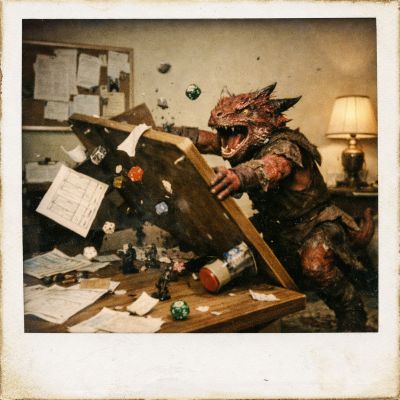
Kobold flipping gaming table in a rage

At some point in every long running campaign, bad behaviour at the table happens. A player goes rogue. Not in the charming backstab-the-dragon way. But in the rules-lawyering, spotlight-hogging, eye-rolling, group-fracturing way. The table energy shifts. Shared fun begins to ebb.

If you run games long enough, you will face this moment. If you lead people long enough, you will too.

The parallels between managing bad behaviour at a roleplaying table and leading a team in the workplace are surprisingly tight. Both require the courage to act before the whole party wipes. Here are three stages to handle it, whether you are behind the DM screen or at the head of a meeting table.

Stage One: The Quiet Word by the Campfire

In the Dungeons & Dragons Player’s Handbook, there is an implicit social contract. The game assumes cooperation. It assumes you are not actively trying to ruin the experience for others. When a player starts derailing sessions, dominating decisions, or treating fellow players like NPCs, your first move cannot be a thunderbolt from the heavens.

It is a quiet conversation. Private. Calm. Specific.

  • “Hey, I’ve noticed you’re interrupting others a lot during planning scenes.” This is preventing them from getting involved.
  • “I’ve seen some frustration when rulings don’t go your way.” This slows down play and creates a bit of a weird atmosphere with myself and the other players.

This is not an accusation. It is feedback. You are describing behaviour and explaining impact.

At the gaming table, most problems live in the land of misunderstanding. Someone may not realise they are hogging spotlight. Someone may think the aggressive banter is funny when others find it draining.

The same is true in the workplace. As a leader, stage one is informal and early. You do not wait for the team to fracture. You address behaviour before it calcifies into culture. Make your expectations clear. The impact must be understood and the request for change cannot be ambiguous.

Most people, when treated like adults, respond like adults.

Stage Two: The Formal Warning Scroll

If behaviour continues after the informal chat , you have to escalate. At the table, this might mean a more direct conversation.

  • “We spoke about this last month. It’s still happening. If it continues, you may not be able to stay in this campaign.”

Now the stakes are visible.

In a group where you are all friends this can be a difficult conversation to navigate. But it doesn’t have to be confrontational. Reiterate the way the group likes to play and that the problem players style is different and not gelling.

In leadership, this is where structure matters. Documentation. Formal performance conversations. Clear consequences. Alignment with policy. Compliance with employment law. You are no longer just nudging behaviour. You are protecting the team.

In both spaces, the key elements are:

  • Clear examples of behaviour
  • Clear expectations going forward
  • Clear consequences if change does not occur
  • A genuine opportunity to improve

You cant escape the fact that this stage is uncomfortable. It requires backbone. Leaders often avoid it because they fear conflict. But avoidance is not kindness. It is deferred damage. Every time you fail to address ongoing bad behaviour, you send a signal to the rest of the group that this behaviour is is acceptable.

And that signal causes more damage than you would imagine.

Stage Three: Removing the Player from the Table

Sometimes, despite every effort, the behaviour does not change. At a gaming table, the final step is simple in principle, but very difficult in practice:

You ask them to leave the campaign. You do not do it lightly. Keep emotion out of it. Do it because the health of the group matters more than the comfort of one individual. Ultimately, it is a leadership decision.

In the workplace, this stage becomes formal performance management that may result in termination. This must comply with employment law, company policy, and procedural fairness. There must be evidence, the employee must have an opportunity to respond. There must be consistency.

But the principle remains the same. A team cannot thrive if one person consistently erodes trust, morale, or performance.

Letting someone go is not failure if you have:

  • Communicated clearly
  • Provided support
  • Given reasonable opportunity to change
  • Acted fairly and consistently

Sometimes the most responsible act of leadership is protecting the many.

The Deeper Lesson

Whether you are running a dungeon or running a department, leadership is not about avoiding conflict. It is about stewarding the experience. In a roleplaying game, you are safeguarding fun, safety, and shared storytelling. While in the workplace, you are safeguarding culture, productivity, and psychological safety.

Both require:

  • Early intervention
  • Honest conversations
  • Escalation when necessary
  • Courage to act

Ignore bad behaviour at the table long enough and it becomes the campaign setting. Unchecked and your game will stop being fun, players will leave and it will eventually implode. Ultimately, following the adage that no D&D is better than bad D&D.

Address the behaviour with clarity and fairness, and you show your players that they are important and that the game matters.

Quick Note: checking bad behaviour at the table doesn’t have to rest on the shoulders of the DM. Rather it can be dealt with by any player. Remember, having fun is a shared responsibility.


Leadership Is a Muscle—And You Need to Train It

business man training his leadership muscle

We all know the value of exercise. You go to the gym to lift weights, run on the treadmill, or maybe stretch through a yoga class. Each of these activities targets different aspects of your physical health: strength, stamina, flexibility. If you don’t exercise those muscles, they weaken over time. Of course, Leadership is no different. Being an effective leader isn’t a fixed trait—it’s a skillset. And like your biceps or your lungs, those skills need intentional training to stay sharp and healthy. You can’t expect to be at your best if you never put them under purposeful stress. How do we train our leadership muscle?

Training Your Leadership Muscle at Work

In the workplace, this means being deliberate. You can:

  • Practice communication: Share openly, listen actively, and make sure your team understands not just what you’re saying, but why.
  • Build self-awareness: Take time to reflect on how you show up for your team, what went well, and where you can improve.
  • Be purposeful: Don’t just drift from meeting to meeting—set clear intentions about how you want to show up as a leader that day.

These small acts, repeated, strengthen your “leadership core.”

Another Gym for Leaders

Here’s where it gets interesting. You don’t have to limit leadership practice to the office. Just as athletes cross-train with different sports, leaders can cross-train with games.

Given the theme of this blog we’ll take Dungeons & Dragons as an example. At first glance, it’s a fantasy roleplaying game filled with dice, dragons, and dungeons. But beneath the surface, it’s an intricate leadership laboratory.

  • As a Dungeon Master, you’re practicing facilitation, storytelling, and group management—all while balancing competing needs and personalities.
  • As a player, you’re practicing collaboration, decision-making under uncertainty, and influencing a group without dominating it.

What’s fascinating is that, as science writer Jennifer Ouellette explains in Me, Myself and Why, our brains treat these imagined experiences as real. When you roleplay leading a group through a perilous dungeon, your memory encodes it as though you actually led people through challenges. That means the leadership muscles you work in a game session can directly strengthen the ones you’ll use in Monday’s staff meeting.

Games can be a useful gym in which to train your leadership muscle.

Purposeful Play as Practice

Think of it this way:

  • A high-stakes project deadline is like a boss battle.
  • Negotiating with a client isn’t all that different from convincing a suspicious NPC to help your party.
  • Balancing diverse team needs mirrors balancing a party of adventurers with wildly different skills and motivations.

If you approach these game scenarios with intentionality—practicing clear communication, reflection, and purposeful decision-making—you’re training your leadership muscles in a safe but meaningful environment.

Keep Your Leadership Strong

Just like the gym, leadership training isn’t a one-and-done activity. You need to keep working at it. At work, in life, and yes—even in play.

So next time you roll dice at the table, don’t think of it as just a game. Think of it as a workout for your leadership. The more you train, the stronger you get.

How Dungeons & Dragons Can Make Me Better at My Job

At first glance, Dungeons & Dragons (D&D) may seem like just a game about fighting dragons, looting treasure, and telling fantastical stories. But can Dungeons & Dragons make me better at my job? Beyond the dice rolls and dungeons lies a useful toolkit for personal and professional growth. If you follow this blog you know I’m a massive proponent of the skills that playing D&D hones. Most of which are critical in the modern workplace, from communication and leadership to problem-solving and emotional intelligence.

If you’re looking to level up at work, here’s how sitting down for a session of D&D can make you a better employee, leader, and teammate.

Improved Communication Skills

In D&D, players must work together to succeed. Whether you’re convincing the rest of your party to take a risky path or role-playing a persuasive negotiation with a merchant, communication is key.

The Job Connection:

  • Clear Articulation: Explaining complex ideas, like a strategy to defeat an ogre or a proposal for a new work initiative, requires clarity and confidence.
  • Active Listening: Success in D&D depends on paying attention to what others say—an essential skill for effective collaboration.
  • Empathy in Messaging: Playing characters with diverse backgrounds helps you learn to tailor your words to different audiences.

Imagine how these skills could translate to leading a team meeting, pitching a new idea, or resolving workplace misunderstandings.

Teamwork and Collaboration

D&D is not a solo game. Success depends on a group of individuals working together, each bringing their unique skills to the table. A rogue may sneak past traps, a wizard might solve an arcane puzzle, and a fighter can hold the line in battle.

The Job Connection:

  • Leveraging Strengths: Just like a party in D&D, workplace teams thrive when individuals understand and utilize their unique talents.
  • Cooperation Under Pressure: Whether it’s a battle against a dragon or a tight project deadline, D&D teaches you how to stay composed and work together during high-stress situations.
  • Building Trust: When you rely on your teammates to save you from a goblin ambush, you learn to trust them—an invaluable skill in any job.

In short, D&D reinforces the importance of working as a team to achieve shared goals.

Dungeons & Dragons Can Make Me Better at My Job!

Creative Problem-Solving

D&D is a game of choices, and there’s rarely one “right” answer. Players constantly face unique challenges, from deciphering cryptic prophecies to outsmarting enemy generals. Success often requires creative thinking.

The Job Connection:

  • Innovation: Brainstorming solutions to complex in-game problems hones your ability to generate innovative ideas at work.
  • Flexibility: When your first plan fails (and it will), D&D teaches you to adapt and pivot, a skill highly valued in dynamic work environments.
  • Decision-Making: The consequences of in-game choices train you to analyze options and make informed decisions under pressure.

If you’ve ever convinced a dragon to become your ally instead of your enemy, you know how valuable creative thinking can be.

Leadership Development

Playing D&D often involves taking on leadership roles, whether as the Dungeon Master (DM) guiding the story or as a player rallying the party. Leadership in D&D mirrors leadership in the workplace: it’s about empowering others, making decisions, and staying composed under pressure.

The Job Connection:

  • Inspiring Others: A great leader can motivate their team, much like a paladin inspires their party to keep fighting.
  • Strategic Thinking: Planning a daring heist or defending a fortress requires the same long-term thinking that leaders use to guide projects.
  • Delegation: D&D teaches you to rely on your team—after all, you can’t cast every spell or swing every sword.

If you want to sharpen your leadership skills, few activities are as effective as stepping into the role of DM.

Emotional Intelligence and Resilience

D&D creates a safe space to explore emotions and practice resilience. Losing a beloved character or failing a critical quest can be tough, but these experiences teach you how to process setbacks and bounce back.

The Job Connection:

  • Resilience: Facing challenges in D&D helps you build the grit to handle workplace obstacles with confidence.
  • Empathy: Role-playing as different characters fosters a deeper understanding of others’ perspectives, enhancing interpersonal relationships.
  • Conflict Resolution: Managing in-game disputes translates to resolving real-world workplace conflicts with tact and diplomacy.

The emotional intelligence you gain from D&D can make you a more thoughtful and adaptable colleague.

Time Management and Organization

D&D requires players to manage their resources (like spell slots and gold), plan their actions, and track multiple storylines. These skills are directly transferable to the workplace.

The Job Connection:

  • Prioritization: Deciding whether to use your last healing potion now or save it for later mirrors how you allocate time and resources at work.
  • Project Management: Keeping track of quests, maps, and NPCs teaches you how to stay organized and on top of multiple tasks.
  • Deadlines: Scheduling regular game sessions with a busy group of people is great practice for managing competing schedules.

Mastering these skills can make you more efficient and reliable at work.

Dungeons & Dragons Can Make Me Better at My Job!

As you may have guessed by now, I believe that Dungeons & Dragons isn’t just a game—it’s a training ground for professional success. By playing the game you’re actually enhancing your communication, teamwork, creativity, leadership, emotional intelligence, and organizational skills. Without even realizing it, D&D prepares you to tackle workplace challenges with confidence.

So, the next time someone raises an eyebrow at your dice bag or asks why you spend hours playing a “nerdy” game, tell them you’re investing in your career. Who knows? Maybe they’ll join your party and level up their professional game too.