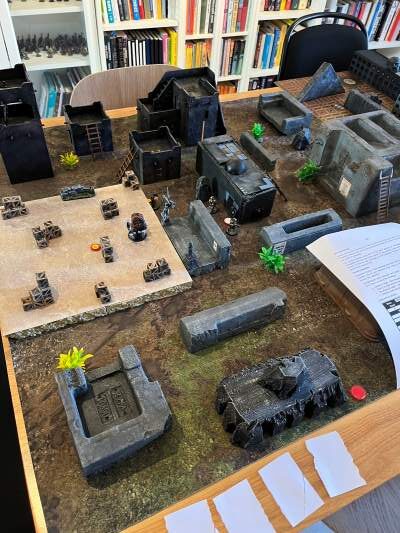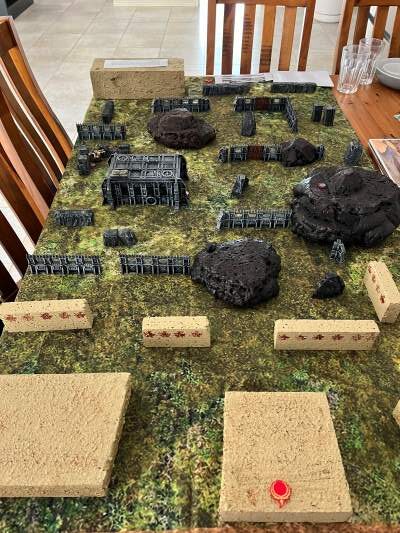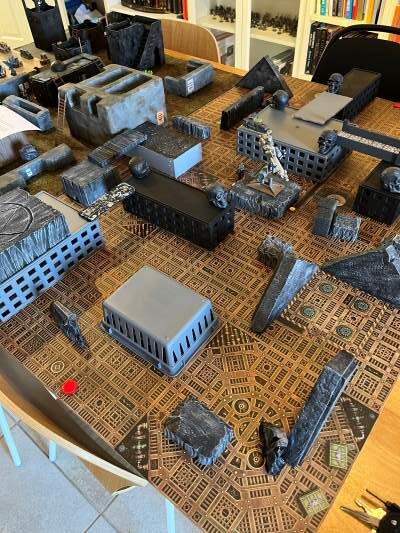
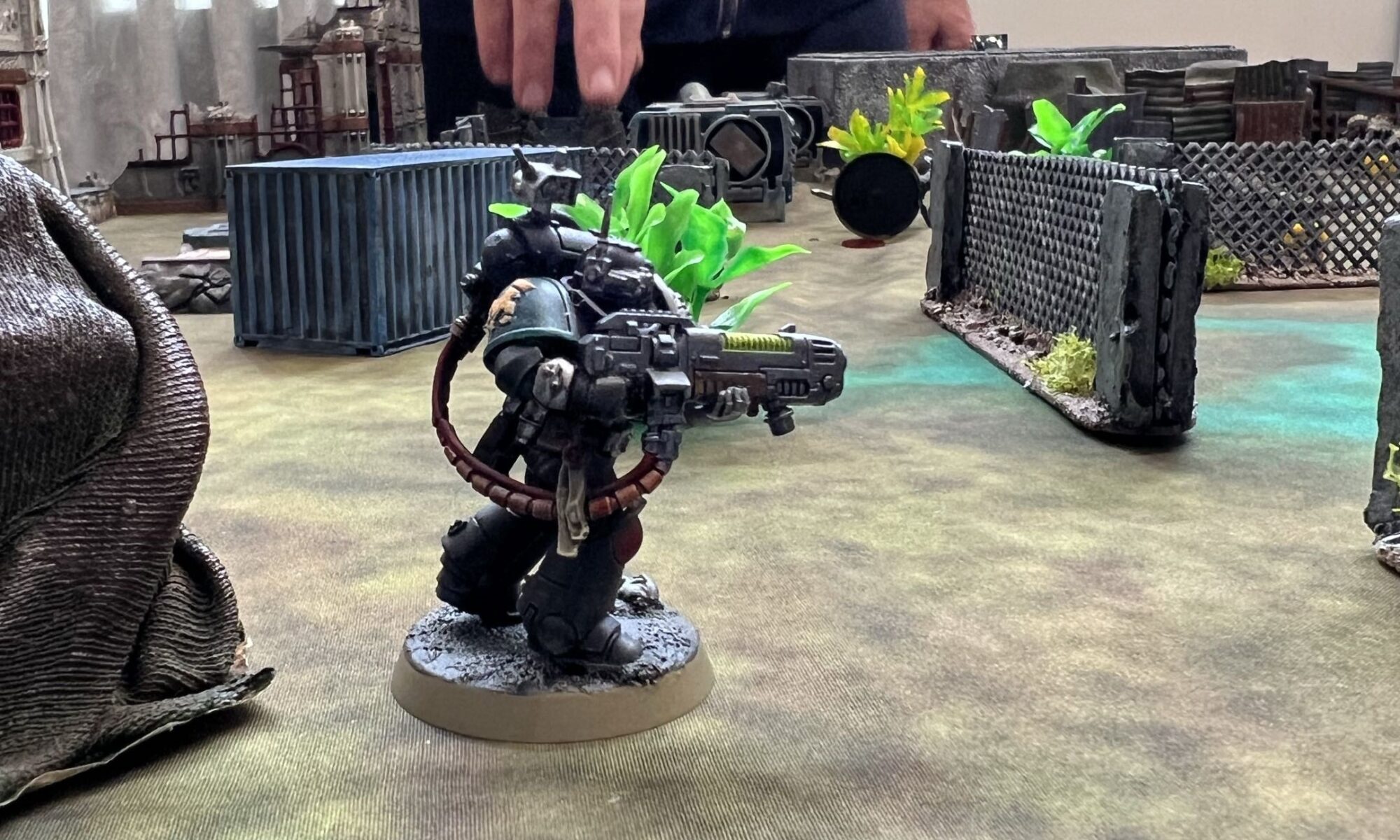
MartyCon was just around the corner and I had promised to run a multiplayer Space Weirdos game. I wanted to double down on the 40K style Inquisitor games, where alliances were uncertain and every protagonist had their own agenda. I love the 40K universe and all the infighting portrayed in their fiction and I’ve played with this concept before. So I really went for it this time. Here is what I came up with.
The Premise: Everyone Has a Plan. None of Them Align.
The scenario uses the gloriously lean and kinetic ruleset of Space Weirdos. This meant that the game would be fast and brutal. Every player had their own secret primary and secondary objectives, all interlocking and clashing. I had planned for chaos.
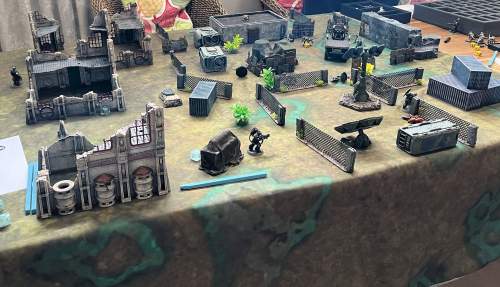
The setting: The Virellion (Imperial Governors) estate
The cast: 9+ players. Each player controls:
1 Character
1 Sidekick
2 Secret Objectives
This means that everyone’s go will be quick, keeping downtime for non active players to a minimum.
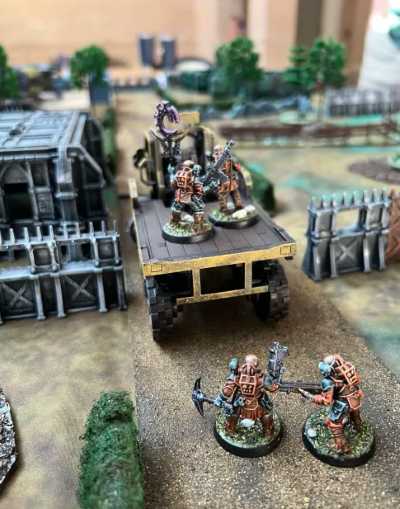
Cult of the Star Filled Maw rams the gates
Some of the Factions & Objectives
The Governor Objective: Escape the palace alive with your priceless artefact.
Security Chief Objective: Keep the Governor and his daughter alive at all costs.
Cultist Leader Objective: Kill the Governor.
Governor’s Daughter Objective: Usurp (kill) the Governor.
Rogue Trader Objective: Steal the Necron artefact, protect the Governors daughter.
Rebel Lieutenant Objective: Free the imprisoned genestealer.
Inquisitor Objective: Defend the genestealer (for future experiments) and kill all cultists.
Mad Priest Objective: Kill the Inquisitor.
While there may be obvious teams to start with. These are just temporary and everyone know betrayal is just around the corner, only they don’t know which one.
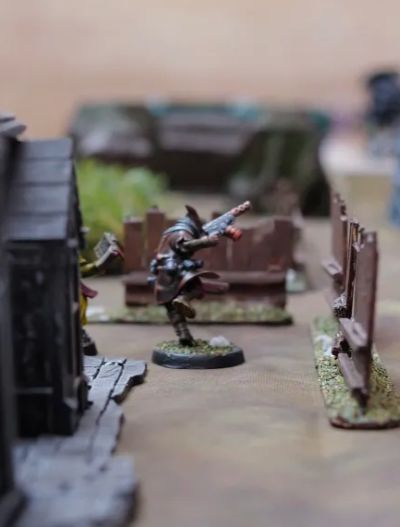
The Mad Priest dashing from the cemetery. “Ill kill that Inquisitor if it’s the last thing I do”
Design for Collision, Not Balance
I’ve experienced multiplayer games where players spend too long maneuvering politely around each other. I wanted the action to begin right from the word go. So I needed to force proximity.
The objectives would create tension, but placing the teams fairly close would make sure that the action started quickly.
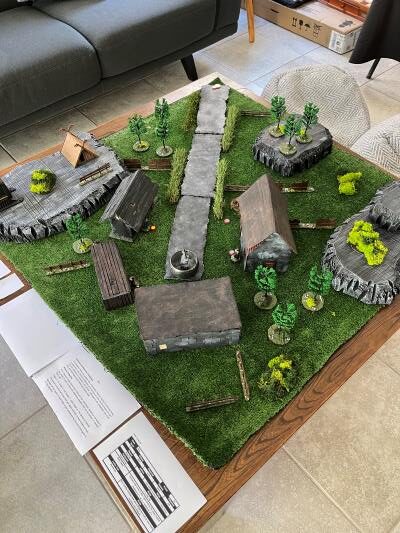
In hindsight this worked well, though the main road in the center of the board did create a bit of a firing lane. In addition I think removing 6″ from the width of the board would have help create even more carnage.
Virellion Estate: peaceful and quiet…. Not for long.
How Did it Play?
All in all we had a blast. I GM’d the game and kept everything moving. I introduced paper and pens so players could send each other secret notes. These added lots of fun for those players waiting for their turns, as well as adding another layer to the uncertainty and chaos.
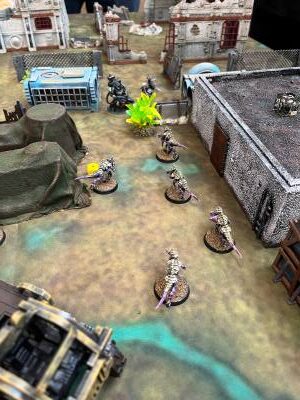
Shots were fired and one Genestealer cultist got killed in turn one. The Genestealers took a beating and couldn’t get anywhere near their objectives. The Rogue Trader tried to defend the Governors only to get shot for his troubles. The Inquisitor and Mad Priest had a standoff while the Governor was assassinated by his own offspring. Joint winners were the Security Team and the Governors Daughter.
The game only ran for a couple of hours before the winners were declared and we moved on to the next game of the day.
Overall it did run well. However, I think I would tweak the objectives a little to make it a bit more of a maelstrom.
There’s something timeless about small squads of soldiers through a larger conflict — tense, personal, and filled with moments of heroism and chaos. That’s what makes shows like Band of Brothersand SAS: Rogue Heroesso compelling. These are exactly the kind of stories that Warhammer 40K: Kill Team excels at telling.
In Kill Team, every operative matters. You’re not moving faceless troops around a battlefield — you’re guiding a handful of specialists, each with their own role, personality, and fate. Which makes it the perfect sandbox to reimagine iconic World War II small unit missions with a sci-fi twist.
Let’s look at how you can take inspiration from Band of Brothers and SAS: Rogue Heroes and turn those classic moments of grit and brotherhood into thrilling tabletop missions.
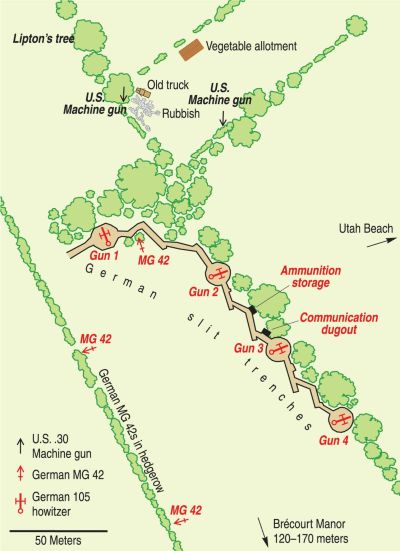
Kill Team Mission Hook: Your squad must disable a chain of heavy weapon emplacements. Each emplacement requires a different skill test or demolition action to destroy.
Objective: Destroy all three artillery emplacements before the end of the battle.
Faction Fit:
Attacker: Veteran Guardsmen, Intercessors, or Pathfinders.
Defender: Traitor Guard, Heretic Astartes, or Necrons.
It’s a mission that rewards smart use of cover, movement, and individual heroics — exactly what Kill Team is built for.
One thing I like about this mission is that you can set up the terrain to reflect the real engagement. Do away with the balanced terrain set ups suggested in the rulebook and give this a go. You don’t have to go with Normandy bocage either, why not set up your more grim dark terrain in a similar configuration.
If you’re worried about balance, why not play the game twice. Switching attacker defender roles each time will a fun experience.
Why not set up your battlefield to reflect the real engagement?
2. Desert Airfield Ambush (SAS: Rogue Heroes)
Theme: Guerilla warfare and improvisation. The Scene: The SAS (episode 6) raids enemy airfields deep in the desert, using speed and shock tactics to devastating effect.
Kill Team Mission Hook: One team is guarding a space port with specific objectives (spaceship, fuel depot, pilots building), while the other launches a hit-and-run ambush.
Objective: The defender must prevent the attacker from destroying 2/3 of the objectives.
Special Rules: Limited visibility due to sandstorm reducing ranged fire; fuel dump and spaceship can explode spectacularly.
Faction Fit:
Attacker: Ork Kommandos, Kroot Farstalkers, or Ratlings.
Defender: Astra Militarum, Adeptus Mechanicus, or Blooded.
This mission brings cinematic chaos to the tabletop — explosions, last stands, and desperate retreats.
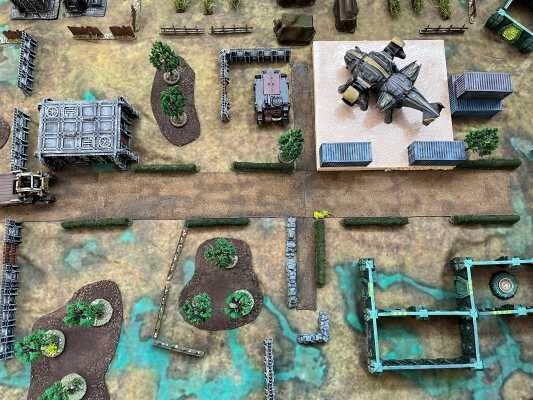
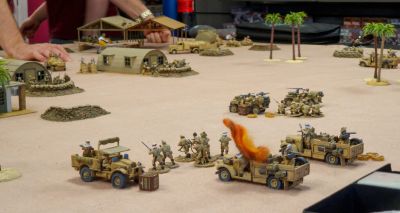
There is a great opportunity to make a themed desert table here. Build it out like an airfield/spaceport. If you have a spaceship model, why not place it front and center. Open spaces, palm trees, pilots mess hut, you get the picture.
This Bolt Action battlefield provides a good suggestion for the table layout. You can find more pics from the Warlord website.
3. Operation Market Garden (Band of Brothers)
Theme: Holding out against overwhelming odds. The Scene: Allied paratroopers seize Eindhoven only to find themselves isolated and outnumbered as German counterattacks close in.
Kill Team Mission Hook: A beleaguered squad must hold a key structure (like a comms tower or reactor junction) until reinforcements arrive.
Objective: Survive for a set number of turns while preventing the enemy from capturing the objective.
Special Rules: The attacker’s numbers increase each round; the defender may receive one small reinforcement drop midway through.
Faction Fit:
Defender: Imperial Navy Breachers, Inquisition Agents, or Deathwatch marines.
Attacker: Chaos Legionaries, Ork Kommandos, or Fellgores.
This setup should create those tense, cinematic moments where every dice roll feels like life or death.
It could be played best as a joint ops mission, with two players fighting off waves of attackers. Why not create a densely packed board to replicate the close confines of the town. Narrow streets will create the need for desperate close combat actions, adding to the difficulty of completing the mission.
Bringing It All Together
By translating these real-world (albeit hollywoodised) operations into Kill Team missions, you blend the historical tension of WWII storytelling with the gothic sci-fi of the 41st millennium. You get all the things that make Band of Brothers and SAS: Rogue Heroes so gripping — camaraderie, courage, chaos — but with plasma rifles and occasional daemon incursions.
Basing your maps on these real engagements and creating asymmetric mission objectives will help add something different to your Kill Team games. So next game night, don’t just roll for missions — tell stories. Steal from history, tweak the details, and create moments that feel like they belong in both Normandy and Necromunda.
Kill Team is a fun, balanced skirmish game, with very thematic teams to choose from. Space Marines play like tough super soldiers and Orks are very anarchic. It also has a cooperative mode where players work together to beat NPOs (non player operatives) and achieve a shared objective. The range of available teams, 42 at the last count, and stats for various NPOs fills a very nice toolbox for the creation of narrative scenarios. This coupled with the fact that I’ve always wanted to play a big game hunt with dinosaurs since playing 40K as a kid has inspired me to build a kill team narrative mission. Of course there needs to be various twists and turns in there too. After all, no narrative mission is complete without secret objectives.
This mission is for six players plus a GM.
Mission Context
The Imperial Governor of Neblar Prime is celebrating his 150th birthday. Tradition dictates that he host a big game hunt as a core part of the festivities. Being useless with a gun, the Governor has engaged the famed Imperial hunter Thaddeus Ravenwick to bag a few dinosaurs for the feast. Of course, the hunters exploits will be televised across the planet so that all the citizens can share the excitement of this momentous occasion. It will be good for the morale of the workers.
However, the Governor should be more worried about the morale of the workers. Even now rebellion is fermenting, aided by a nefarious genestealer cult. The locals, who revere the dinosaurs are being stirred up and have been convinced that disrupting the hunt will spark an uprising that will overthrow their uncaring overlords once and for all!
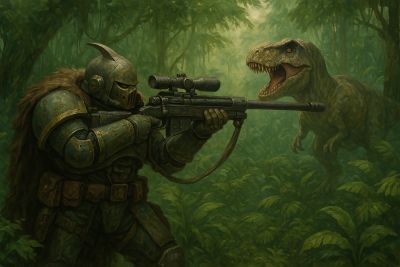
The Imperial Hunter confronts the Young blood in thick jungles of Neblar Prime.
Factions and Objectives
This game is set for six players split into two factions, the imperial hunters and the zealous rebels/cult. A third faction, consisting of three dinosaurs will be run by the GM.
To win the imperials must kill more dinosaurs than the rebels can save. Five points each respectively. In addition each player will score three points for completing their secret objective.
Characters
Each player gets one character and one to two support operatives. I have listed them below including the equivalent Kill Team stats for each as well as their secret objective. All the Kill Team operative stats are free to download from the Warhammer website.
Team Imperial
Big Game Hunter:
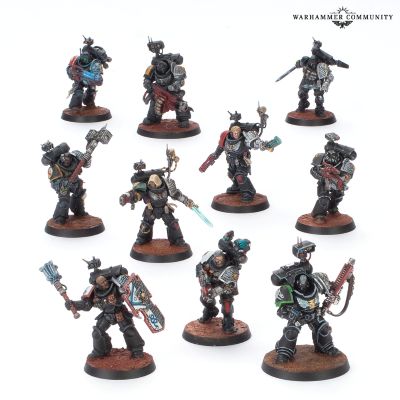
The famous Thaddeus Ravenwick (Angels of Death Eliminator).
His trusty manservant Djeeves (Exaction Squad Vigilant).
Secret Objective: Keep your legend alive, kill at least two dinosaurs.
Long Suffering Security Detail:
Lt Salazza (Rogue Trader Void Master)
Shadowy guard (Rogue Trader Death Cult Assassin)
Secret Objective: Do your job, make sure Thaddeus is alive at the end of the scenario.
Imperial Scouts:
Lead scout Ragman (Space Marine Scout Sgt)
Scout (Space Marine Scout Hunter)
Secret Objective: Had a bar fight with the Rebel Gunna last night and need to finish what he started, make sure he is dead by the end of the scenario.
Rebels (Sneaky Genestealer Cult!)
The Boss:
Rebel Leader Vispoz (Wyrmblade Kelemorph)
Cult Brother (Brood Brother trooper)
Secret Objective: Make sure Thaddeus is dead by the end of the scenario and fuel the fire of the rebellion.
The Heavy
Gunna Bigarms (Brood Brother with grenade launcher)
Buddy (Brood Brother trooper)
Secret Objective: Had a bar fight with the Scout Ragman last night and need to finish what he started, make sure he is dead by the end of the scenario.
The Young Blood
Falco Soarer (Wyrmblade Primus)
Buddy (Brood Brother trooper)
Secret Objective: If The Boss doesn’t make it out alive you’ll get promoted. Make sure he doesn’t.
Kill Team Dinosaurs
The GM will control three mega fauna (dinosaurs) that the hunting party are stalking. These will be set up together in the designated area. Kill team stats as follows:
Grand Lizard (x1):
APL 3, Move 6″, Save 4+, Wounds 30
Melee Claws and Teeth Attack 6, 3+ 5/6 Relentless
Ignore piercing (tough hide), can attack twice per activation.
Sub Lizard (x2):
APL 2, Move 7″, Save 5+, Wounds 20
Melee Teeth Attack 4 3+ 4/5
The kill team dinosaurs operate in a simple way.
If they can see an operative – Charge and attack the closest.
If they cannot see an operative move in a random direction.
“I’m sure the lizard is around here somewhere”
Game Set Up
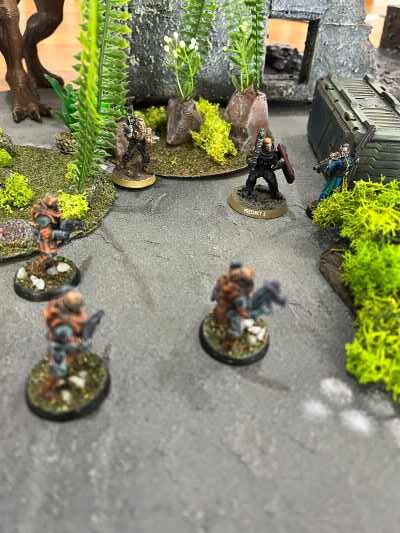
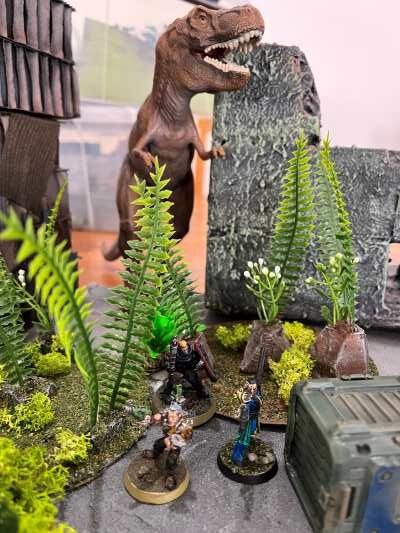
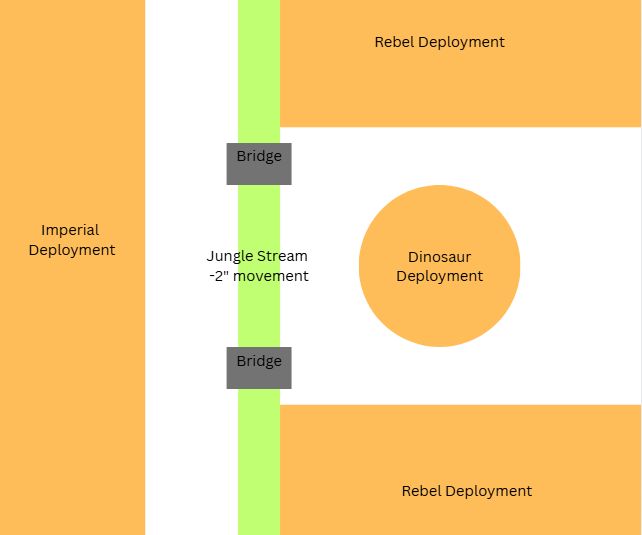
For this Kill Team narrative mission place thick jungle terrain across the board. Feel free to add ruined temples, abandoned hab blocks etc. Make the terrain denser than a normal Kill Team battle. A jungle stream with 2 bridges is also a fun addition. The dinosaurs start in a clearing to the right of the board. Make sure to have no firing lanes between the Imperial deployment and the dinosaur clearing.
Kill Team Narrative Mission map – play around with the set up to make something that looks thematic with limited firing lanes.
Terrain Rules
Some suggested rules for the terrain are:
Stream – minus 2″ to movement when crossing.
Jungle – blocks line of sight and gives light cover.
Ruins etc – heavy cover and blocks line of sight.
Playing The Mission
Players position themselves around the table in alternating order: Imperial-Rebel-Imperial-Rebel etc. Roll for initiative and play moves in the above order.
No tac ops, no crit ops. The sole mission is that described above.
Play lasts for 4 turns.
Final Thoughts
Although I’ve designed this narrative mission with Kill Team in mind this could very easily be ported to Space Weirdos or 5 Parsecs from Home. In fact I’m aiming to run this at the local club using Kill Team and Space Weirdos for the next Marty Con. I’ll write up a battle report when the dust has settled.
I’d love to hear if anyone uses this scenario. But if nothing else I hope I’ve shown that Kill Team can be used for some different narrative style missions. There is so much scope here. Lots of inspiration can be drawn from WW2 commando actions and I’m looking at how to create a 40Kified Battle of Termoli.
Following on from my last experience running a multiplayer game I’ve been exploring emergent play. In parallel to this I have developed a mini event for six participants that I hope will create an emergent narrative experience for all involved. I’ve included mechanics to ensure that no two games are alike and every decision can lead to unexpected outcomes. Welcome to Echoes of Xenos!!
While this is a campaign of sorts with players playing multiple games, it is going to take place over the afternoon/evening of a single Saturday. Keeping it short and sweet will foster maximum engagement. Resulting, I hope, in lots of player interaction with the narrative and each other.
Setting the Stage: Embrace the Unknown
I’ve always had a soft spot for the INQ28 movement. This is based loosely on an old Games Workshop game that was more roleplaying game than wargame. It pits bands of Inquisitors, secret agents of the Imperium, against one another. Different ideologies, agendas and objectives make for a murky espionage fueled setting that truly fosters creativity in scenarios, art and model making. As such I’ve set this event squarely within this milieu.
The campaign is based in the western reaches of the Ultima Segmentum, specifically in the enigmatic Lupin System. As commanders of various factions, players are on a mission to retrieve the lost research of the radical Inquisitor Tiberius Glaze. While they all have the same core objective, secret objectives, emergent narrative and sworn enemies will make this anything but straight forward.
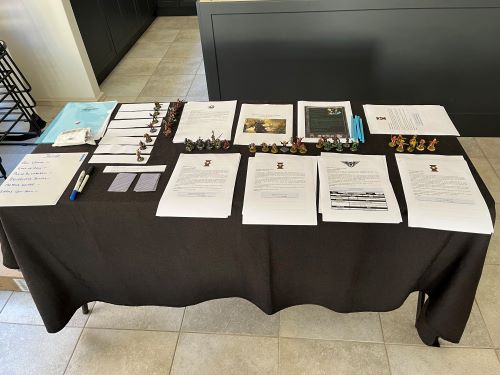
Player packs and warbands ready to go
Factions in Pursuit
As mentioned, multiple factions are on the hunt for Glaze’s elusive research. Each with its unique motivations and secret agendas:
Puritan Inquisitor of the Ordo Hereticus: Determined to destroy the heretical research.
Rogue Trader: Sees profit in capturing and selling the research.
Tech Priest of the Adeptus Mechanicus: Aims to harness the research for their own mysterious purposes.
Two Radical Inquisitors of the Ordo Xenos: Both seek glory through the continuation of Glaze’s work. However, the glory can only go to one!
Rogue Inquisitor of the Ordo Malleus: Believes the research is linked to a prophecy foretelling the downfall of the Imperium.
As you can see, there is already a lot of scope for conflict. But for emergent play to flower we need additional complications.
The Mechanics: Fueling Emergent Narrative
This campaign is structured to encourage emergent play, where the unfolding story and strategic interactions create a unique and engaging experience for every participant. As such the details of each battle will be randomly determined. Firstly, there will be three rounds of 1v1 battles . At the start of each round, factions will randomly draw opponents and battle locations. Each location has a shared primary objective and a set of secret objectives. After objectives are revealed, faction leaders select their roster for the engagement. The final round will involve all the players competing against one another in a large multiplayer scenario.
Like the last game I ran we’ll be using the Space Weirdos ruleset. This is simple enough for players to pick up the concepts easily. However, it has enough complexity to allow for strategic play. A great balance. It also plays fast. Letting us complete multiple games over the course of the event.
Roster Management
Each faction begins with a 125-point Space Weirdos list, but for each scenario, players can only field three agents from their roster. This limitation means roster management is crucial, as losing agents can significantly impact your strategy and the outcome of future battles. It also means that agents need to be carefully chosen for each game, as each have different advantages. I’m interested to see how this plays out. Will players be more cautious in their tactics? When will they commit their more valuable agents?
Locations and Objectives:
To keep things uncertain battles will be fought over 4 different locations. Each is rich with potential for emergent play, featuring primary objectives and a variety of special secret objectives specific to each. Here’s a glimpse of what to expect:
Abandoned Orbital Station: Retrieve data from the lone servitor.
Research Station on the Moon: Get a copy of the research papers.
Ag Settlement: Identify and interrogate Glaze’s old companions for the location of the genetics research base.
Space Port Relay Station: Hack the last communication from the Research Station.
Winning a game at each location gives the victorious player a secret clue that details some of the back story and the villainy that Inquisitor Glaze was up to.
Combining roster management, narrative clues, secret objectives and a range of game boards will keep the players on their toes. Decisions will have to be made with imperfect information. Stories will emerge. I cant wait to see how the game evolves.
Ag settlementSpaceportResearch stationOrbital
Points and Clues
An emergent narrative may not be enough for some players so I have introduced a competitive element in the Campaign Points (CP) which are awarded based on performance
Win Primary Objective: 2 CP
Win Secret Objective: 1 CP
Beat sworn enemy in battle: 1 CP
The warband with the most CP will start the final scenario with a crucial advantage – the research genetic material. A tally of points on a whiteboard near game control will keep everyone on their toes. Announcing changes in the leaderboard at the end of every round should enhance the competitive element.
It’s my hope that this element spurs players to strive for a win and push their secret objectives for each round to get that valuable additional CP.
The Grand Finale
The final showdown takes place at a secret location (no spoilers), the fifth moon of Lupin III. Here, factions must secure the genetic material – the ultimate prize. With dangerous abominations lurking, this climactic battle will push the players strategic skills to the limit and create unforgettable moments of emergent play. Will they work together to get run the gauntlet or fall into mad competitive scrambling to get the prize. Only time will tell.
Preparation
In an effort to make the game as immersive as possible I’ve prepared individual player briefings, faction rosters, thematic clues and ideological clashes. Additionally, I’ll be using my collection of miniatures and terrain to its fullest. I’m hoping that this will give the players enough to really lean into the setting and make the most of the game. This has take a lot of work, but I’m hoping it’s worth it.
Once we’ve played I’ll write about the experience and my learnings from it. Will emergent narrative occur? I’ll also see whether this format may be utilized in a different form to teach/enhance leadership skills.
April saw me attend MartyCon 2024, where I ran a miniatures wargame intended to test players resolve under uncertain conditions. As leaders in the real world we deal with a distinct lack of information about our competitors motives and objectives. This uncertainty leads to difficult decision making and stress. My players came from all walks of life including engineers, teachers, ex soldiers and bankers. All were thrust into a scenario of limited information where quick decision making was needed to win the game. In this article I describe the game set up and play before looking at three leadership lessons we can draw from the experience.
The Set Up
I designed the game using the Space Weirdos ruleset with players commanding one of six factions battling it out under a giant factory complex set in the underbelly of the Warhammer 40,000 universe. Each player had a different primary and secondary objective. These ranged from hunting a demon infused artefact, starting a rebellion and assassinating a rival leader. Below is a summary of each group:
Inquisition/Sisters of Battle: A formidable force dedicated to rooting out heresy and chaos, armed with faith and righteous fury.
Enforcers: Tasked with maintaining order and eliminating gang activity, these elite warriors are the enforcers of Imperial law.
Honor Guard Kill Team: The personal guard of the Imperial Governor, wielding the authority to bring the Mining Guild. They also had a side mission to get rid of the Governors future Son in Law.
Acolytes of the Red Mist: A mysterious order shrouded in secrecy, rumored to be on the brink of completing an elaborate ritual with unknown consequences.
Mining Guild: Hard-bitten workers pushed to the brink of rebellion by mistreatment, seeking to assert their rights amid the chaos of civil unrest.
Scissor Sisters: An influential crime syndicate capitalizing on the turmoil, maneuvering in the shadows to exploit opportunities for profit and power.
Each players team comprised four miniatures with different weapons and abilities. But so many that the game became overwhelming.
I took the role of gamemaster to keep play moving, answering rules queries and making sure everyone was having fun. Of course, this was key in keeping the game running smoothly and allowing for players to try things outside of the normal ruleset.
Part of the battlefield with four factions visible
Space Weirdos
I chose the Space Weirdos ruleset intentionally during my planning of the experience. First, it is very simple, but with enough variety in character skills and weapons to keep things interesting. Secondly, players take turns moving one miniature each. This, and the fact that players can interrupt each others goes with actions made sure that no players were left out twiddling their thumbs. Lastly, movement was completed using a 6 inch stick removing the cumbersomeness and clutter of tape measures.
Everyone around the table picked the rules up easily. This is high praise indeed as most hadn’t played a wargame before. I cant recognize this game enough. In fact, I know my friends and I will be playing this ruleset again in the near future.
Adding Uncertainty
Having read their briefs, each player knew their main objective and main adversary. They also had notes on potential allies. Consequently, there was a base line of understanding around the situation. Encouraging players to communicate by secret notes added extra spice. Creating and breaking alliances as needed. Communications lit up within the first minute of the game, with notes flying between all participants. I quickly ran out of post-it notes and players turned to texting one another.
Now the waters were truly muddied. Who to trust. How to win your objective and how to illicit help in doing so was no longer a straight forward concern.
Game Action
We played for two and half action filled hours. Alliances were made. Motives were guessed at. The ensuing firefight unleashing chaos. Feedback from the players showed how difficult they found working with such unknowns. Enjoyable, but difficult.
One player, found himself getting frustrated at another player, perceived to be a neutral party who seemed to be targeting him. Afterwards it dawned on him that the targeting was the result of an unknown objective. He was of course completely right about that.
The player who eventually won, was double crossed, lost most of their team members, but stayed focused on their objective to pull a win on the very last turn.
Often wargames can turn into straight forward affairs. Not this one. Everyone was second guessing each other right until the end. The debrief at the end created more than a few ah ha moments as pieces of the puzzle fell into place.
Given all this uncertainty experienced by the players, what lessons can we learn from the scenario?
The action from a models perspective
Lesson 1: Flexibility and Collaboration
The game’s setup, designed to pit players against each other amidst uncertainty, showcased the importance of flexibility and collaboration in leadership. One of the players, embodying these traits, adeptly negotiated alliances and adapted his strategy on the fly to help achieve his objective. His willingness to collaborate with unexpected allies underscored the power of flexibility in leadership, demonstrating the value of adaptability in the face of adversity.
Lesson 2: Trust, Betrayal, and the Art of Managing Expectations
As players delved into the fray, trust, betrayal, and the delicate art of managing expectations emerged as crucial leadership lessons. The player running the Sisters of Battle/Inquisition faction, initially sought alliances based on his knowledge of the Warhammer 40,000 universe. However, when his allies turned on each other and betrayal ran rampant, he found himself isolated and betrayed. His assumptions very nearly cost him the game. This experience highlighted the importance of managing expectations and understanding the fluid nature of alliances in leadership scenarios.
More action as the mining guilder sprints for the vox cast station (their primary objective)
Lesson 3: Effective Communication and Information Management in the Face of Adversity
Against the backdrop of clandestine dealings and covert alliances, effective communication and information management emerged as critical leadership skills. Players communicated covertly through notes and smartphones, forming secret alliances and plotting betrayals. This emphasis on information management underscored the importance of access to key intelligence and the ability to convey messages discretely in leadership scenarios, especially amidst the chaos of conflict.
Final Thoughts on Uncertainty
In conclusion, I believe this experience moved beyond that of a simple game. Instead serving as fertile ground for exploring leadership dynamics. Leading the different factions, players not only battled for victory but also honed their leadership skills in the crucible of conflict amidst uncertainty.
I will be sure to use this type of game to explore other leadership themes in the future.