Unleashing Attributes: Translating D&D Abilities into the Business World

Dungeons and Dragons (D&D) is not only a game of fantasy and adventure but also a platform that explores the diverse abilities that define characters. In today’s article, we delve into the six primary attributes of D&D—Strength (STR), Dexterity (DEX), Constitution (CON), Wisdom (WIS), Intelligence (INT), and Charisma (CHA). Ultimately, with the aim of uncovering their relevance to the business world. As a player in D&D, understanding these abilities and their impact on the game allows creation of a character that has a strong chance of success. Likewise, by understanding how each attribute relates to essential qualities and skills in business, individuals can harness their own strengths and develop a well-rounded approach to professional success.

Strength (STR): Power in Action

Strength in D&D represents physical prowess, raw power, and the ability to overcome challenges. Characters with high STR scores would be Conan the Barbarian, Buffy the Vampire Slayer or Aragorn from Lord of the Rings.

In the business world, strength translates into action-oriented leadership, resilience, and the ability to navigate and overcome obstacles. Individuals with high STR traits exhibit determination, drive, and the physical and mental fortitude required to persevere in demanding and competitive environments. Entrepreneurs and construction managers exhibit this trait, as leaders dealing with fast paced highly fluid situations every day.

Dexterity (DEX): Agility and Adaptability

The Dexterity attribute encompasses agility, nimbleness, and reflexes. Sneaky rogues and accurate archers are characters with high DEX. Think Robin Hood or Jyn Erso from Rogue One.

In leadership, DEX translates into adaptability, quick thinking, and the ability to respond swiftly to changing circumstances. Individuals with high DEX traits exhibit flexibility, strategic thinking, and the capacity to navigate complex situations with grace and efficiency. Development managers in the IT sector and project managers of all scales must have high DEX to succeed.

Constitution (CON): Resilience and Endurance

Constitution reflects resilience, stamina, and the ability to withstand physical and mental challenges. Within the game this equates to more hit points and thus makes your character harder to kill. Ellen Ripley from Alien and Ethan Hunt from Mission Impossible display huge levels of constitution and fortitude.

In the real world, CON translates into resilience, perseverance, and the capacity to endure setbacks and overcome adversity. Individuals with high CON traits exhibit determination, emotional stability, and the ability to maintain focus and performance in high-pressure situations. Successful leaders with high CON bounce back from failure stronger than ever before. For real world examples think Elon Musk or JK Rowling of Harry Potter fame.

A great explanation of D&D abilities, referencing tomatoes…

Wisdom (WIS): Insight and Decision-Making

Intuition, perception, and the ability to make sound judgments fall out of a high WIS attribute. From a players perspective these characters are often Clerics, wise in the ways of the world. In fiction characters with high WIS often take the form of mentors. Dumbledore and Yoda are great examples from popular culture and need no introduction. A character with high WIS who is most definitely not a mentor is Tyrion Lannister from Game of Thrones. Throughout the series Tyrion displays great wisdom, finding inner peace where his flaws are concerned and recognizing his great power lies in his ‘smart brain’.

WIS translates into insightful decision-making, problem-solving, and the capacity to evaluate situations holistically. In the business world, individuals with high WIS traits possess keen observation skills, intuition, and the ability to navigate ambiguity and make informed choices. Often leaders with high WIS act as mentors. However, positions where a large number of conflicting stakeholders are involved also need this attribute. Any leadership position in a government department or other bureaucracy must have this to succeed.

Intelligence (INT): Knowledge and Analytical Thinking

Intelligence for a D&D character signifies intellectual acumen, knowledge, and the ability to process information. Since the first days of the game INT has bee important for Wizards as they research the arcane. Over time this has ported to alchemists, artificers and bards. It comes as no surprise that fictional characters like Gandalf, Spock and Hermione Granger display intelligence as their primary attribute.

When looking at real world professionals, INT translates into analytical thinking, strategic planning, and the capacity to gather and apply knowledge effectively. Individuals with high INT traits exhibit strong problem-solving skills, critical thinking abilities, and the capacity to make informed decisions based on data and insights. Leaders with this primary attribute excel in running teams and projects with a high level of technical complexity. They should also be included when formulating long term strategic plans for the business or division.

Charisma (CHA): Influence and Relationship-Building

Charisma in D&D represents charm, persuasiveness, and the ability to influence others. In the game this is often used to avoid deadly combat situations. Fast talking Bards, inspirational Paladins and silver tongued Warlocks all benefit from having a high CHA attribute. In the business world, CHA translates into effective communication, relationship-building, and the capacity to inspire and motivate others. In the movies Tony Stark, James Bond, Jack Sparrow and Princess Leia all have high CHA scores.

Leaders with high CHA abilities possess strong interpersonal skills, the ability to communicate ideas effectively, and the capacity to build rapport and influence outcomes. This is particularly important if you have a large team so that messages are clear and easily understood. A leader with the ability to communicate a strong and compelling vision to his team can create strong loyalty and collaboration. Think Elon Musk or Steve Jobs and see what they have achieved by using this attribute.

Final Thoughts

The six abilities of Dungeons and Dragons—Strength, Dexterity, Constitution, Wisdom, Intelligence, and Charisma—hold valuable lessons for leaders. By understanding and harnessing these attributes, individuals can identify their strengths and develop the qualities necessary for success. Whether it’s leveraging physical and mental fortitude, adapting to changing circumstances, building resilience, making informed decisions, applying analytical thinking, or fostering effective communication and relationship-building, the attributes of D&D can empower individuals to thrive and excel as leaders in the real world.

Survive the Sinking Submarine: Ultimate Hell Week Scenario

My last post explored using roleplaying games like Dungeons and Dragons to create a Hell Week scenario experience for your staff. With the aim of creating a bonding experience for teams, leaders and new starters. In this post I aim to develop a scenario/event that you could use to create this type of experience.

Event Goals

Before we start, it is essential to understand the goals of the event and work out from there. This event is designed to be run for groups of new leaders in an organization. These are high performing individuals tipped for future leadership positions or newly promoted into one.

The goal of the event is to foster a sense of team and belonging amongst the future leadership of the business. This will achieved through overcoming shared adversity.

Overview of the Hell Week Scenario

In an effort to keep the hell week scenario outside of the lived experience of the cohort but allowing for high pressure the scenario will focus on escaping from a submarine. Participants will be allocated different roles/skillsets and work together to escape. A series of tasks requiring multiple skillsets will need to be prioritized and completed against time pressures. Additionally, surprise events throughout the scenario will add additional pressure, upsetting any planning. Adaptability and teamwork will be essential in beating the scenario.

In addition, each participant will have six endurance points that are lost if tasks are failed. They can also be traded in to help improve the likelihood of success. However, when the last point is lost the player is out of the scenario.

The player briefing might look something like the following:

Congratulations on joining our team! We believe in hands-on training to prepare you for real-world challenges ahead. In this immersive training scenario, you will find yourself a crew member of a sinking research submarine. Your mission is to work together to overcome a series of challenges and escape before it’s too late. Remember, teamwork, communication, and quick thinking are essential. Good luck!

Duration: 2 hours

Location: Office setting or conference center. Smaller rooms preferred.

Lighting and sound effects can really enhance the immersion

Required Props and Setup to Enhance Immersion

As discussed in my last post immersion is really important. Of course, you don’t need a full on mock up of a submarine. But there are some simple things you can do to help create a sense of place out with the normal office environment.

  1. Submarine Environment: Create a makeshift submarine environment by shifting tables and chairs into a series of spaces along a thin column Alternatively, set up in a corridor to give an improved sense of the enclosed space. Additionally, turn off overhead lights and use desk lights with blue/green lighting gels to mimic the underwater setting. Having a red alarm light will definitely add to the sense of urgency when it goes off.
  2. Sound Effects: Use a portable speaker to play submarine sounds, alarms, and underwater noises. This can be used as a timed track signaling surprise events and highlighting the sense of urgency.
  3. Props:
    • Flashlights
    • Walkie-talkies or two-way radios
    • Gauges to indicate hull integrity and oxygen levels
    • Life vests
    • Clipboards with task instructions
    • Stopwatch
    • Nautical maps and charts
    • First-aid kit
    • Ropes and carabiners
    • Puzzles or challenges related to navigation and communication
  4. Instructor/Facilitator: You will need someone to facilitate the scenario and provide guidance when necessary.
Keeping to schedule is key in running an event like this

Training Scenario Schedule

Below is a proposed schedule of the hell week scenario.

  1. Briefing (15 minutes):
    • Gather all participants and explain the scenario.
    • Emphasize the importance of teamwork, quick decision-making, and effective communication.
    • Assign roles to each participant (e.g., captain, engineer, navigator, medic, radio operator etc) and distribute their respective skills and tasks.
  2. Submersion and Initial Challenges (20 minutes):
    • Participants enter the makeshift submarine (clearly demarcated).
    • Turn on the sound effects to create an immersive atmosphere.
    • The submarine begins “sinking.” Water and pressure-related challenges arise.
    • Participants must address immediate issues like water leakage, pressure indicators, and stabilizing the vessel. Limited resources, must prioritize tasks.
  3. Navigation and Communication (20 minutes):
    • Provide a nautical map with coordinates.
    • Participants must collaborate to determine their location and chart a course to safety.
    • Encourage the use of walkie-talkies for communication between navigation and the steering team.
  4. Obstacle Challenge (15 minutes):
    • Present a challenge that requires participants to work together to overcome an obstacle (e.g., blocked hatch or damaged equipment).
    • They must use ropes, carabiners, and problem-solving skills to succeed.
  5. Medical Emergency (10 minutes):
    • Simulate a crew member’s injury.
    • The medic must provide first aid while others maintain the vessel and continue with the mission.
  6. Countdown to Escape (20 minutes):
    • Introduce a time constraint and associated red lights and klaxon.
    • Announce that the submarine’s condition is deteriorating rapidly.
    • Participants must complete their tasks and navigate to the surface before it’s too late.
  7. Debriefing (20 minutes):
    • After the scenario, gather the team and discuss their experiences.
    • Encourage feedback, focusing on what went well and what could be improved.
    • Highlight the importance of adaptability, teamwork, and problem-solving under pressure.
  8. Final Remarks (10 minutes):
    • Conclude the training with a reminder of key takeaways.
    • Reiterate the importance of quick thinking, clear communication, and collaboration in real-life situations.

Further Work

While I have listed each of the tasks above in a linear series, it would be better to have tasks overlapping. Teams must then prioritize tasks. Remember, failed tasks remove endurance points from participants, adding additional pressure. Endurance points can also be traded for clues and assistance.

Perhaps you can restrict the number of people in each section of the submarine and create time penalties for movement between the sections. This would emphasize the use of walkie talkies for communication. It would also highlight the need for clear and concise communication between different sections of the submarine.

Each task needs more work around the detail, but I think this gives the picture of how an event like this might work. I for one would love to experience it. Part escape room, part rpg, part leadership learning experience. For me it ticks all the boxes.

What do you think? Would this hell week scenario work? Is there anything you would add? Have you attended something similar?

Failed Negotiation: A Real example from D&D

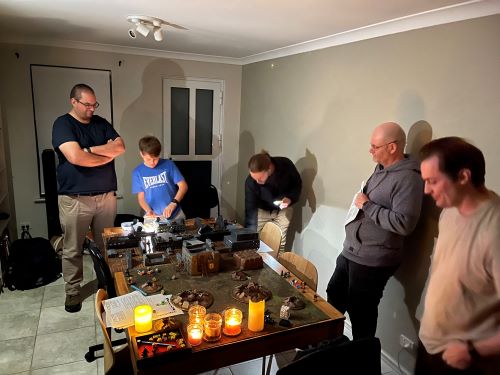
Today I want to discuss a failed negotiation that occurred in my Thursday night Dungeons and Dragons group. While the players were roleplaying their characters to the hilt, making some questionable decisions, I thought that there were some real learnings to be gleaned in the art of negotiation.

As Dungeon Master I had set up what I thought was a straight forward in-game negotiation. One that would take up half an hour at best. What transpired was a crazy rollercoaster of demands, ultimatums, alley chases and moral dilemmas. Three hours later and the Party was no closer to achieving their goal.

So what went down and what lessons can we learn?

Keep in mind that this was part of an ongoing campaign with well established characters. The players were heavily leaning into these characters, definitely not looking for the optimal outcome. Even so I think this example shows how you can gain real world leadership learnings through the medium of role playing games.

What Went Down

So as not to bore you I’m going to give you the basic framework of what went down. Ultimately, the player characters (PC) are the leaders of a now influential street gang. They needed the location of a key. The only person with this knowledge was the local Fence “Old Mog”. Go to Mog, find out what she wants, negotiate, get the location, move on. Simple. Or not! Here’s what happened:

  • Start discussions with Mog, fairly confrontational straight out of the gate, thinly veiled threats, posturing etc
  • Mog is open about what she wants (safety, by becoming part of the PCs street gang)
  • Party react aggressively and dive straight into an ultimatum
  • Mog demands a counter offer, as none is forthcoming
  • Counter offer does not take into account what Mog wants
  • Becomes clear that Mog is also negotiating with their arch enemies (shock, disbelief, anger)
  • Tempers flare, more ultimatums and threats are thrown around
  • Negotiations break down and Mog cuts a deal with the enemy
  • PC’s walk away empty handed.

Interestingly it seems like the PC’s treated the negotiation as a competition that ended in frustration and failure. So what could they have done differently? What can we, as learning leaders, gain from this experience.

BATNA

Firstly, what is BATNA? BATNA is an acronym that stands for Best Alternative To a Negotiated Agreement. This is what the best outcome would be if no agreement between the two parties can be reached. When entering a negotiation it is important to state what this is amongst your team. Understanding your BATNA gives you the ramifications of not reaching a deal.

Negotiating with a car salesman for example, the BATNA might be having to take public transport over the next week.

In the above D&D example the group didn’t even consider a BATNA to begin with. However, the consequences of not reaching an agreement was they wouldn’t get the location of the key they needed. Pretty straight forward. But not considered.

This meant that there was no strategy or no direction going in.

Understand What the Other Side Wants

The first part of any negotiation should be finding out what the other side of the negotiation wants. Often this may not be obvious at the very beginning. At this point all assumptions should be checked. As they may not be accurate. Once this understanding has been found it’s much easier to start crafting a mutually beneficial solution.

In the D&D negotiation example above, the Party did ask what Mog wanted. They got a response. She wanted to join their organization and feel safe in the area of her home. Unfortunately, this need from Mog was overshadowed by the competitive nature brought out by the act of negotiating. Which neatly leads to my next point.

Becoming overly competitive can lead to a failed negotiation

It’s Not a Competition

A negotiation is not a point scoring contest. It is not about having a winner or a loser. It’s about getting what you need and not agreeing to an outcome worse than your identified BATNA.

The problem can be that the act of negotiating brings out competitiveness in people. I remember an international Chief Sales Officer arguing for hours that in every negotiation there had to be a winner and a loser. He obviously didn’t think very highly of his customers, which is probably why he got fired a few months later. Ego takes over and the actual value of the outcome gets lost.

Back to the game. The Party didn’t define a BATNA, ignored what Mog wanted and went straight into competitive behavior. This included bullying, threats and ultimatums. Who wants to make a deal with people like that? Of course, Mog considered her BATNA and joined the opposition where she would be safe.

The result. A massive fail for our heroes.

Don’t let your ego lead to a failed negotiation. Stay calm and focused. Don’t lose your cool.

Final Thoughts on the Failed Negotiation

Despite the fact that this gaming session wasn’t being run as a Learning-RPG there are definitely some real world learnings to be taken from it.

If I was to run this type of scenario with leadership development in mind I would be tempted to have Mog played by a different person, not by me the DM. I’d give Mog a simple BATNA and guidance on motivations. I could then facilitate rather than be the focus of the players attention.

I would also give a clearer briefing to the players, defining set goals for their team. Lastly, a debrief after the scenario would put everyone’s actions into perspective.

Running the team through multiple negotiation scenarios with increasing levels of hostility and emotion from the opposition would provide an excellent experiential learning experience.

Lots of food for thought. I feel that this example really highlights the potential of using rpgs for experiential leadership learning.