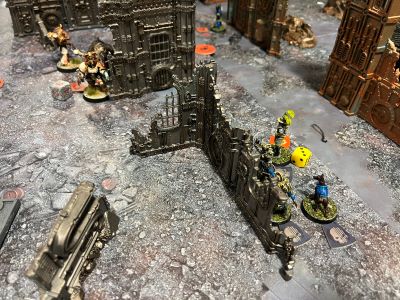
MartyCon was just around the corner and I had promised to run a multiplayer Space Weirdos game. I wanted to double down on the 40K style Inquisitor games, where alliances were uncertain and every protagonist had their own agenda. I love the 40K universe and all the infighting portrayed in their fiction and I’ve played with this concept before. So I really went for it this time. Here is what I came up with.
The Premise: Everyone Has a Plan. None of Them Align.
The scenario uses the gloriously lean and kinetic ruleset of Space Weirdos. This meant that the game would be fast and brutal. Every player had their own secret primary and secondary objectives, all interlocking and clashing. I had planned for chaos.
The setting: The Virellion (Imperial Governors) estate
The cast: 9+ players. Each player controls:
1 Character
1 Sidekick
2 Secret Objectives
This means that everyone’s go will be quick, keeping downtime for non active players to a minimum.
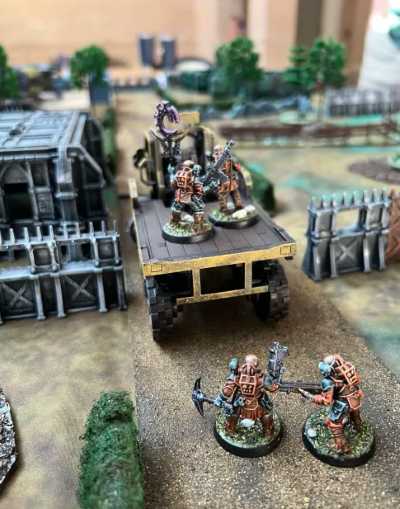
Cult of the Star Filled Maw rams the gates
Some of the Factions & Objectives
The Governor Objective: Escape the palace alive with your priceless artefact.
Security Chief Objective: Keep the Governor and his daughter alive at all costs.
Cultist Leader Objective: Kill the Governor.
Governor’s Daughter Objective: Usurp (kill) the Governor.
Rogue Trader Objective: Steal the Necron artefact, protect the Governors daughter.
Rebel Lieutenant Objective: Free the imprisoned genestealer.
Inquisitor Objective: Defend the genestealer (for future experiments) and kill all cultists.
Mad Priest Objective: Kill the Inquisitor.
While there may be obvious teams to start with. These are just temporary and everyone know betrayal is just around the corner, only they don’t know which one.
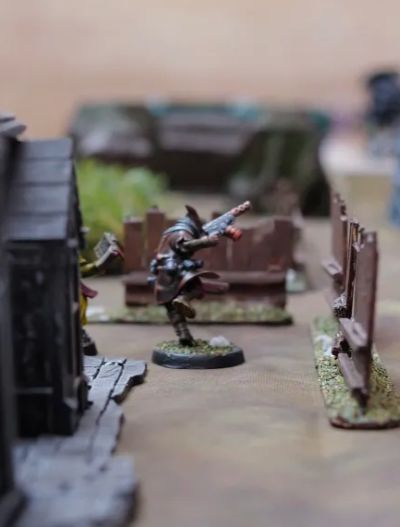
The Mad Priest dashing from the cemetery. “Ill kill that Inquisitor if it’s the last thing I do”
Design for Collision, Not Balance
I’ve experienced multiplayer games where players spend too long maneuvering politely around each other. I wanted the action to begin right from the word go. So I needed to force proximity.
The objectives would create tension, but placing the teams fairly close would make sure that the action started quickly.
In hindsight this worked well, though the main road in the center of the board did create a bit of a firing lane. In addition I think removing 6″ from the width of the board would have help create even more carnage.
Virellion Estate: peaceful and quiet…. Not for long.
How Did it Play?
All in all we had a blast. I GM’d the game and kept everything moving. I introduced paper and pens so players could send each other secret notes. These added lots of fun for those players waiting for their turns, as well as adding another layer to the uncertainty and chaos.
Shots were fired and one Genestealer cultist got killed in turn one. The Genestealers took a beating and couldn’t get anywhere near their objectives. The Rogue Trader tried to defend the Governors only to get shot for his troubles. The Inquisitor and Mad Priest had a standoff while the Governor was assassinated by his own offspring. Joint winners were the Security Team and the Governors Daughter.
The game only ran for a couple of hours before the winners were declared and we moved on to the next game of the day.
Overall it did run well. However, I think I would tweak the objectives a little to make it a bit more of a maelstrom.
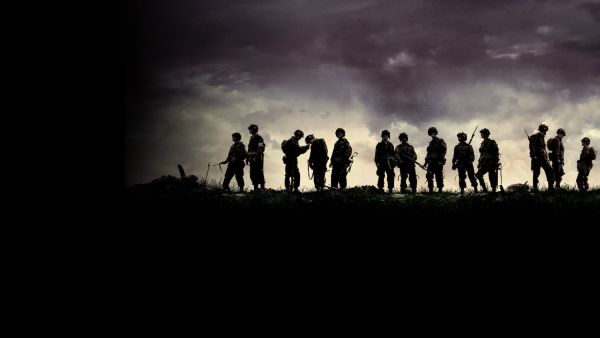
There’s something timeless about small squads of soldiers through a larger conflict — tense, personal, and filled with moments of heroism and chaos. That’s what makes shows like Band of Brothersand SAS: Rogue Heroesso compelling. These are exactly the kind of stories that Warhammer 40K: Kill Team excels at telling.
In Kill Team, every operative matters. You’re not moving faceless troops around a battlefield — you’re guiding a handful of specialists, each with their own role, personality, and fate. Which makes it the perfect sandbox to reimagine iconic World War II small unit missions with a sci-fi twist.
Let’s look at how you can take inspiration from Band of Brothers and SAS: Rogue Heroes and turn those classic moments of grit and brotherhood into thrilling tabletop missions.
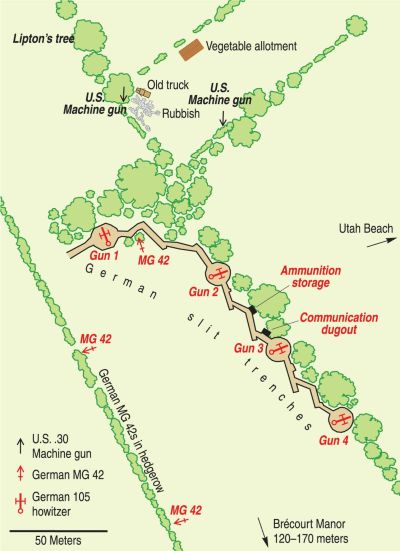
Kill Team Mission Hook: Your squad must disable a chain of heavy weapon emplacements. Each emplacement requires a different skill test or demolition action to destroy.
Objective: Destroy all three artillery emplacements before the end of the battle.
Faction Fit:
Attacker: Veteran Guardsmen, Intercessors, or Pathfinders.
Defender: Traitor Guard, Heretic Astartes, or Necrons.
It’s a mission that rewards smart use of cover, movement, and individual heroics — exactly what Kill Team is built for.
One thing I like about this mission is that you can set up the terrain to reflect the real engagement. Do away with the balanced terrain set ups suggested in the rulebook and give this a go. You don’t have to go with Normandy bocage either, why not set up your more grim dark terrain in a similar configuration.
If you’re worried about balance, why not play the game twice. Switching attacker defender roles each time will a fun experience.
Why not set up your battlefield to reflect the real engagement?
2. Desert Airfield Ambush (SAS: Rogue Heroes)
Theme: Guerilla warfare and improvisation. The Scene: The SAS (episode 6) raids enemy airfields deep in the desert, using speed and shock tactics to devastating effect.
Kill Team Mission Hook: One team is guarding a space port with specific objectives (spaceship, fuel depot, pilots building), while the other launches a hit-and-run ambush.
Objective: The defender must prevent the attacker from destroying 2/3 of the objectives.
Special Rules: Limited visibility due to sandstorm reducing ranged fire; fuel dump and spaceship can explode spectacularly.
Faction Fit:
Attacker: Ork Kommandos, Kroot Farstalkers, or Ratlings.
Defender: Astra Militarum, Adeptus Mechanicus, or Blooded.
This mission brings cinematic chaos to the tabletop — explosions, last stands, and desperate retreats.
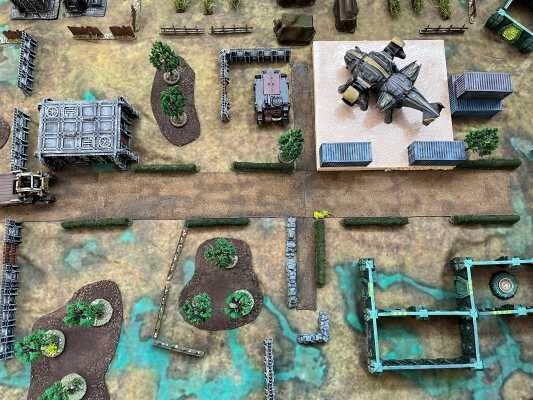
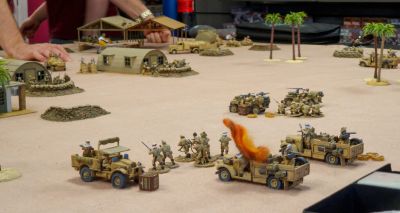
There is a great opportunity to make a themed desert table here. Build it out like an airfield/spaceport. If you have a spaceship model, why not place it front and center. Open spaces, palm trees, pilots mess hut, you get the picture.
This Bolt Action battlefield provides a good suggestion for the table layout. You can find more pics from the Warlord website.
3. Operation Market Garden (Band of Brothers)
Theme: Holding out against overwhelming odds. The Scene: Allied paratroopers seize Eindhoven only to find themselves isolated and outnumbered as German counterattacks close in.
Kill Team Mission Hook: A beleaguered squad must hold a key structure (like a comms tower or reactor junction) until reinforcements arrive.
Objective: Survive for a set number of turns while preventing the enemy from capturing the objective.
Special Rules: The attacker’s numbers increase each round; the defender may receive one small reinforcement drop midway through.
Faction Fit:
Defender: Imperial Navy Breachers, Inquisition Agents, or Deathwatch marines.
Attacker: Chaos Legionaries, Ork Kommandos, or Fellgores.
This setup should create those tense, cinematic moments where every dice roll feels like life or death.
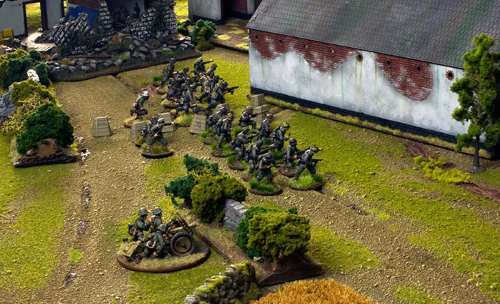
It could be played best as a joint ops mission, with two players fighting off waves of attackers. Why not create a densely packed board to replicate the close confines of the town. Narrow streets will create the need for desperate close combat actions, adding to the difficulty of completing the mission.
Bringing It All Together
By translating these real-world (albeit hollywoodised) operations into Kill Team missions, you blend the historical tension of WWII storytelling with the gothic sci-fi of the 41st millennium. You get all the things that make Band of Brothers and SAS: Rogue Heroes so gripping — camaraderie, courage, chaos — but with plasma rifles and occasional daemon incursions.
Basing your maps on these real engagements and creating asymmetric mission objectives will help add something different to your Kill Team games. So next game night, don’t just roll for missions — tell stories. Steal from history, tweak the details, and create moments that feel like they belong in both Normandy and Necromunda.
As I’ve mentioned in previous articles, I love the grimdark of Warhammer 40,000 and the tight, tactical skirmishes of Kill Team. I love both systems—they’ve given me epic moments, great friends, and plenty of tabletop fun. But I’ve found myself looking for a game that recaptures the excitement of wargaming that I experienced back when I was first starting out (a long time ago). The recent incarnations of 40K are super complicated and I’ve been on the lookout for something a little simpler with engaging gameplay. And recently, I’ve been noticing something called Bolt Action.
World War II miniatures. Thematic, gritty tables. Terrain that looks like an actual battlefield. Order dice being drawn creating a chaotic swirl of combat that keeps you engaged throughout. This sounded like just my thing. I’d always been curious… so last November I reached out on the Facebook group of a local club and Jackson offered to run a demo game.
I’m very, very glad I said yes.
The Demo Game: Soviets vs Germans
It was a simple setup: Soviets vs. Germans, a classic match-up. Jackson had everything ready—beautiful terrain, two well painted armies, and the kind of calm, patient enthusiasm you only get from someone who genuinely loves the game.
I took the Germans.
Within minutes, I realised two things:
This system is incredibly easy to pick up. The core mechanics are intuitive. No encyclopedic stratagems. No flipping between multiple supplements. Just straightforward rules that give you tactical freedom without drowning you in complexity. It basically boils down to rolling a 4 + on a D6 with various modifiers. Obviously there’s more to it than that, but it’s a very simple game at its core.
There is no down time. The way units activate based on the order dice draw creates this constant feeling of uncertainty.. You never know who’s going next, so you’re always involved, always paying attention, always planning. This swinging back and forth keeps the engagement level high at all times.
These put Bolt Action in a completely different space to 40K. It’s not better or worse—it’s just different. More narrative. More engaging. Much less downtime.
The Table Matters
One thing that really sold me was the terrain. This wasn’t a competitive layout with perfect symmetry and L-shaped ruins. This was:
hedgerows
burnt-out farmhouses
muddy fields
woodlands
cover that looked like cover
The whole experience felt like we were playing a real battle on the Eastern Front. That immersion was much deeper than I expected.
The Mechanics Just Make Sense
The alternating activation system keeps both players engaged constantly—no long, 40K-style “go make a coffee” phases.
You draw a die. If it’s yours, you activate a unit. Next die drawn determines the next force to activate. Is it yours or your opponents….
It’s simple, but the tension it creates is addictive. You’re always one dice pull away from something heroic, chaotic, or disastrous. Despite the game’s easy fundamentals, it forces you to make deep decisions. Which unit do you activate first and which stay in reserve for later in the turn. Where do you focus your efforts and how do you react to your opponents activations.
From Demo to… Buying a Whole New Army
I don’t think I am alone in suffering this and I’ve heard many wargamers lamenting the same thing. You try something new, enjoy it, before convincing yourself you’ll just dip our toe in the water.
And then suddenly you’re on Ebay and thinking:
“Well, Commandos do look cool…”
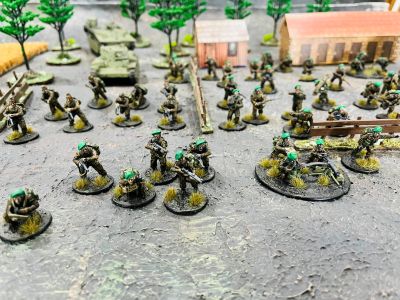
So yes… I’ve taken the plunge. I now own a British Commando starter army, which I spent quiet periods of the Christmas break painting and basing.
The playstyle appeals to me: mobile, elite, characterful, full of flavour. I also have a strong family connection to the Royal Marines. So, I’ve been researching WW2 commando engagements and uncovering some fascinating stuff including the many raids across the English channel and the battle of Walcheren. I’m also doing some reading about 30 Assault Unit, the commando group set up by Ian Fleming of James Bond fame. I hadn’t realised it would be so satisfying setting up a force that has such real-world history behind it.
My first Bolt Action Army: Commandos, painted and ready for action.
The 20-Player Game
There’s a big multiplayer Bolt Action event planned for March—around twenty players from different clubs and communities. If all goes well, I’ll be joining that battle line with my freshly-painted and battle-tested Commandos.
The idea of a huge, sprawling WWII tabletop game filled with gorgeous terrain, cinematic moments, and dozens of players all leaning in together? That sounds like exactly the kind of hobby experience I want more of.
Not only that, but I’m taking my commandos to a 6 player narrative game this weekend as part of the open day of a nearby club. I’m really looking forward to this and I’m sure the experience will form another article in the near future.
Final Thoughts
My first game of Bolt Action was everything I’d hoped for:
easy to learn
narratively rich
tactically engaging
visually immersive
very welcoming community
It hasn’t replaced 40K or Kill Team for me—instead adding something new and refreshing. And honestly? I can’t wait to get stuck in.
Kill Team is a fun, balanced skirmish game, with very thematic teams to choose from. Space Marines play like tough super soldiers and Orks are very anarchic. It also has a cooperative mode where players work together to beat NPOs (non player operatives) and achieve a shared objective. The range of available teams, 42 at the last count, and stats for various NPOs fills a very nice toolbox for the creation of narrative scenarios. This coupled with the fact that I’ve always wanted to play a big game hunt with dinosaurs since playing 40K as a kid has inspired me to build a kill team narrative mission. Of course there needs to be various twists and turns in there too. After all, no narrative mission is complete without secret objectives.
This mission is for six players plus a GM.
Mission Context
The Imperial Governor of Neblar Prime is celebrating his 150th birthday. Tradition dictates that he host a big game hunt as a core part of the festivities. Being useless with a gun, the Governor has engaged the famed Imperial hunter Thaddeus Ravenwick to bag a few dinosaurs for the feast. Of course, the hunters exploits will be televised across the planet so that all the citizens can share the excitement of this momentous occasion. It will be good for the morale of the workers.
However, the Governor should be more worried about the morale of the workers. Even now rebellion is fermenting, aided by a nefarious genestealer cult. The locals, who revere the dinosaurs are being stirred up and have been convinced that disrupting the hunt will spark an uprising that will overthrow their uncaring overlords once and for all!
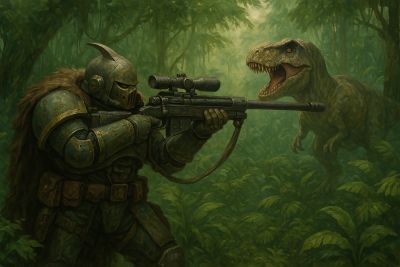
The Imperial Hunter confronts the Young blood in thick jungles of Neblar Prime.
Factions and Objectives
This game is set for six players split into two factions, the imperial hunters and the zealous rebels/cult. A third faction, consisting of three dinosaurs will be run by the GM.
To win the imperials must kill more dinosaurs than the rebels can save. Five points each respectively. In addition each player will score three points for completing their secret objective.
Characters
Each player gets one character and one to two support operatives. I have listed them below including the equivalent Kill Team stats for each as well as their secret objective. All the Kill Team operative stats are free to download from the Warhammer website.
Team Imperial
Big Game Hunter:
The famous Thaddeus Ravenwick (Angels of Death Eliminator).
His trusty manservant Djeeves (Exaction Squad Vigilant).
Secret Objective: Keep your legend alive, kill at least two dinosaurs.
Long Suffering Security Detail:
Lt Salazza (Rogue Trader Void Master)
Shadowy guard (Rogue Trader Death Cult Assassin)
Secret Objective: Do your job, make sure Thaddeus is alive at the end of the scenario.
Imperial Scouts:
Lead scout Ragman (Space Marine Scout Sgt)
Scout (Space Marine Scout Hunter)
Secret Objective: Had a bar fight with the Rebel Gunna last night and need to finish what he started, make sure he is dead by the end of the scenario.
Rebels (Sneaky Genestealer Cult!)
The Boss:
Rebel Leader Vispoz (Wyrmblade Kelemorph)
Cult Brother (Brood Brother trooper)
Secret Objective: Make sure Thaddeus is dead by the end of the scenario and fuel the fire of the rebellion.
The Heavy
Gunna Bigarms (Brood Brother with grenade launcher)
Buddy (Brood Brother trooper)
Secret Objective: Had a bar fight with the Scout Ragman last night and need to finish what he started, make sure he is dead by the end of the scenario.
The Young Blood
Falco Soarer (Wyrmblade Primus)
Buddy (Brood Brother trooper)
Secret Objective: If The Boss doesn’t make it out alive you’ll get promoted. Make sure he doesn’t.
Kill Team Dinosaurs
The GM will control three mega fauna (dinosaurs) that the hunting party are stalking. These will be set up together in the designated area. Kill team stats as follows:
Grand Lizard (x1):
APL 3, Move 6″, Save 4+, Wounds 30
Melee Claws and Teeth Attack 6, 3+ 5/6 Relentless
Ignore piercing (tough hide), can attack twice per activation.
Sub Lizard (x2):
APL 2, Move 7″, Save 5+, Wounds 20
Melee Teeth Attack 4 3+ 4/5
The kill team dinosaurs operate in a simple way.
If they can see an operative – Charge and attack the closest.
If they cannot see an operative move in a random direction.
“I’m sure the lizard is around here somewhere”
Game Set Up
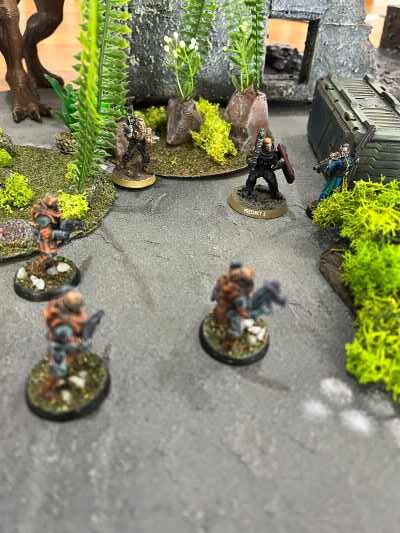
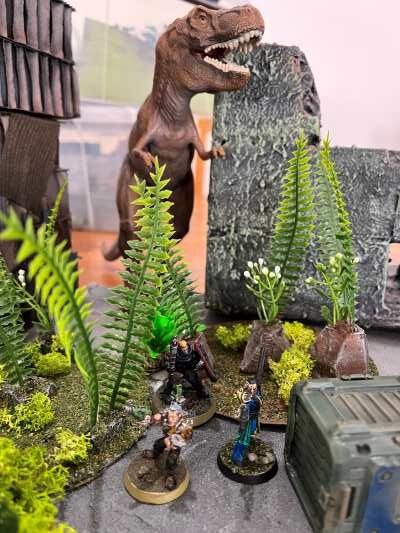
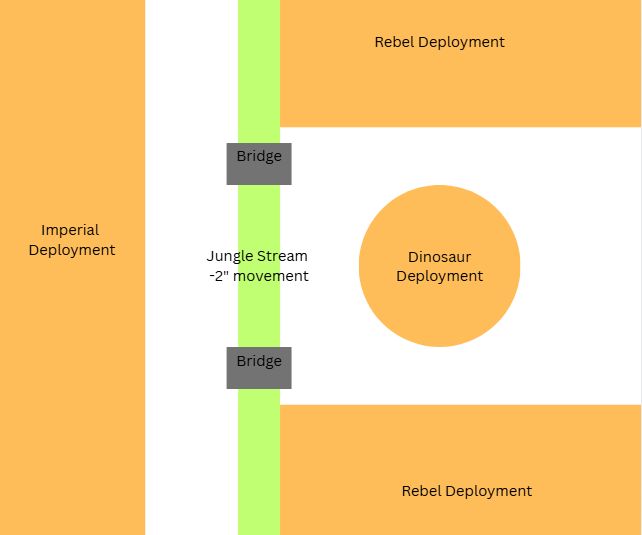
For this Kill Team narrative mission place thick jungle terrain across the board. Feel free to add ruined temples, abandoned hab blocks etc. Make the terrain denser than a normal Kill Team battle. A jungle stream with 2 bridges is also a fun addition. The dinosaurs start in a clearing to the right of the board. Make sure to have no firing lanes between the Imperial deployment and the dinosaur clearing.
Kill Team Narrative Mission map – play around with the set up to make something that looks thematic with limited firing lanes.
Terrain Rules
Some suggested rules for the terrain are:
Stream – minus 2″ to movement when crossing.
Jungle – blocks line of sight and gives light cover.
Ruins etc – heavy cover and blocks line of sight.
Playing The Mission
Players position themselves around the table in alternating order: Imperial-Rebel-Imperial-Rebel etc. Roll for initiative and play moves in the above order.
No tac ops, no crit ops. The sole mission is that described above.
Play lasts for 4 turns.
Final Thoughts
Although I’ve designed this narrative mission with Kill Team in mind this could very easily be ported to Space Weirdos or 5 Parsecs from Home. In fact I’m aiming to run this at the local club using Kill Team and Space Weirdos for the next Marty Con. I’ll write up a battle report when the dust has settled.
I’d love to hear if anyone uses this scenario. But if nothing else I hope I’ve shown that Kill Team can be used for some different narrative style missions. There is so much scope here. Lots of inspiration can be drawn from WW2 commando actions and I’m looking at how to create a 40Kified Battle of Termoli.
Following the success of my last Kill Team narrative campaign at my local club I’ve decided to run another one. This time I want to incorporate some of the feedback from the participants in an attempt to heighten the narrative and increase engagement. Membership at the club has increased over the last few months so I’m hopeful we can have even more players than previous. But first I need to plan the narrative and scope. So read on for my Kill Team campaign design notes, to get my take on where this next event might take us.
Campaign Scope
While the last campaign was purposefully kept as simple as possible I want to increase the length and scope of this attempt without stretching myself or the players too thin. A couple of goals I’ve set myself includes:
Longer event without losing momentum. 7 week campaign this time round.
Engaging storyline that goes beyond the regular 40 faction divides of Chaos, Imperium and Xenos.
More opportunities for narrative.
Links to previous Promethium Wars event.
Include more than 12 players if possible.
Accessible to all play levels.
Multiplayer events.
Multiplayer grand finale.
Succession War Narrative
In an attempt to open up the alliances to multiple factions I’ve worked in a narrative based around the death of a Planetary Governor on an Imperial World. His offspring are fighting for the governorship supported by multiple factions. The plot will look something like this:
In the dying embers of the Forge World Velkira Prime, the great Steward Magus Regulus Thane lies on the edge of death. His three children—each bearing different visions for the planet’s future—prepare to seize power.
Amid their silent war of diplomacy, bribery, and sabotage, an external threat looms: Rhyskar the Unbound, a newly ascended Daemon Prince, seeks dominion of the system to prove his worth to the Chaos Pantheon. With Pyrothis V already in ruin, Velkira Prime is next.
The Imperium watches. The Xenos listen. And the Forge World burns with secrets.
Players take the role of shadow operatives, kill teams loyal to hidden masters. At the beginning of the campaign, each player secretly chooses a sibling to support. Each sibling also has one player assigned as their Captain—privy to deeper strategy and mission briefings.
Sibling Factions
The player base will be split across the three sibling factions regardless of whichever faction their Kill Team is aligned to. While each sibling is outwardly aligned to a particular faction they actually appeal to all three as described below.
Darian Thane – The Iron Heir
Loyalty: The Imperium
Vision: A brutal but stable militarized technocracy. Increased tithe to the Imperium to win political favor.
Theme: Order, sacrifice, grim determination.
Support: Militarum, Adeptus Mechanicus hardliners, conservative Space Marine chapters.
Darian Thane the Iron Heir
Chaos Support: Chaos-aligned factions view Darian’s rigid order as fertile ground for insidious infiltration. His obsessive devotion to law and productivity blinds him to the slow rot within. Imperial Support: Darian is the traditionalist’s choice. He vows loyalty to the Imperium, pledges increased tithes, and promotes military strength and hierarchy. Xenos Support: Pragmatic T’au or mercenary Kroot may ally with Darian via under-the-table deals with his logisticians, supplying rare resources or weapons in exchange for toleration.
Selene Thane – The Hidden Flame
Loyalty: Xenos sympathizer
Vision: Secret alliances with the T’au and Aeldari to boost production and evade Imperial taxes.
Chaos Support: Chaos cults view Selene’s obsession with innovation and progress as an open door to Tzeentchian manipulation. Her radical reforms destabilize the status quo—perfect for seeding anarchy. Imperial Support: Some elements in the Imperium (Inquisition radicals, free-thinking Magi, or certain Rogue Traders) see her ideas as necessary evils for survival on the frontier. Xenos Support: Selene has already opened discreet trade lines with T’au diplomats and Aeldari seers. Her faction embraces alien tech, psychic insight, and fringe experimentation.
Kato Thane – The Pale Prophet
Loyalty: Chaos
Vision: A Forge World as a daemon-forge of flesh and steel. Secretly devoted to Nurgle and Tzeentch.
Chaos Support: Kato is a willing servant of Chaos. His hidden cults grow daily, and his daemon-forges swell with unsanctioned warp energies. He dreams of apotheosis. Imperial Support: Kato presents himself as a quiet, dutiful son. Loyalist factions that prefer a weak or pliable ruler may support him as a puppet candidate. Xenos Support: Genestealer Cult remnants, radical Necron Crypteks, or even Ork Mekboyz might be amused by Kato’s grotesque tech-heresy. Some see his reign as inevitable—and profitable.
Player Distribution and Captains
In an effort to even up the teams players will be assigned based on rough skill level and experience. A captain will also be assigned with the aim of hyping up their team as well as dishing out specialist campaign equipment. The captains will also be tasked with encouraging the narrative within the campaign, creating rivalries and grudges etc.
Campaign Progression
Campaign progression will look something like the following:
Week
Theme
Crit Ops
Notes
1
Fires of Ambition
Secure – Capture Key industrial sites on Velkias Prime
2
Silent Alliances
Dead Drop – Deliver/collect coded intel across the map
Team Captains will be given a selection of rare equipment to pass out to their team members.
3
Saboteurs Unleashed
Sabotage of key rival infrastructure
2v2 Half teams multiplayer missions
4
Assassination
Assassination crit op targeting rival leaders
The sibling with the weakest control is assassinated and removed from the race. Lost faction players redistributed to the winners.
5
Aftershocks Turf War
Seize and control disputed territory
Captains given further assets to distribute to their teams.
6
Final Strike
Kill Op, wipe out the other teams
2v2 Half teams multiplayer missions Adding double control points.
7
Control
Large multiplayer event set in the Governors Palace
Players bring 1-2 operatives for a final show down. Which faction will control the winning Sibling?
Victory Conditions
A simple map of Velkaria Prime divided into 5 sectors will form the basis of the win condition. Each game (decided or rolled for by the players) will take place in a different sector and a win will create a control point in that location. Control of the planet will therefore take on a visual aspect as control of the different sectors changes hands.
Having a map came up a lot in the player feedback and will form a central unifying aspect of this Kill team campaign design.
A separate element will be the Champion. Each player will nominate a champion (not their leader). Each champion gets a point for every Kill they make. This will form a different leader board giving players another victory condition to work towards.
Final Thoughts on the Kill Team Campaign Design
With regards to this Kill Team campaign design, I’m hoping that the mix of factions and player captains and map will all serve to keep the players engaged. As well as the multiplayer events and shifts in the story arc.
While players will be assigned to factions, it will be important that they develop a narrative around why their team is supporting the given sibling and work changes in the plot.
While a little more complicated than the previous campaign, the administration is actually fairly limited for me as the Arbitrator (organiser). Having the captains help corral players will also be a big help.
Looking forward to getting the map, missions and player pack finalized and kicking it off in a couple of months.