
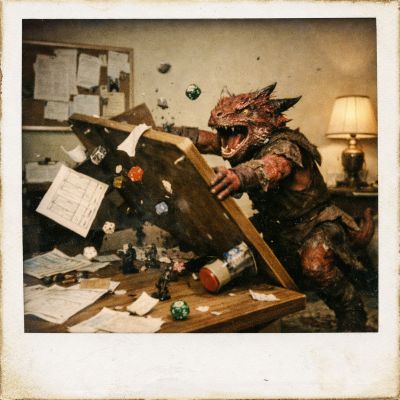
At some point in every long running campaign, bad behaviour at the table happens. A player goes rogue. Not in the charming backstab-the-dragon way. But in the rules-lawyering, spotlight-hogging, eye-rolling, group-fracturing way. The table energy shifts. Shared fun begins to ebb.
If you run games long enough, you will face this moment. If you lead people long enough, you will too.
The parallels between managing bad behaviour at a roleplaying table and leading a team in the workplace are surprisingly tight. Both require the courage to act before the whole party wipes. Here are three stages to handle it, whether you are behind the DM screen or at the head of a meeting table.
Stage One: The Quiet Word by the Campfire
In the Dungeons & Dragons Player’s Handbook, there is an implicit social contract. The game assumes cooperation. It assumes you are not actively trying to ruin the experience for others. When a player starts derailing sessions, dominating decisions, or treating fellow players like NPCs, your first move cannot be a thunderbolt from the heavens.
It is a quiet conversation. Private. Calm. Specific.
- “Hey, I’ve noticed you’re interrupting others a lot during planning scenes.” This is preventing them from getting involved.
- “I’ve seen some frustration when rulings don’t go your way.” This slows down play and creates a bit of a weird atmosphere with myself and the other players.
This is not an accusation. It is feedback. You are describing behaviour and explaining impact.
At the gaming table, most problems live in the land of misunderstanding. Someone may not realise they are hogging spotlight. Someone may think the aggressive banter is funny when others find it draining.
The same is true in the workplace. As a leader, stage one is informal and early. You do not wait for the team to fracture. You address behaviour before it calcifies into culture. Make your expectations clear. The impact must be understood and the request for change cannot be ambiguous.
Most people, when treated like adults, respond like adults.
Stage Two: The Formal Warning Scroll
If behaviour continues after the informal chat , you have to escalate. At the table, this might mean a more direct conversation.
- “We spoke about this last month. It’s still happening. If it continues, you may not be able to stay in this campaign.”
Now the stakes are visible.
In a group where you are all friends this can be a difficult conversation to navigate. But it doesn’t have to be confrontational. Reiterate the way the group likes to play and that the problem players style is different and not gelling.
In leadership, this is where structure matters. Documentation. Formal performance conversations. Clear consequences. Alignment with policy. Compliance with employment law. You are no longer just nudging behaviour. You are protecting the team.
In both spaces, the key elements are:
- Clear examples of behaviour
- Clear expectations going forward
- Clear consequences if change does not occur
- A genuine opportunity to improve
You cant escape the fact that this stage is uncomfortable. It requires backbone. Leaders often avoid it because they fear conflict. But avoidance is not kindness. It is deferred damage. Every time you fail to address ongoing bad behaviour, you send a signal to the rest of the group that this behaviour is is acceptable.
And that signal causes more damage than you would imagine.
Stage Three: Removing the Player from the Table
Sometimes, despite every effort, the behaviour does not change. At a gaming table, the final step is simple in principle, but very difficult in practice:
You ask them to leave the campaign. You do not do it lightly. Keep emotion out of it. Do it because the health of the group matters more than the comfort of one individual. Ultimately, it is a leadership decision.
In the workplace, this stage becomes formal performance management that may result in termination. This must comply with employment law, company policy, and procedural fairness. There must be evidence, the employee must have an opportunity to respond. There must be consistency.
But the principle remains the same. A team cannot thrive if one person consistently erodes trust, morale, or performance.
Letting someone go is not failure if you have:
- Communicated clearly
- Provided support
- Given reasonable opportunity to change
- Acted fairly and consistently
Sometimes the most responsible act of leadership is protecting the many.
The Deeper Lesson
Whether you are running a dungeon or running a department, leadership is not about avoiding conflict. It is about stewarding the experience. In a roleplaying game, you are safeguarding fun, safety, and shared storytelling. While in the workplace, you are safeguarding culture, productivity, and psychological safety.
Both require:
- Early intervention
- Honest conversations
- Escalation when necessary
- Courage to act
Ignore bad behaviour at the table long enough and it becomes the campaign setting. Unchecked and your game will stop being fun, players will leave and it will eventually implode. Ultimately, following the adage that no D&D is better than bad D&D.
Address the behaviour with clarity and fairness, and you show your players that they are important and that the game matters.
Quick Note: checking bad behaviour at the table doesn’t have to rest on the shoulders of the DM. Rather it can be dealt with by any player. Remember, having fun is a shared responsibility.