Kill Team Narrative Mission: Dinosaur Hunt Challenge

Kill Team is a fun, balanced skirmish game, with very thematic teams to choose from. Space Marines play like tough super soldiers and Orks are very anarchic. It also has a cooperative mode where players work together to beat NPOs (non player operatives) and achieve a shared objective. The range of available teams, 42 at the last count, and stats for various NPOs fills a very nice toolbox for the creation of narrative scenarios. This coupled with the fact that I’ve always wanted to play a big game hunt with dinosaurs since playing 40K as a kid has inspired me to build a kill team narrative mission. Of course there needs to be various twists and turns in there too. After all, no narrative mission is complete without secret objectives.

This mission is for six players plus a GM.

Mission Context

The Imperial Governor of Neblar Prime is celebrating his 150th birthday. Tradition dictates that he host a big game hunt as a core part of the festivities. Being useless with a gun, the Governor has engaged the famed Imperial hunter Thaddeus Ravenwick to bag a few dinosaurs for the feast. Of course, the hunters exploits will be televised across the planet so that all the citizens can share the excitement of this momentous occasion. It will be good for the morale of the workers.

However, the Governor should be more worried about the morale of the workers. Even now rebellion is fermenting, aided by a nefarious genestealer cult. The locals, who revere the dinosaurs are being stirred up and have been convinced that disrupting the hunt will spark an uprising that will overthrow their uncaring overlords once and for all!

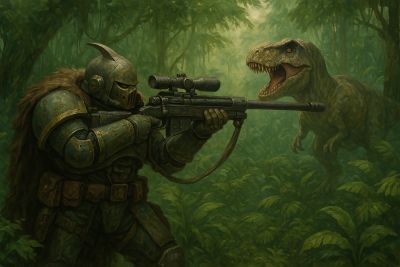
The Imperial Hunter confronts the Young blood in thick jungles of Neblar Prime.

Factions and Objectives

This game is set for six players split into two factions, the imperial hunters and the zealous rebels/cult. A third faction, consisting of three dinosaurs will be run by the GM.

To win the imperials must kill more dinosaurs than the rebels can save. Five points each respectively. In addition each player will score three points for completing their secret objective.

Characters

Each player gets one character and one to two support operatives. I have listed them below including the equivalent Kill Team stats for each as well as their secret objective. All the Kill Team operative stats are free to download from the Warhammer website.

Team Imperial

Big Game Hunter:

  • The famous Thaddeus Ravenwick (Angels of Death Eliminator).
  • His trusty manservant Djeeves (Exaction Squad Vigilant).
  • Secret Objective: Keep your legend alive, kill at least two dinosaurs.

Long Suffering Security Detail:

  • Lt Salazza (Rogue Trader Void Master)
  • Shadowy guard (Rogue Trader Death Cult Assassin)
  • Secret Objective: Do your job, make sure Thaddeus is alive at the end of the scenario.

Imperial Scouts:

  • Lead scout Ragman (Space Marine Scout Sgt)
  • Scout (Space Marine Scout Hunter)
  • Secret Objective: Had a bar fight with the Rebel Gunna last night and need to finish what he started, make sure he is dead by the end of the scenario.

Rebels (Sneaky Genestealer Cult!)

The Boss:

  • Rebel Leader Vispoz (Wyrmblade Kelemorph)
  • Cult Brother (Brood Brother trooper)
  • Secret Objective: Make sure Thaddeus is dead by the end of the scenario and fuel the fire of the rebellion.

The Heavy

  • Gunna Bigarms (Brood Brother with grenade launcher)
  • Buddy (Brood Brother trooper)
  • Secret Objective: Had a bar fight with the Scout Ragman last night and need to finish what he started, make sure he is dead by the end of the scenario.

The Young Blood

  • Falco Soarer (Wyrmblade Primus)
  • Buddy (Brood Brother trooper)
  • Secret Objective: If The Boss doesn’t make it out alive you’ll get promoted. Make sure he doesn’t.

Kill Team Dinosaurs

The GM will control three mega fauna (dinosaurs) that the hunting party are stalking. These will be set up together in the designated area. Kill team stats as follows:

Grand Lizard (x1):

  • APL 3, Move 6″, Save 4+, Wounds 30
  • Melee Claws and Teeth Attack 6, 3+ 5/6 Relentless
  • Ignore piercing (tough hide), can attack twice per activation.

Sub Lizard (x2):

  • APL 2, Move 7″, Save 5+, Wounds 20
  • Melee Teeth Attack 4 3+ 4/5

The kill team dinosaurs operate in a simple way.

  • If they can see an operative – Charge and attack the closest.
  • If they cannot see an operative move in a random direction.
“I’m sure the lizard is around here somewhere”

Game Set Up

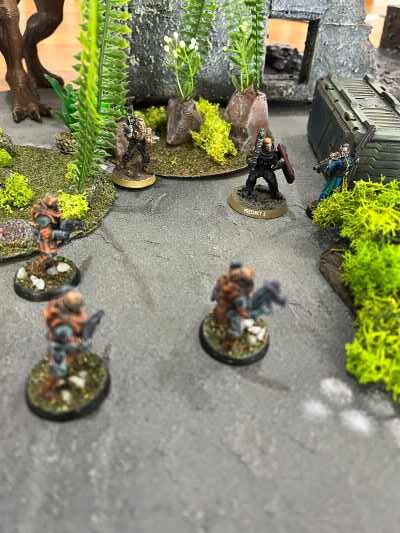
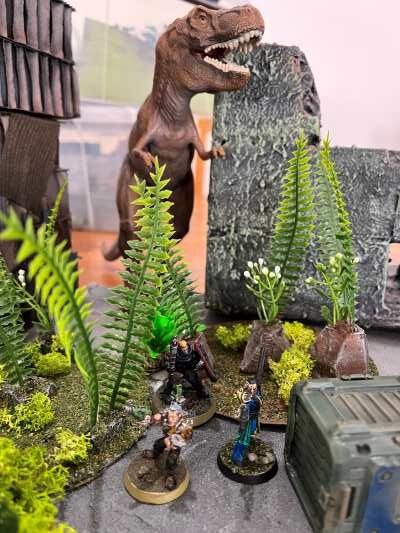
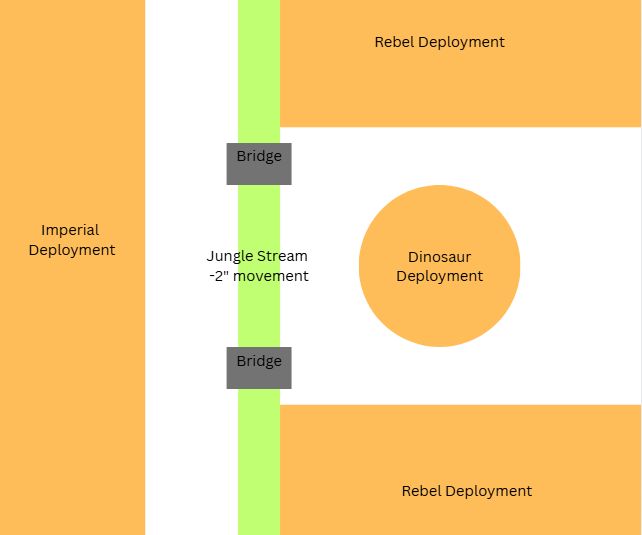
For this Kill Team narrative mission place thick jungle terrain across the board. Feel free to add ruined temples, abandoned hab blocks etc. Make the terrain denser than a normal Kill Team battle. A jungle stream with 2 bridges is also a fun addition. The dinosaurs start in a clearing to the right of the board. Make sure to have no firing lanes between the Imperial deployment and the dinosaur clearing.

Kill Team Narrative Mission map – play around with the set up to make something that looks thematic with limited firing lanes.

Terrain Rules

Some suggested rules for the terrain are:

  • Stream – minus 2″ to movement when crossing.
  • Jungle – blocks line of sight and gives light cover.
  • Ruins etc – heavy cover and blocks line of sight.

Playing The Mission

Players position themselves around the table in alternating order: Imperial-Rebel-Imperial-Rebel etc. Roll for initiative and play moves in the above order.

No tac ops, no crit ops. The sole mission is that described above.

Play lasts for 4 turns.

Final Thoughts

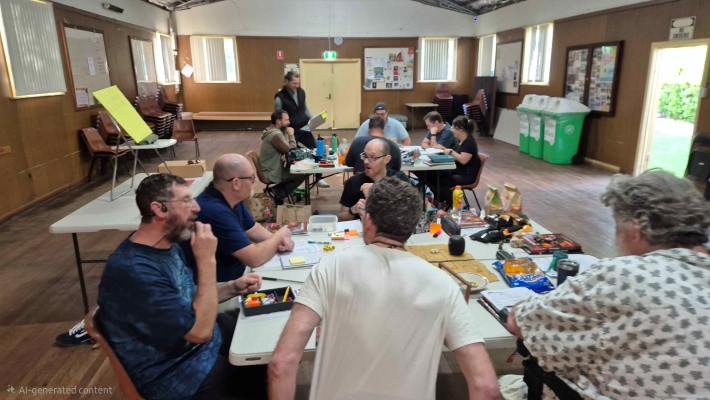
Although I’ve designed this narrative mission with Kill Team in mind this could very easily be ported to Space Weirdos or 5 Parsecs from Home. In fact I’m aiming to run this at the local club using Kill Team and Space Weirdos for the next Marty Con. I’ll write up a battle report when the dust has settled.

I’d love to hear if anyone uses this scenario. But if nothing else I hope I’ve shown that Kill Team can be used for some different narrative style missions. There is so much scope here. Lots of inspiration can be drawn from WW2 commando actions and I’m looking at how to create a 40Kified Battle of Termoli.

You can see more about the narrative Kill Team Campaign I ran here.

How to Run a Great One-Shot RPG

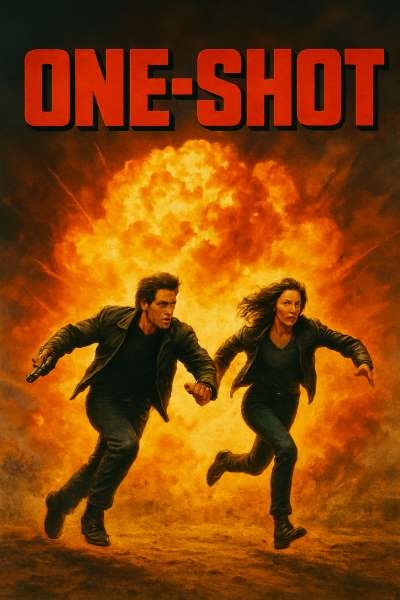
Long campaigns are amazing for building worlds, deep character arcs, and epic stories—but sometimes you just need a shot of adrenaline. That’s where the one-shot comes in. A one-shot is a single-session adventure designed to start and finish in just a few hours. Done right, it feels like being in a high-octane movie: fast, dangerous, and unforgettable. I’ve talked about the joy of the one-shot in a previous article here. But how do you actually run a great one-shot that lands well? Let’s find out.

Set the Ground Rules

Because one-shots run on tight timeframes, you need to make expectations clear with your group from the beginning:

  • It’s short: Everything happens in one session. No dangling plot threads.
  • It’s fast: Rules are kept simple; don’t get bogged down in fiddly mechanics.
  • It’s dangerous: Character death is on the table. That danger makes choices matter.

Letting your players know upfront that this is not your regular slow-burn campaign gets them invested. Tonight is about pace, energy, and action.

Quick Character Creation (or Pre-Gens)

Time is precious. You don’t want to spend an hour on character creation for a three-hour game. You’ve got two options:

Pre-Generated Characters: Hand players ready-made characters. Give each one a short description and a couple of unique abilities or quirks. Bonus points if you add a little “secret” or motive to fuel roleplay.

Fast Build Rules: Strip character creation down to the essentials: name, a role, a quirk, and what they’re good at. Systems like Those Dark Places, Mothership, or Dungeon World do this brilliantly. Even D&D can be hacked for speed by handing out simplified sheets. Another option would be to provide playbooks to speed up character creation while giving players a meaningful customization.

Aim to have characters ready in 5–10 minutes, max.

Pick a Different Genre

A great one-shot is the perfect excuse to step outside your group’s regular game. If your campaign is fantasy, try a sci-fi horror. If you’re usually running superheroes, jump into pulp mystery. The contrast makes the session feel fresh and exciting.

Changing genre also helps players break free of their usual habits. A D&D rogue might always act a certain way, but suddenly they’re playing a doomed spaceship mechanic or a washed-up detective with different motivations. That fresh perspective fuels creativity.

A Great One-Shot is Like a Movie

The best one-shots feel cinematic. Here’s a few ideas to help bring the excitement of the big screen into the game.

  • Cold Open: Throw players straight into action—explosions, monsters, a chase. Skip the slow build.
  • Middle Twist: Add a big revelation that flips the situation on its head.
  • Final Showdown: End with a bang. The danger should feel real, and not everyone has to make it out alive.

If you structure it like a two-hour action movie, the pacing will carry the game.

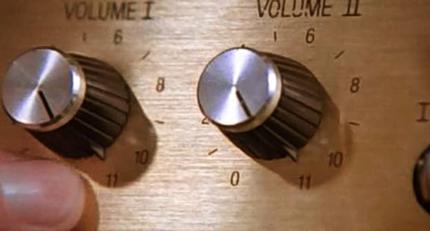
Be like Spinal Tap, dial it up to Eleven.

Keep It High Action & Dangerous

In a campaign, the DM sometimes dials back the risk to preserve story arcs. In a great one-shot, you can crank the danger up to eleven. Encourage bold play and reckless decisions:

  • Throw in bigger monsters or threats than you usually would.
  • Use time pressure (ticking clocks, collapsing buildings, oxygen running out).
  • Say yes to crazy plans—and let the dice decide if they succeed spectacularly or crash in flames.

The point is excitement, not balance.

Tips & Tricks for Smooth Play

Here are a few extra tips to wring the most out of your game:

  • Limit prep: Don’t write a novel. Outline three encounters, with a twist and a finale.
  • Visual cues: Use props, handouts, or mood music to instantly set the tone.
  • Encourage roleplay fast: Give each character one hook or motivation to lean into right away.
  • Embrace chaos: Players will do something unexpected. Roll with it—it’s part of the fun.

I tried to incorporate as much of the above as possible in my recent Star Wars themed One-Shot.

Final Thought

Running a one-shot is like directing a blockbuster movie. Keep it lean, keep it moving, and keep it dangerous. By the end, your players should feel like they just went on a wild ride—and you’ll all return to your regular campaign with fresh energy.

So next time a couple of players can’t make your regular session—or you just want to try something new—queue up a one-shot. Lights, camera, dice!

Leadership Is a Muscle—And You Need to Train It

business man training his leadership muscle

We all know the value of exercise. You go to the gym to lift weights, run on the treadmill, or maybe stretch through a yoga class. Each of these activities targets different aspects of your physical health: strength, stamina, flexibility. If you don’t exercise those muscles, they weaken over time. Of course, Leadership is no different. Being an effective leader isn’t a fixed trait—it’s a skillset. And like your biceps or your lungs, those skills need intentional training to stay sharp and healthy. You can’t expect to be at your best if you never put them under purposeful stress. How do we train our leadership muscle?

Training Your Leadership Muscle at Work

In the workplace, this means being deliberate. You can:

  • Practice communication: Share openly, listen actively, and make sure your team understands not just what you’re saying, but why.
  • Build self-awareness: Take time to reflect on how you show up for your team, what went well, and where you can improve.
  • Be purposeful: Don’t just drift from meeting to meeting—set clear intentions about how you want to show up as a leader that day.

These small acts, repeated, strengthen your “leadership core.”

Another Gym for Leaders

Here’s where it gets interesting. You don’t have to limit leadership practice to the office. Just as athletes cross-train with different sports, leaders can cross-train with games.

Given the theme of this blog we’ll take Dungeons & Dragons as an example. At first glance, it’s a fantasy roleplaying game filled with dice, dragons, and dungeons. But beneath the surface, it’s an intricate leadership laboratory.

  • As a Dungeon Master, you’re practicing facilitation, storytelling, and group management—all while balancing competing needs and personalities.
  • As a player, you’re practicing collaboration, decision-making under uncertainty, and influencing a group without dominating it.

What’s fascinating is that, as science writer Jennifer Ouellette explains in Me, Myself and Why, our brains treat these imagined experiences as real. When you roleplay leading a group through a perilous dungeon, your memory encodes it as though you actually led people through challenges. That means the leadership muscles you work in a game session can directly strengthen the ones you’ll use in Monday’s staff meeting.

Games can be a useful gym in which to train your leadership muscle.

Purposeful Play as Practice

Think of it this way:

  • A high-stakes project deadline is like a boss battle.
  • Negotiating with a client isn’t all that different from convincing a suspicious NPC to help your party.
  • Balancing diverse team needs mirrors balancing a party of adventurers with wildly different skills and motivations.

If you approach these game scenarios with intentionality—practicing clear communication, reflection, and purposeful decision-making—you’re training your leadership muscles in a safe but meaningful environment.

Keep Your Leadership Strong

Just like the gym, leadership training isn’t a one-and-done activity. You need to keep working at it. At work, in life, and yes—even in play.

So next time you roll dice at the table, don’t think of it as just a game. Think of it as a workout for your leadership. The more you train, the stronger you get.