Building a Realm One Session at a Time: My Fortnightly Mythic Bastionland Game

Every fortnight my gaming group gathers to play Mythic Bastionland by the talented Chris McDowall, a game about wandering knights defending their realm from strange myths and ancient dangers.

If you imagine the sweeping, generational storytelling of Pendragon, but loosen the strict expectations of chivalric codes, you are somewhere close to the spirit of the game. The knights of Bastionland are not bound to an exact interpretation of honour. Instead, they roam the realm keeping to their oaths: Seek the Myths, Honour the Seers, Protect the Realm. In doing so they confront mysterious forces that threaten the realm, shaping its fate through their deeds.

And it has been an absolute blast to run.

The Knights of the Realm

Our current band of defenders is a wonderfully strange mix of personalities and mythic archetypes:

  • Ser Steele, the Cosmic Knight, who has a fascination with the stars and enormous ambition.
  • Lady Faun, the Snare Knight, at one with nature, preferring the wilds to the slowly burgeoning civilisation.
  • Ser Aegen, the Salt Knight, hardened by sea winds and coastal hardships.
  • Ser Whynn, the Iron Knight, steadfast, laughs in the face of danger with a mead in hand.
  • Ser Perceval, the Temple Knight, devoted to sacred duty and the protection/creation of holy places.

Together they wander the realm confronting the myths that threaten the fragile stability of civilisation.

Creating characters is easy, 1D12 +1D6 for three virtues Vigour, Clarity and Spirit, roll or choose a knight and you’re off.
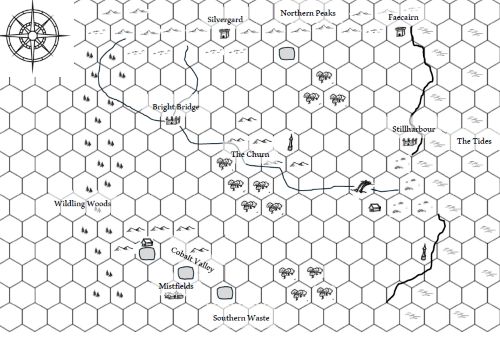
The Realm of Caer Senara

Creating the Realm of Caer Senara

As the games master, one of the joys of Mythic Bastionland is how easily it helps you create a living world. Rather than meticulously designing everything in advance, I generated most of the setting using the book’s random tables.

The result was the realm of Caer Senara, centred around Stillharbour, the coastal port and Seat of Power. Around it lie several holdings:

  • Mistfields – a valley of lakes and vineyards, ruled by a drunken lord with a sinister senechal pulling strings in the background
  • Faecairn – Watchtower where the boundary to the fey is thinner
  • Silvergard – Home of the Praetorians and taciturn and well trained military force
  • Brightbridge – Foodbowl of the realm with seas of wheat and hotbed of rebellion

To give the realm immediate tension, I also generated four myths lurking within its borders, along with a number of strange landmarks including the Sea Kings throne, a ruined monastery and a deranged alchemist. What emerged surprised me. The random tables didn’t create chaos. Instead they produced something that felt layered, mysterious, and alive.

The bones of the world came together over a couple of afternoons. However, the real magic began once the dice started rolling.

When the Realm Comes Alive

Over the first ten sessions, the knights have already shaped the fate of Caer Senara in dramatic ways.

  • The company won a grand tourney against knights forged from clockwork
  • A tidal wave once threatened to devastate the realm, forming in the mountains instead of the sea.
  • A giant boar roamed the countryside, leaving destruction in its wake.
  • Political tensions simmered among the noble houses resulting in a rebellion erupting within the realm itself.

None of these stories felt forced. They grew naturally out of the myths, locations, and the decisions of the knights. I feel that I am discovering the plot at the same time as the players.
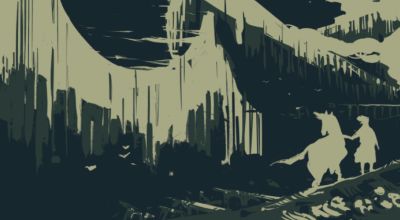
The artwork in Mythic Bastionland is thematic, intriguing and beautiful.

Entering the Second Age

Now, after ten sessions, the campaign has reached an important milestone.

We are entering the Second Age of the realm.

Time moves forward in Mythic Bastionland, and the passage of years is part of the story. The knights themselves are growing older, as they do their stats initially improve, but as they enter old age they begin to decline. Marriages have been arranged and the key holdings are now run by the players. Successors have been appointed. The political landscape has completely shifted.

New challenges loom on the horizon. This movement of time gives the campaign an epic quality. It feels like a chronicle of a realm slowly changing across generations.

A Breath of Fresh Air

Another reason I enjoy this game so much is its simplicity.

Running a campaign that isn’t Dungeons & Dragons has been surprisingly refreshing. The rules are lighter, record keeping is minimal, and the style of play is very different. Players rely more on their wits than an array of powerful abilities.

Less bookkeeping means more time for story, strange myths, and the unpredictable decisions of wandering knights.

Sharing the Realm

I’ll be making my original scrappy realm notes for Caer Senara available for anyone who is interested. You might use them as the starting point for your own campaign, or simply as an example of what a randomly generated realm can look like. Either way, they show how a few tables, a handful of myths, and a group of players can quickly grow into a living world.

And who knows. Perhaps your knights will one day ride through the misty fields of Caer Senara as well.
Bullets, Bandannas, and Beautiful Nonsense: Playing 80’s Action Dudes

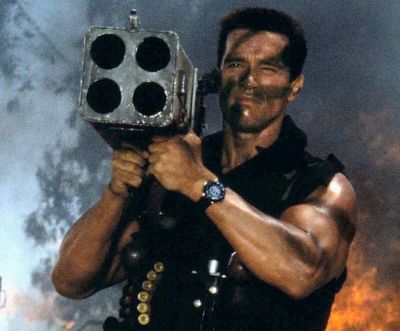
There are roleplaying games where you carefully track encumbrance, calculate modifiers, and debate the tactics of which spell to cast first. And then there are games where you kick down a door, fire an assault rifle one-handed, and shout something so gloriously ridiculous that reality slaps your back and gives you your hit points back.

80’s Action Dudes, created by my mate Marty, lives proudly in the second category.

Welcome to the Jungle (Bring a Soundtrack)

From the moment we sat down, the tone was locked in harder than a flexed bicep in a sleeveless vest. An 80s rock soundtrack blared in the background, all electric guitars and swagger, the kind of music that makes you feel like you could outrun an explosion purely out of principle. Marty had curated the perfect soundtrack with bands like Poison, Whitesnake and Boston, that had us all ready to play before we even created our characters.

It only took Marty 2 minutes to explain the system of 80’s Action Dudes, a clever hack of Cthulhu Dark by Graeme Walmsley. Different dice for different guns (D4, D6, D10) and the dice didn’t tell you if you hit. No way. They told you how many people you took out of action.

We came to kick ass and chew gum, and we were all out gum. Oh and we had three hit points.

Character Creation: Maximum Velocity, Zero Brakes

Character creation was also quick and easy. You needed:

  • A cool name
  • A main weapon
  • A one line description
  • Some special kit

That’s it. Vibes and testosterone.

Enter my character:

Rusty MacGregor
Ex–French Foreign Legionnaire. American as fuck.

Armed with his trusty assault rifle, razor sharp machete, and a tin of chewing tobacco, Rusty also sported a stars and stripes bandanna across his ruggedly handsome brow and was ready for action.

The Action Dude Team… you get the picture

The Crew: The Action Team

Our team was exactly what you’d hope for:

  • A Chinese ninja who moved like a shadow deadly throwing stars at the ready
  • A bare-knuckle fighter built like Van Damme with mad nunchuck skills
  • A mad radioman “Giggles”
  • Two M60 armed musclemen Rip and Butch.

Together, we were dropped into a jungle with one mission:

Take out a camp of commie insurgents. No diplomacy. Just kicking ass and shooting guns.

Mechanics That Punch You in the Face (In a Good Way)

The genius of the game wasn’t just in its theme, it was in how the mechanics fed that theme. Marty had got the balance just right.

Grenades? You didn’t roll for them. You physically threw balls into a bucket. Missed the bucket? Bad luck. That grenade is now someone else’s problem. Hit it? Boom. Cue cheering, high-fives, and a slow-motion dive.

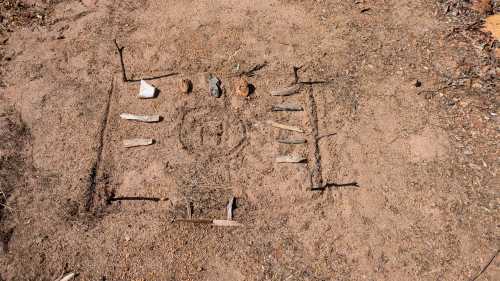
We even had a proper mud map laid out in the garden adding to the immersion of our grand tactical planning.

Mud map ready for our Action Dudes to plan their assault

Now here’s where the game transcends even further. When you took wounds, you didn’t just sit there and sulk like an unpatriotic man baby. You earned them back the only way that matters:

One-liners.

Drop something suitably punchy, and you’d claw back your health.

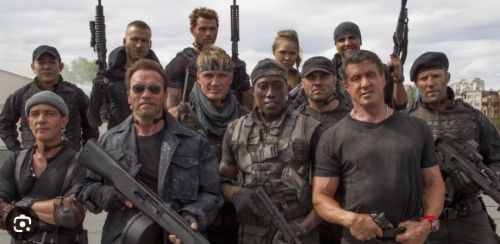
Something in the spirit of Arnie and Stallone, like:

“I eat Green Berets for breakfast. And right now, I’m very hungry!”

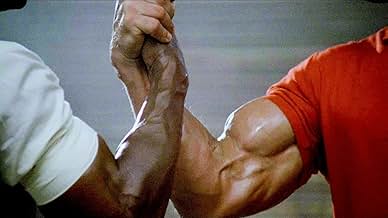
Alternatively, you could clasp hands with a teammate, lock eyes like long-lost brothers, and bellow:

“SON OF A BITCH!”

Instant recovery to full hit points!

Action dude HP recovery

Scenes That Shouldn’t Work (But Absolutely Do)

What followed was a cascade of moments that felt ripped straight out of an Expendables fever dream:

  • Rusty leaping from a creek firing into enemy reinforcements
  • The ninja appearing and disappearing like a lethal magic trick
  • Grenades arcing through the air with varying degrees of success and panic
  • Entire squads of enemies being removed from existence in single, glorious dice rolls
  • The ammo dump exploding in a tongue of flame
  • Rusty dying in a blaze of glory at the helm of a Russian attack helicopter (dont ask)

It was loud, chaotic and deeply, deeply … fun!

Why It Works

At its core, 80’s Action Dudes is a masterclass in one simple idea:

Commit to the bit.

The rules are light, but laser-focused. Every mechanic pushes you to be louder, bigger, and more ridiculous. There’s no room for hesitation, only escalation. And because everyone understands the tone, the table becomes a kind of shared action movie, where each player tries to outdo the last in sheer action-hero bravado.

The result? Eight grown adults laughing like lunatics while throwing pretend grenades and inventing increasingly terrible one-liners.

What it’s all about

Final Thoughts: Explosions Optional (But Encouraged)

What this game proves, more than anything, is that you don’t need complexity to create something unforgettable.

  • Give players a strong theme.
  • Give them permission to go all in.
  • Add a few clever mechanics that reinforce the fantasy.

Then stand back and watch the magic happen. 80’s Action Dudes wasn’t just a game., it was a riot. And Marty was an absolute legend for pulling together such a memorable game.

The Lost Temple: An Adventure in Collaboration

I’ve been working on the idea of a roleplaying game that can be used for leadership development for a while now. My first attempts can be found in my Play2Lead ruleset. During playtesting the rules definitely work as intended. Now all that is needed are some scenarios that focus on specific leadership lessons. There are so many themes to choose from it was difficult to work out which to use. However, the more I thought about it the more collaboration bubbled to the surface. Every successful team, business and leader thrive on collaboration. Therefore this adventure scenario focuses on exactly that.

Design Principles

For a game to work in the leadership development setting I believe it should attempt to fit within the following principles:

  • Easily identifiable. Players who don’t like or understand fantasy should be able to relate to the setting and themes of the adventure
  • Playable in a lunch break. Maximum play time of 1.5 hours, though ideally within 1 hour
  • Playable for 4-6 participants excluding the gamemaster
  • Have a clear objective
  • Start in the action immediately
  • Apply pressure throughout, forcing fast tense decision making
  • Focus heavily on the leadership lesson. In this instance “collaboration”.

Given the short playing time I have designed the scenario around the following timeline:

  • Introduction, explanation of rules and choosing of roles – 10 mins
  • Encounter 1 – straight into the action – 15 mins
  • Encounter 2 – problem solving – 15 mins
  • Encounter 3 – explosive finale – 15 mins
  • Wrap up and debrief – 10-20mins

Adventure Introduction

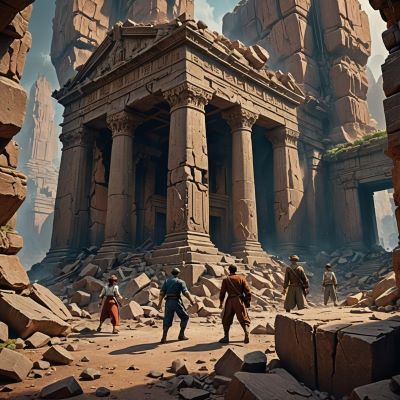
In the heart of the dense jungle lies the ruins of an ancient temple, rumored to hold untold riches and artifacts of great power. However, the temple is also said to be filled with traps and puzzles designed to test the wit and cooperation of those who dare to enter.

A group of treasure hunters have funded an expedition to the temple in the hope of uncovering it’s wonders to share with the world. The architects of this ancient place were cunning beyond measure, and the team will soon discover that their greatest challenge will be working together to make it out alive.

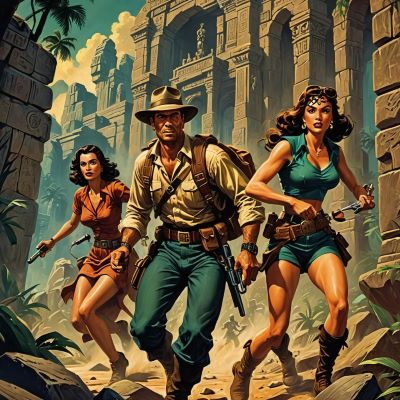
For inspiration think Indiana Jones, Tomb Raider, Unchartered and Jungle Cruise.

Player Set Up with Collaboration in Mind

Using the Play2Lead ruleset all players need is an occupation. For this adventure they can choose from:

  • Archaeologist – professor of the ancient world. Equipped with a lantern. Read hieroglyphics, understand artefacts, high level of knowledge
  • Climber – working at heights professional. Equipped with a 50m rope. Climbing, ropework, high level of agility
  • Engineer – technical specialist. Equipped with a shovel and axe. Construction, demolition, high level of practical know how
  • Navigator – directional expert. Equipped with a compass. Map and compass skills, unerring sense of direction
  • Pilot – helicopter pilot. Equipped with a lantern. Piloting vehicles of all types, radio use, electronics master
  • Expedition Leader (optional) – no specialist skills. Equipped with a knife. Must facilitate the team working together

To speed things up have a character sheet for each character type ready to go.

#1 Collapsing Chamber

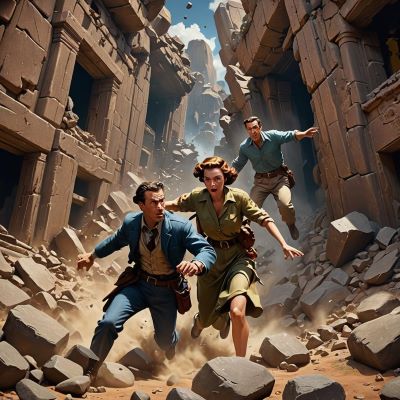
We begin in the treasure room of the Lost Temple. A chamber adorned with intricate carvings, hieroglyphics and ancient relics. Piles of gold and gems lie strewn along the walls. Timber shelves lie broken on the floor. On a roughly hewn plinth sits the fabled statue of the gods glinting in the torchlight. Pick a player at random. That characters hand has just closed around the ancient artefact. Suddenly, they trigger a hidden mechanism, causing the chamber to shake violently as the ceiling starts to collapse. Large stone blocks begin to fall from above, blocking the exit. Gold coins rain from the ceiling filling the chamber and restricting movement.

Challenge: The party must quickly assess the situation and find a way to escape before they’re crushed by falling debris.

Solution: A hidden lever is located up one of the walls. Reading the hieroglyphics will point out it’s location. Otherwise careful observation might allow it to be found. Pulling the lever stops the collapse and reveals a new passage to safety. Alternatively, the party could use their strength and agility to dodge falling rocks and clear a path to the exit.

Remember this is a high pressure situation. Make players take Exhaustion (Play2Lead) or other Pressure Tests if using another system to ratchet up the tension. Don’t give the players too much time to plan. If an individual is taking too much time skip them and move on. Pushing the time threat is a critical part of this encounter.

#2 River Rapids

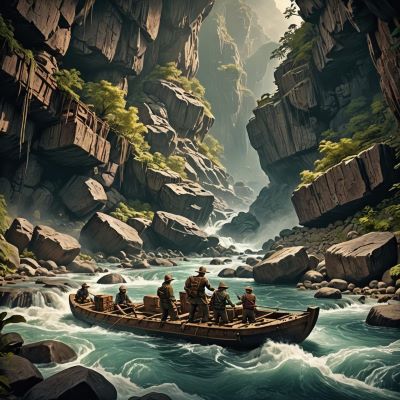
Exiting the collapsing chamber, the group of adventurers find themselves in a vast underground river that flows through the heart of the temple. The river’s currents are swift and treacherous, and the only means of escape seems to be an old rickety raft tethered to the shore.

Challenge: Maneuvering the raft through the river’s rapids while avoiding jagged rocks and hidden dangers.

Solution: The party must work together first to make the raft river worthy. Not doing this will give it a chance to break up halfway through the encounter. Secondly, to navigate the river, using their skills to steer the raft safely. The river will fork. The navigator will be able to tell which way to go. Alternatively there is a fresher breeze coming from the right channel. Along the way, they encounter a series of jagged rocks that threaten to damage and capsize the raft.

Reward player ingenuity here. What will they use to steer the raft? How will they make it safe to use?

#3 Guardian’s Gauntlet

The river throws the group from a low waterfall into a pool below. The bright sunlight of the jungle pool meets them as they find themselves out of the temple. However, as they swim to the side something slides against the leg of one of the swimmers. They are not alone.

Within the pool lives a formidable guardian—a massive, serpentine creature with gleaming scales and razor-sharp fangs. Blocking their path, the guardian seems intent on preventing anyone from leaving the temple alive. It will attempt to encircle the character that is most alone and attempt drown it. One bite from this creature will kill a character outright. This should be played as a deadly, exciting grand finale to the adventure.

Challenge: Defeating or evading the guardian while making a desperate dash for freedom.

Solution: The party must use their wits to outmaneuver the guardian, perhaps by exploiting its weaknesses or finding a way to distract it long enough to slip past. Alternatively, they could way to incapacitate it temporarily, allowing them to make their escape without resorting to violence.

Heighten the terror by having the creature signal it’s presence. Slithering past a leg. Ripples on the water. A flick of a slimy, scaly tail. When the creature reveals itself play up the danger, the toothy maw, the crazed eyes. Make sure the payers know that their characters are in trouble.

Once again reward out of the box thinking and collaboration. How will the team distract or defeat the creature together. This is not something they can win alone.

Collaboration Debrief

Did the players escape unscathed? While the adventure is over, the experience is not. Now is the time to get your players reflecting upon their experience. Ask some or all of the following questions to draw out the discussion.

  • Where did you as a team collaborate well?
  • Did you utilize everyone’s skills?
  • How could you have integrated collaboration better?
  • Is there anything you would have done better?

Following the debrief it’s also worth asking your players for feedback. Did they enjoy the experience and was there anything that could have been done better?

Final Thoughts on an Adventure in Collaboration

This adventure aims to be a fast, exciting experience that fosters collaboration between the players. A chance to debrief afterwards gives attendees a chance to reflect on their experience and what went well and what didn’t.

I envisage this as a useful experience for a cohort of a future leaders training course. Run this experience at the beginning of the course. Then, follow up with a similar experience at the end and see how they have grown as leaders. Has their level of collaboration increased?

Alternatively it could be used as a way help a newly forming team. A chance to get to know each other in a fun experience as well as reflect on how they might work together moving forward. Other uses might be as a way to introduce new people to world of rpgs. A small commitment of time as a way to dip their toes into this exciting medium.

I hope this simple scenario opens your eyes to what can be done with a short, simple adventure. Where do you think it could be used?

A pdf of this adventure with character sheets can be found at the Play to Lead downloads page.