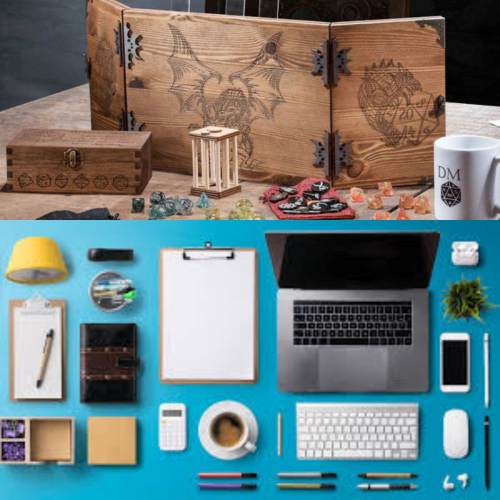

Some of you might already know that I am a huge fan of playing Dungeons & Dragons face to face around a table. The phones are away, everyone is present at the table and reacting to one another in real time. Somewhere between the terrible (but infectious) jokes, dramatic character moments and crazy in world hi-jinks something happens that is difficult to recreate online.
You become a group.
Don’t get me wrong online D&D is has its place. It allows people who live in different cities, countries or even continents to play together. As proved in the Covid pandemic it creates options for groups to keep gaming when meeting in person isn’t practical.
But when you can get everyone around the same table, there is a particular kind of magic that happens that cant be replicated online.
Having spent three years working from home, I fully understand how these face to face lessons apply to the workplace. Being fully remote loses the significant benefits of working with your teams in person.
There is more to communication than words
When you’re playing D&D face to face, communication isn’t just about what someone says. You see the beginnings of a grin when someone has an idea. Carol leans forward because they’re suddenly interested. Two players share a look when they realise they’ve had the same thought. Andrew hesitates before suggesting something. You hear the change in Marty’s voice when they’re getting excited. A huge amount of communication happens without anyone deliberately communicating it.
Online, much of that information gets lost. Cameras might be turned off or mics muted. Someone’s face might be reduced to a tiny square on a screen. If you’re playing through a virtual tabletop, there may be several windows competing for your attention.
Funnily enough the same things happen at work. Email is excellent for communicating information. Teams and Slack are great for quick questions. Video calls are incredibly useful and have their place. But none of them completely replace being in the same physical space.
Human beings communicate through much more than words. Cues created by body language are critical in gaining understanding the other person. Sometimes the most important part of a conversation is the five seconds before someone says anything.
The conversations between the conversations
One of the great things about playing D&D face to face is what happens when nobody is technically playing. When everyone arrives before the game and settles in the conversation starts flowing. Two players start discussing what happened last session. while the DM and another player have a quick conversation about a character. Someone tells a story. You end up talking about something completely unrelated to the game.
I can be guilty of thinking of these as wasted moments. I want to get on with the game. However, think of them instead as part of the social glue that holds the group together.
The same thing happens in workplaces. Think about the conversations that happen before a meeting starts. Or that quick chat while making coffee. While these interactions can seem insignificant. They aren’t. Each small interaction helps build relationships which ultimately makes collaboration easier.
A shared physical space creates shared experiences
There is something powerful about everyone experiencing the same thing at the same time. The Kraken rises from the depths. Everyone reacts. The dice clatter on the table, while the group hold their breath. A natural 20 and the table erupts. Moments like this become shared memories. And shared memories create relationships.
Workplaces have these moments too. The project that somehow came together at the last minute. That ridiculous client meeting. Celebrations after winning a major piece of work. The office Christmas party that probably shouldn’t be discussed in too much detail. These experiences become part of the team’s story. Eventually you get a group of people who don’t just work together. They have a history together and that’s a powerful thing.
Physical presence makes collaboration easier
D&D is fundamentally collaborative. Players need to listen to each other, understand what others are doing and coordinate their actions. Being physically present makes some of this easier. You can point at the map, move a miniature, describe a plan with hand movements and more easily react to what someone else is doing. There is less friction.
The same applies to some workplace activities. A complicated problem can sometimes be solved in ten minutes around a whiteboard when the same discussion might take an hour through a series of emails or Teams messages. People can build on each other’s ideas immediately. Someone draws something, another changes it, while the third person spots a problem. Suddenly the group has moved from spending hours discussing the problem to solving it. The physical environment becomes part of the collaboration.
Serendipity matters
Perhaps one of the biggest advantages of being physically together is something that is very difficult to schedule. Serendipity. You bump into someone on the way to the lab. Perhaps you overhear a conversation and discover that someone else has been working on a problem similar to yours. Maybe you mention an idea while making coffee.
Someone says:
“Actually, I’ve been thinking about that too.”
And a completely unexpected connection appears.
D&D has plenty of examples. Someone mentions a character idea while setting up. Another player has a suggestion. The DM suddenly gets an idea. An NPC becomes a central part of the campaign. A throwaway comment becomes an entire adventure. The physical table creates opportunities for those things to happen.
But this isn’t an argument against being online
There is an important caveat. Online D&D isn’t bad D&D and remote work isn’t bad work. Technology has given us extraordinary opportunities to connect with people who otherwise couldn’t participate.
For some people, remote work provides flexibility that is genuinely valuable. In a D&D group, online play might be the only reason the campaign can continue. The lesson isn’t that everything needs to happen face to face. Rather that physical interaction has unique benefits that are easy to underestimate. We should recognise those benefits rather than assuming technology can perfectly replicate them.
Bring people together for the things that benefit from being together
This is where I think the D&D analogy becomes particularly useful for workplaces. You don’t necessarily need everyone sitting in the office every day. But there are some activities where getting people together can create disproportionate value.
Of course you don’t always need an agenda. Sometimes the agenda can simply be “Let’s have lunch.” That’s not wasted time. It’s an investment in the relationships that make the rest of the work possible.
The face to face table creates belonging
There is something wonderfully democratic about a D&D table. Everyone has a seat and everyone’s character matters. The wizard might be opening a magical portal while the fighter is holding the doorway and the rogue is quietly investigating something nobody else noticed. Everyone contributes something different and yet are all part of the same story.
That sense of belonging matters in workplaces too. People don’t just want to know what their job is. They want to know where they fit and to feel connected to the people around them. Face-to-face interaction can help create that sense of belonging because relationships become more tangible.
Instead of being just a name in an email, you’re the person who sits across the table, who helped solve that problem. The person who laughed at the ridiculous thing that happened in the meeting.
The person you know.
Sometimes you just need to roll some dice
Perhaps this is why I keep coming back to the physical D&D table. It’s not because technology is incapable of delivering a good game. Rather, it’s because there is something about being physically present with other people that is difficult to replace.
You hear the dice hit the table, see their reaction before anyone says anything, laugh at the terrible plan, celebrate the natural 20. Eventually, after several hours, you pack everything away and realise you’ve spent an evening with a group of people creating something unique together.
That’s more than playing a game. It’s social connection.
And perhaps that’s the lesson D&D has for the workplace.
Technology can connect us. But connection isn’t the same thing as being connected.
Sometimes we need the video call, the email, or the flexibility of working from home. And sometimes we need to put the screens away, sit around the same table and spend some time together.