
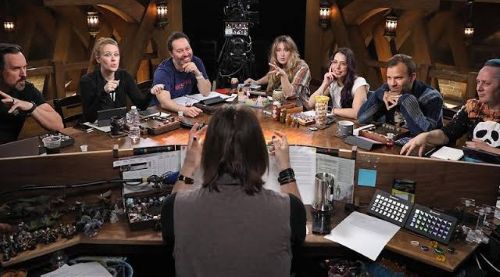
There is a moment in every Dungeons & Dragons game when the party encounters a problem that no single character can solve. Each character has specific strengths: the fighter might be able to stand toe-to-toe with the monster, the rogue can sneak past the guards and of course the cleric can keep everyone alive when things inevitably go wrong.
But none of them can do everything.
The party succeeds because the players combine their different abilities, perspectives and ideas to solve the problem in front of them. That is collaboration. And, interestingly, it is one of the biggest lessons D&D has to offer the workplace.
You don’t need another hero
One of the easiest traps for a D&D party, particularly when players are new and enthusiastic, is assuming that one character should solve every problem. It can be entertaining, but rarely effective. Threatening a red dragon on your own can be down right deadly, regardless how high your strength score is.
The same thing happens in workplaces.
We can become overly reliant on the person who is particularly good at something. The technical expert becomes the person everyone asks to solve technical problems. Our successful salesperson becomes responsible for every client conversation. The manager becomes the person expected to make every decision. Eventually, you create a team where everyone is waiting for the “hero” to solve the problem.
That isn’t collaboration. It’s dependency.
Good teams understand that different people bring different strengths. The trick isn’t getting everyone to become good at everything. It is learning how to combine those strengths effectively. In D&D, the rogue doesn’t need to become a wizard. They just need to know when the wizard’s abilities might help.
Know what everyone brings to the table
While a good D&D player understands their own character, a great player also perceives the strengths of the rest of the party. If you know the cleric has a powerful healing spell, don’t waste your turn trying to replicate it. The party’s rogue is particularly good at opening locks, don’t get the barbarian to start headbutting the door. You learn what your teammates can do and look for opportunities to use those strengths.
Workplaces are no different.
Collaboration starts with understanding the people around you. What are they good at? Where does their experience lie? Do they need support? What do they enjoy doing? And perhaps most importantly: When should you involve them?
Don’t just wait for your turn
There is another subtle lesson from D&D. While one player is taking their turn, everyone else is still involved. Good players are watching what is happening. They are thinking about what they might do next. They are listening to the Dungeon Master. They are considering how their abilities could interact with what the other characters are doing.
The game works because people aren’t simply waiting for someone else to finish speaking so they can have their turn.
Work meetings can sometimes feel very different.
- Someone presents an idea.
- Everyone waits.
- Someone asks a question.
- Everyone waits.
- The manager makes a decision.
- Everyone goes back to their desks.
Collaboration requires something different. Listen actively. Think about what has been said. Build on it. Ask questions. Connect ideas. You don’t have to be the person who comes up with the brilliant idea. Sometimes your contribution is making someone else’s idea better. That’s collaboration too.
The best plans are usually shared plans
Every experienced D&D player knows that the party’s beautifully constructed plan will probably survive for approximately six seconds after the adventure begins. Things don’t go expected, the dice fall as they do. The party has to adapt.
This is another important lesson for workplace teams. Collaboration isn’t about getting everyone to agree on one perfect plan and then following it religiously.
It is about creating enough shared understanding that the team can adapt when reality inevitably disagrees with the plan. That means communicating clearly so that everyone understands the objective and that important information is shared rather than kept in your own head. Crucially it also means being willing to alter your approach when someone else has information that changes the situation.
A collaborative team doesn’t need everyone to think the same way, rather it needs everyone to understand where they are trying to go.
Different perspectives make better decisions
D&D parties are often deliberately diverse. The characters have different abilities, personalities, backgrounds and approaches to problems. That diversity creates possibilities. Our sneaky rogue might notice something everyone else completely missed, or the wizard might create a magical solution nobody else considered. The barbarian might simply say, “What if we just break the wall?” And sometimes she is absolutely right.
Workplaces benefit from exactly the same thing.
If everyone approaches a problem in exactly the same way, you may get agreement quickly, but you can also miss things. Collaboration creates an opportunity to challenge assumptions. simply asking Why are we doing it that way? can open up whole new solutions.
Questions like this aren’t obstacles to collaboration. They are part of it. Good collaboration isn’t about avoiding disagreement. It is about creating an environment where disagreement can improve the outcome.
Share the spotlight
There is an important distinction between participating in a game and contributing to a game. A player can dominate the table. They can make every decision, interrupt other players, solve every puzzle and become the centre of every scene. While they might have a very powerful character this sort of behaviour makes the game much worse for everyone else.
The same applies at work.
Collaboration requires us to create space for other people. If you always speak first, try speaking second. Ask someone else how they would approach the problem. If you have the most experience in the room, use that experience to help others contribute rather than using it to close down the discussion.
Sometimes collaboration means stepping forward. Sometimes it means stepping back. The skill is knowing which one the situation needs.
What can you do to become more collaborative?
Collaboration can sound like something a team or party needs to fix. But teams don’t collaborate. People do.
Here are a few practical things each of us can do, whether at the gaming table or in the office.
1. Ask before assuming
Before deciding you know how something should be done, ask someone else for their perspective. You might discover something you hadn’t considered.
2. Learn your teammates’ strengths
Know who has experience in what, who enjoys solving particular problems and who has useful knowledge that might not be obvious from their job title. Your team’s collective capability is much bigger than your own skill set.
3. Share information proactively
Don’t make people hunt for information that you already have. If something changes or you learn something useful, tell the people who are affected.
4. Listen to understand
Don’t spend the other person’s sentence preparing your response. Actually listen. Sometimes the most useful contribution you can make is understanding what someone else is trying to say.
5. Build on other people’s ideas
Instead of immediately evaluating an idea, try adding to it.
You don’t always need to bring a completely new idea to the table, instead what if you made an existing idea better.
6. Give credit
If someone helped solve a problem or had an original idea, acknowledge it. Collaboration becomes much easier when people know their contribution will be recognised rather than absorbed into someone else’s success story.
7. Make space for quieter voices
The loudest person in the room isn’t necessarily bringing the best idea. Ask for input from people who haven’t spoken. Sometimes the person quietly examining the map has noticed the trap everyone else is about to walk into.
The party wins together
One of the great things about D&D is that success rarely belongs to one person. At the end of an adventuring session there isn’t one winner. No, the party succeeded together. Everyone contributed.
The same is true of good workplaces. Projects succeed because people contribute different skills. Clients are won because different people bring different expertise. Problems are solved because someone asks a question, someone else provides information, and someone else turns that information into action. The final result might have one person’s name attached to it, but the achievement belongs to the team.
That is perhaps one of the most useful lessons D&D can teach us about work:
You don’t build a great team by finding a group of individual heroes. You build one by teaching people how to be a party.
And when the inevitable workplace equivalent of a dragon walks through the door, you’ll be much better off facing it together.