Succession War: Kill Team Campaign Design

Kill Team Campaign Design

Following the success of my last Kill Team narrative campaign at my local club I’ve decided to run another one. This time I want to incorporate some of the feedback from the participants in an attempt to heighten the narrative and increase engagement. Membership at the club has increased over the last few months so I’m hopeful we can have even more players than previous. But first I need to plan the narrative and scope. So read on for my Kill Team campaign design notes, to get my take on where this next event might take us.

Campaign Scope

While the last campaign was purposefully kept as simple as possible I want to increase the length and scope of this attempt without stretching myself or the players too thin. A couple of goals I’ve set myself includes:

  • Longer event without losing momentum. 7 week campaign this time round.
  • Engaging storyline that goes beyond the regular 40 faction divides of Chaos, Imperium and Xenos.
  • More opportunities for narrative.
  • Links to previous Promethium Wars event.
  • Include more than 12 players if possible.
  • Accessible to all play levels.
  • Multiplayer events.
  • Multiplayer grand finale.

Succession War Narrative

In an attempt to open up the alliances to multiple factions I’ve worked in a narrative based around the death of a Planetary Governor on an Imperial World. His offspring are fighting for the governorship supported by multiple factions. The plot will look something like this:

In the dying embers of the Forge World Velkira Prime, the great Steward Magus Regulus Thane lies on the edge of death. His three children—each bearing different visions for the planet’s future—prepare to seize power.

Amid their silent war of diplomacy, bribery, and sabotage, an external threat looms: Rhyskar the Unbound, a newly ascended Daemon Prince, seeks dominion of the system to prove his worth to the Chaos Pantheon. With Pyrothis V already in ruin, Velkira Prime is next.

The Imperium watches. The Xenos listen. And the Forge World burns with secrets.

Players take the role of shadow operatives, kill teams loyal to hidden masters. At the beginning of the campaign, each player secretly chooses a sibling to support. Each sibling also has one player assigned as their Captain—privy to deeper strategy and mission briefings.

Sibling Factions

The player base will be split across the three sibling factions regardless of whichever faction their Kill Team is aligned to. While each sibling is outwardly aligned to a particular faction they actually appeal to all three as described below.

Darian Thane – The Iron Heir

  • Loyalty: The Imperium
  • Vision: A brutal but stable militarized technocracy. Increased tithe to the Imperium to win political favor.
  • Theme: Order, sacrifice, grim determination.
  • Support: Militarum, Adeptus Mechanicus hardliners, conservative Space Marine chapters.

Darian Thane the Iron Heir

Chaos Support: Chaos-aligned factions view Darian’s rigid order as fertile ground for insidious infiltration. His obsessive devotion to law and productivity blinds him to the slow rot within.
Imperial Support: Darian is the traditionalist’s choice. He vows loyalty to the Imperium, pledges increased tithes, and promotes military strength and hierarchy.
Xenos Support: Pragmatic T’au or mercenary Kroot may ally with Darian via under-the-table deals with his logisticians, supplying rare resources or weapons in exchange for toleration.

Selene Thane – The Hidden Flame

  • Loyalty: Xenos sympathizer
  • Vision: Secret alliances with the T’au and Aeldari to boost production and evade Imperial taxes.
  • Theme: Innovation, progress, secrecy.
  • Support: Rogue Traders, T’au diplomats, Harlequin agents, Forge World fringe cults.

Selene Thane the Hidden Flame

Chaos Support: Chaos cults view Selene’s obsession with innovation and progress as an open door to Tzeentchian manipulation. Her radical reforms destabilize the status quo—perfect for seeding anarchy.
Imperial Support: Some elements in the Imperium (Inquisition radicals, free-thinking Magi, or certain Rogue Traders) see her ideas as necessary evils for survival on the frontier.
Xenos Support: Selene has already opened discreet trade lines with T’au diplomats and Aeldari seers. Her faction embraces alien tech, psychic insight, and fringe experimentation.

Kato Thane – The Pale Prophet

  • Loyalty: Chaos
  • Vision: A Forge World as a daemon-forge of flesh and steel. Secretly devoted to Nurgle and Tzeentch.
  • Theme: Corruption, mutation and progress.
  • Support: Cults, Traitor Astartes, Renegade Mechanicus, Genestealer remnants.

Kato Thane the Pale Prophet

Chaos Support: Kato is a willing servant of Chaos. His hidden cults grow daily, and his daemon-forges swell with unsanctioned warp energies. He dreams of apotheosis.
Imperial Support: Kato presents himself as a quiet, dutiful son. Loyalist factions that prefer a weak or pliable ruler may support him as a puppet candidate.
Xenos Support: Genestealer Cult remnants, radical Necron Crypteks, or even Ork Mekboyz might be amused by Kato’s grotesque tech-heresy. Some see his reign as inevitable—and profitable.

Player Distribution and Captains

In an effort to even up the teams players will be assigned based on rough skill level and experience. A captain will also be assigned with the aim of hyping up their team as well as dishing out specialist campaign equipment. The captains will also be tasked with encouraging the narrative within the campaign, creating rivalries and grudges etc.

Campaign Progression

Campaign progression will look something like the following:

Week ThemeCrit OpsNotes
1Fires of Ambition Secure – Capture Key industrial sites on Velkias Prime
2Silent Alliances Dead Drop – Deliver/collect coded intel across the mapTeam Captains will be given a selection of rare equipment to pass out to their team members.
3Saboteurs Unleashed Sabotage of key rival infrastructure2v2 Half teams multiplayer missions
4Assassination Assassination crit op targeting rival leadersThe sibling with the weakest control is assassinated and removed from the race. Lost faction players redistributed to the winners.
5Aftershocks Turf WarSeize and control disputed territoryCaptains given further assets to distribute to their teams.
6Final StrikeKill Op, wipe out the other teams2v2 Half teams multiplayer missions Adding double control points.
7ControlLarge multiplayer event set in the Governors PalacePlayers bring 1-2 operatives for a final show down. Which faction will control the winning Sibling?

Victory Conditions

A simple map of Velkaria Prime divided into 5 sectors will form the basis of the win condition. Each game (decided or rolled for by the players) will take place in a different sector and a win will create a control point in that location. Control of the planet will therefore take on a visual aspect as control of the different sectors changes hands.

Having a map came up a lot in the player feedback and will form a central unifying aspect of this Kill team campaign design.

A separate element will be the Champion. Each player will nominate a champion (not their leader). Each champion gets a point for every Kill they make. This will form a different leader board giving players another victory condition to work towards.
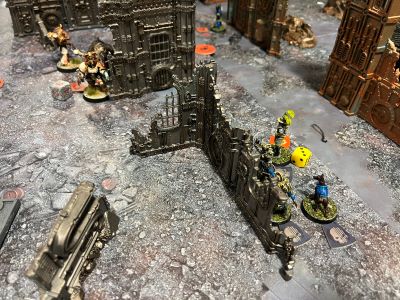
Final Thoughts on the Kill Team Campaign Design

With regards to this Kill Team campaign design, I’m hoping that the mix of factions and player captains and map will all serve to keep the players engaged. As well as the multiplayer events and shifts in the story arc.

While players will be assigned to factions, it will be important that they develop a narrative around why their team is supporting the given sibling and work changes in the plot.

While a little more complicated than the previous campaign, the administration is actually fairly limited for me as the Arbitrator (organiser). Having the captains help corral players will also be a big help.

Looking forward to getting the map, missions and player pack finalized and kicking it off in a couple of months.
Planning a Kick-Ass D&D Campaign with Minimal Effort

Planning a Dungeons & Dragons campaign can feel overwhelming, especially for Dungeon Masters who want to keep their preparation time manageable. However, by borrowing concepts from Dungeon World Fronts and embracing minimalist planning, you can create a dynamic, player-driven experience that feels rich and engaging without requiring hours of prep work. I use this methodology in many of my own campaigns and I can say from experience that it works a treat.

What Are Dungeon World Fronts?

Dungeon World, a narrative-driven RPG, uses Fronts as a way to organize campaign threats and storylines without rigid scripting. Instead of planning each session in detail, you create major factions, events, and dangers that will evolve naturally based on player actions. These Fronts act as living forces in the world, ensuring the story unfolds dynamically.

Step 1: Define Your Fronts

A Front is a significant force or conflict that drives the game’s narrative. Examples include:

  • A Rising Cult – A mysterious order gathers followers to summon an ancient deity.
  • A Warlord’s Ambition – A power-hungry warlord seeks to conquer the region.
  • A Failing Empire – The once-great kingdom crumbles due to internal corruption.
  • A Forgotten Curse – An ancient evil begins to stir beneath the land.

Each Front has:

  1. A Core Threat – The central danger or goal of the Front.
  2. Grim Portents – Steps showing how the Front advances if unchecked.
  3. Impending Doom – The final, catastrophic outcome if players fail to intervene.

It is best to have 2-3 Fronts in play. This creates interesting moral dilemmas for the players. Do we find the rising cults source of power, or stop the Warlords ambition in the border lands? Combatting one will leave the other unchecked for a time and closer to reaching it’s impending doom.

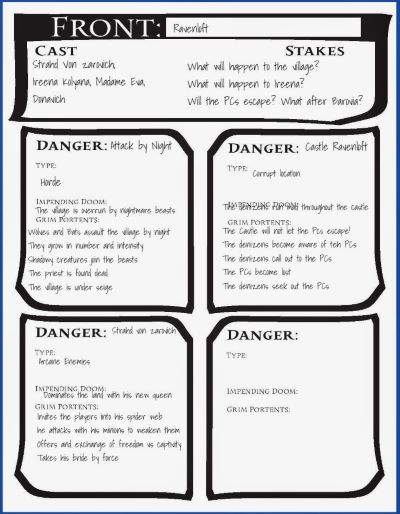
Example of Dungeon World fronts used for a Castle Ravenloft campaign

Step 2: Keep Session Prep Minimal

Instead of spending hours scripting intricate encounters, use situation-based preparation:

  • What’s Happening Right Now? – Consider what the antagonists are currently doing.
  • What Might Happen Next? – Think about the logical consequences of past events.
  • What Questions Need Answers? – Let player curiosity drive exploration.

This method of play does require getting comfortable with improvisation. For some tips on upping your improve game you can check out my previous article on the subject.

Step 3: Build NPCs and Factions, Not Plots

Rather than rigid story arcs, create motivated NPCs with clear goals. If you establish what each faction or villain wants, they will naturally push the world forward, reacting to the players’ choices.

This keeps the game very fluid and flexible. It will actually create intricate and compelling stories without the rigidity and time spent on creating these beforehand.

Step 4: Use Player Backstories for Hooks

Weave your players’ backgrounds into the campaign. A character’s lost sibling, old rival, or mysterious prophecy can become central elements of the story, creating organic engagement without extra planning.

Step 5: Let the World React

One of the best ways to keep a campaign like this engaging is to make the world feel alive. To do that use the following:

  • Actions Have Consequences – If players ignore a threat, it advances.
  • Factions and NPCs Adapt – Enemies respond to failures and successes.
  • The Story Evolves – The campaign unfolds based on player choices, not a fixed script.

Final Thoughts

By using Dungeon World Fronts, embracing minimal prep, and letting players drive the story, you can create a rich, immersive D&D campaign without hours of meticulous planning. While this type of campaign can seem too freewheeling, it does in fact take less effort while creating adventures that the players get fully engaged with. By focusing on dynamic factions, evolving conflicts, and player-driven narratives, and you’ll have an unforgettable game that practically runs itself.

Launching the Promethium Wars: Designing a Narrative Kill Team Campaign

Those who have been reading this blog for a while will know that I love the idea of stories emerging from game play. While this is obvious in games like D&D, I’m also interested in trying to create similar emergent experiences with other game systems. I’m a member of a local wargaming club where we play games of Kill Team and 40K on a weekly basis. I think there’s something special about a wargaming campaign that tells a story. Not one written in advance, but one that emerges—slowly, chaotically, gloriously—from the dice rolls, the table banter, and the narrative fragments players build together. With that in mind I volunteered to run a narrative campaign for the group. As a result, Promethium Wars, a narrative Kill Team campaign, was born.

I wanted something simple enough to run with minimal admin, but rich enough to spark real engagement amongst the participants. Something where a quick game on a weeknight could feel like part of a bigger war. Games would no longer be transactional affairs, but rather threads forming a larger narrative. And with twelve players already signed up—divided evenly across the Imperial, Chaos, and Xenos factions—it’s clear the idea has struck a chord.

Design Principles

Narrative and Emergent Storytelling were at the core of the campaign design. I didn’t want to script the campaign’s twists and turns. Instead, each week’s outcomes will steer the story. Players can dive in as much (or as little) as they want—whether that means writing full-blown battle reports, communicating in character or just rolling dice and watching the story evolve.

To keep things light and playable for everyone, I leaned into the principle of Limited Admin. No complicated map-tracking or bookkeeping for the campaign manager (me) or the players. Just clear weekly themes, short prompts, and a shared space for storytelling. Every game counts, but you don’t need to log three hours on a spreadsheet for it to matter. The minimum admin for each participant is to log game results and send them to me. Of course, if the players get really into the game the Discord server should begin to grow with narrative reports and banter, but it is not a requirement.

Each faction has its own win condition, giving players a reason to show up and push their agenda forward. The Chaos and Imperial factions want control of Pyrothis V and must win the most number of games. The Xenos faction, who can fight for either side, wants to grind both enemies down to an ineffective stalemate, wins if the Chaos and Imperial sides are effectively tied (two points difference). Regardless of the game mission being played, there’s always a motive. The stakes are casual but meaningful—exactly the balance I was aiming for.

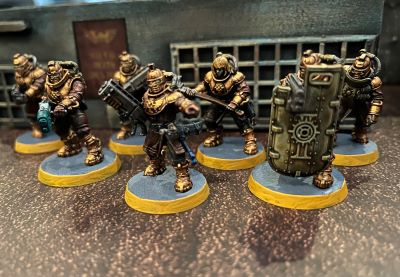
My Imperial Navy Breacher Team, ready to help rescue Pyrothis V.

Structure and Themes

The last principle was Short Campaign Length. I don’t want the campaign to fizzle out. Keeping it short ensures that the high energy at the start can be maintained. Short, sharp, explosive. I hope that this will keep the players coming back for more campaigns in the future.

Therefore, the campaign unfolds over four weeks, with a new theme each week to guide missions and inspire storytelling. These themes won’t constrain players—they’re meant to be narrative fuel. Players are encouraged to run games when and how they like, as long as it fits the week’s vibe. The four themes are:

  • Week 1: Infiltration and Sabotage
  • Week 2: Open Conflict
  • Week 3: Firestorms and Disaster
  • Week 4: Final Gambit

Once reports begin trickling in from the front lines, I’ll be putting together a short newsletter each week to highlight key developments, turning points, and of course, the faction scores.

For more detail on the background, win conditions and campaign set up, you can download the players pack below:

A Living, Breathing War

Perhaps the most exciting part of any narrative kill team campaign is the player energy. Already, folks are crafting characters, naming squads, and giving them relevant back stories. And while there’s no pressure to write stories, every player is invited to contribute. These tales—written, spoken, or just shared at the table—are what will give the campaign its true shape.

Ultimately, Promethium Wars is a story we’re writing together. And the pen happens to be shaped like a bolter.

Final Thoughts on Narrative Kill Team Campaign Design

The campaign is started mid April and will run to mid May. I’m aiming to learn from this experience to hone the opportunity for emergent narrative play and see what comes out. Depending on the actions of the players I’m considering running a multiplayer finale to cement the end of the campaign. But the fact that this is an emergent experience I guess I’ll have to wait and see how the whole thing pans out.

Once the campaign has finished, I’ll post the results along with any lessons learned from the experience.

To find out how the campaign went and to read the weekly journals check out my summary post here.

Mordax Prime: Worldbuilding for an Immersive 40K Campaign

One of things I love about Dungeons and Dragons campaigns is the worldbuilding. Particularly when the world advances and changes through the player actions and creativity. My long standing Salkire campaign evolved from a ruined city to a huge world with kingdoms, factions and villains vying for attention. All formed through gameplay and collaboration between my players and me, as DM. Over the last couple of years I have rediscovered sci fi wargaming with a particular focus on Warhammer 40K lore. I discovered the incredible Corvus Cluster, a long running blog tying together a groups games into one long running and immersive campaign. Ultimately, not too dissimilar to a long term D&D campaign really. Using this as inspiration I wanted to do similar worldbuilding for my own 40K inspired games. Mordax Prime is the result.

What is Mordax Prime

Mordax Prime a sector of space in the Warhammer 40K universe that I have developed as a narrative backdrop for my 40K inspired games. While I have retrofitted some of my previous games into this Sector, future games will be informed by and change the setting. My hope is that the setting begins to take a life of it’s own. Dictated by the outcomes of games and player actions. As mentioned previously this is narrative focused, providing colour and setting to our games. Players will know that game outcomes will have impact and I hope that this will add flavour not present in a normal game.

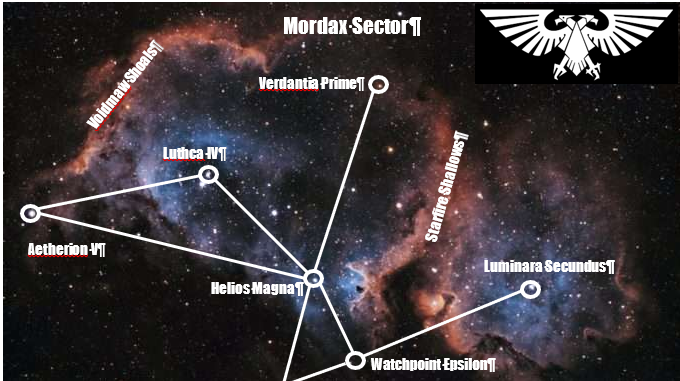
Star chart of Mordax Prime. A good starting place.

The Mordax Sector begins the campaign under Imperial control. Of course, this is likely to change as the narrative progresses.

Current Worlds

These were easy to develop using AI prompts as well as additions from my own imagination. I knew that I needed Luthca IV and a jungle death world, based on previous skirmish games I’d run. Other than that I was open to other 40K tropes like the forge and hive worlds. The last addition was the navy watch station. As I’d had pirate captain Mad Claw make an appearance in a game I want to explore this narrative a bit more. An Imperial naval port is exactly the location needed to help it play out in an exciting way.

So far, Mordax Prime comprises the following worlds. Of course new worlds and clusters may appear over time as the narrative dictates. As you can see from the descriptions below there is plenty of scope for conflict already.

Helios Magna (Hive World and Sector capital)

Description: A sprawling, industrial hive world teeming with millions of souls and the Administratum center for the system. Its vast manufactorums supply weapons and armor for the Imperial Guard. The towering spires of the hive cities are hotspots for intrigue and rebellion, making it a critical point of interest for both Imperial and Chaos forces.

Strategic Importance: Helios Magna’s output is vital for sustaining Imperial war efforts. Control of this planet secures supply lines and access to vast manpower resources.

Challenges: Frequent underhive uprisings and the ever-present threat of Genestealer Cult infiltration.

Verdantia Prime (Death World)

Description: A lush, verdant world filled with dangerous flora and fauna. The thick jungles are a perfect hiding place for renegades and xenos. It’s rumored to be home to ancient artifacts of great power.

Strategic Importance: Control of Verdantia Prime offers access to rare resources and strategic defensive positions. It’s also a key site for potential xeno-archaeological discoveries. Thought to house a top secret Dark Angels training facility.

Challenges: Navigating treacherous terrain and dealing with constant ambushes from Tyranid bioforms or feral Chaos cultists.

Aetherion V (Forge World)

Description: A heavily fortified forge world, Aetherion V is known for its production of advanced weaponry and vehicles. It is a linchpin in the sector’s defenses, equipped with formidable orbital platforms and ground-based macro-cannons.

Strategic Importance: Control of Aetherion V ensures a steady flow of high-quality wargear and defensive capabilities. It’s also a prime target for sabotage by the Chaos Space Marines.

Challenges: Infiltration by Chaos cults and the risk of large-scale conflicts breaking out in its production facilities.

Luthca IV (Industrial World)

Description: Highly productive factorium world built over ancient ruins. Supplies nearby sectors with manufacturing and agricultural machinery. Caches of archaeotech are thought to lie hidden deep within the Cinder Desert and in the roots of the hive cities.

Strategic Importance: While of lower manufacturing importance than Luminara Secundus, Luthca IV is the focus of many expeditions looking for ancient artefacts thought to provide great power..

Challenges: Both Chaos cults and Xenos vie with Imperial and Mechanicus agents in the search for forbidden tech. It is also rumoured that a Chaos gate lies buried deep beneath Hive Secundo.

Watchpoint Epsilon (Imperial Port)

Description: Key naval station providing patrols of nearby warp lanes.

Strategic Importance: Home of Watchfleet Epsilon, key in the defense of the Sector and nearby warp lanes.

Challenges: Seen as a backwater posting has led to dissatisfaction and potential heresy amongst some of the officer cadre.

Luminara Secundus (Pleasure World/Trade Hub)

Description: Known for its beautiful landscapes and luxury, Luminara Secundus serves as a retreat for the sector’s elite and a bustling trade hub. Its relative tranquility makes it an ideal location for diplomacy or covert operations.

Strategic Importance: Though less militarized, control of Luminara Secundus provides economic leverage and a base for Rogue Traders. It also serves as a critical node for intelligence gathering.

Challenges: The planet’s affluence attracts both political machinations from Imperial Nobles and covert infiltration by Chaos agents.

Active Factions

A number of factions are thought to be active within Mordax Prime. These are listed below with significant personalities coming from previous games and player invention.

  • Inquisition: Rooting out heresy and maintaining order.
    • Inquisitor Jaegermann: Ordo Hereticus seeking out daemonic influences with the Imperial hierarchy.
  • Rogue Traders: Seeking profit and ancient relics.
    • Benedictus Sixtus: notorious Rogue Trader known to play all sides. Fond of tall tales.
  • Imperial Nobles: Defending their estates and political power.
    • The Duchess: Leader of the most powerful family on Helios Magna.
  • Sisters of Battle: Purging heretics and xenos.
    • Enclave of the Veiled Light: Located on Helios Magna.
  • Space Marines: Responding to major threats with precision strikes.
    • Dark Angels: Secret training base in the jungles of Verdantia Prime.
    • Lancet Hereticus: Elements of this Inquisition controlled chapter thought to be active in this sector.
  • Imperial Guard: Garrisoning key locations and mounting large-scale defenses.
  • Tyranids: Emerging from hidden bio-ships, consuming everything in their path.
    • Possibly identified on Verdantia Prime. Thought to be connected to the researches of the late radical Inquisitor Tiberious Glaze.
  • Genestealer Cult: Sowing rebellion from within.
    • Heralds of the Star Children: active on Luthca IV, threat level high. Currently being investigated by Dark Angels and agents of the Inquisition.
  • Forces of Chaos: Undermining Imperial control and seeking to bring the sector into the warp.
    • Acolytes of the Red Mist: active on Luthca IV threat level unknown.
    • Mad Claw Crew: notorious pirate currently working from a secret location in the Starfire Shallows.

Plenty of scope for interesting battles, with room enough for additional factions as play progresses.

Current Campaign Log

This was a really fun part of the worldbuilding for me. Placing past games into the sector started uncovering links between factions and planets. Consequently, Mordax Prime is beginning to feel more than a map with some planet names. Life has been breathed into it.

356.658.M41 Unrest on Luthca IV

During a period of unrest on Luthca IV an Inquisitor, Enforcers, Planetary Guard, Acolytes of the Red Mist, Mining Guild and Infractionist gangs fought a vicious skirmish. Each group was making the most of the unrest to pursue their own agendas. Ultimately, Inquisitor Jaegermans retinue won the firefight retrieving the infamous Chaos artefact “Belial Goblet”.

Gangers face off in the streets of Luthca IV

357.020.M41 Echoes of Xenos

Located in the nearby Lupin Sector, Rogue Trader Benedictus Sixtus competed with various Inquisitors and Adeptus Mechanicus to retrieve heretical research of the late Ordo Xenos Inquisitor Tiberious Glaze. The battle raged over a number of sectors and moons as the warbands pursued the trail of clues. Despite battling an emergent Xenos threat Sixtus escaped with the research and fled to the Mordax Sector intent on finding a buyer.

Gun servitor covers an Inquisitor as he explores the depths of an orbital gun platform

357.125.M41 Jungle Hunt

Imperial troopers of the navy and guard pursued the downed vessel of the notorious pirate captain Mad Claw into the jungles of the death world Verdantia Prime. A vicious firefight broke out between the renegades and the brave Imperial patrol. The noise of the firefight awoke some xenos terrors of the jungle, who grabbed combatants from both sides from the leafy darkness. Those lost were never seen again. Unfortunately, Mad Claw and his allies applied superior tactics and fought their way to freedom. The Captain and his crew are thought to be hiding in the Starfire Shallows nursing their hunger for revenge.

It is rumoured that some of the research uncovered by Benedictus Sixtus has made its way to the planet surface. But how or why is unknown.

A brave naval trooper hides as a xenos monster stalks the jungle

357.450.M41 Potential Heresy on Helios Magna

A small but lethal force of suspected Dark Angel space marines assaulted an Ecclesiarchy compound on Helios Magna. The garrison of Adepta Sororitas (Order of the Veiled Light) scrambled quickly to defend. However, could not match the firepower of the marines and their formidable dreadnought. By the time reinforcements arrived the Dark Angels had disappeared as mysteriously as they had appeared, their objective unknown.

Dark Angels capture the objective under the heavy yet ineffective fire from the Sisters of Battle

357.556.M41 The Heist: Luthca IV

On the edge of Hive Secundo a multitude of gangs competed to retrieve a dangerous xenos artefact from the convoy of a Mechanicus expedition. What started as a tense standoff erupted into extreme violence as the hivers made and broke alliances while mercilessly blasting one another. Before order could be restored the artefact was opened releasing a powerful daemonic entity onto the planet. Few survivors lived to tell the tale. Yet, the Planetary Governor has requested aid to eliminate the creature.

Tense standoff before the firefight erupted
The warp daemon materializes causing mass panic!

357.790.M41 Verdantia Prime Ambush

A Dark Angels patrol was ambushed by an unidentified xenos threat whilst on a training exercise in an abandoned outpost on Verdantia Prime. The space marines fought with characteristic courage obliterating the opposing force. Needless to say, agents of the Inquisition are currently investigating the source of this surprising incursion. It is rumoured amongst those who know that the xenos threat is connected to the research purloined by Benedictus Sixtus and his crew. This incident has been linked to the Xenos discovered during the pursuit of Mad Claw and his gang.

A group of unidentified xenos approach the Dark Angel position

357.800.M41 Heralds of the Star Children Bomb threat

Local enforcers on Luthca IV uncovered a plot to destroy the primary administratum building on Hive Primus. Members of the Heralds of the Star Children placed a large explosive device with the vicinity. Fortunately, it wasn’t set properly giving a small Dark Angels detachment the chance to intercept.

A vicious firefight erupted within the shadowed streets below the administratum. The Heralds employed a psyker of note giving the space marines a difficult time of things. Fortunately, the heroes of the Imperium killed wiped out the xenos heretics and diffused the bomb, saving the Hive from a terrible fate. Inquisitor Mattias Criese has been assigned the investigation of the rogue psyker and this cult, which are both now more than just minor annoyances.

Children of the Star Children advance through the empty streets intent on reaching the bomb first

357.850.M41 Xenos Hunt

Following the recent thwarted bomb threat on Luthca IV by Dark Angels Forces, Inquisitor Criese has been actively investigating the Heralds of the Star Children. In an effort to prevent any further insurrection the Inquisitor has dispatched a crack team of agents to take out Magos Drevender the revered leader of the cult.

The kill team tracked him down into the depths of Hive Primus. But before they could raid the xenos cult an unseen sentry alerted the Magos. Cult members frenziedly assaulted the agents trying to buy time for their illustrious leader to escape. However, Drevender couldn’t quite get there. Instead, he was gunned down by two agents in a hail of bolter shells.

So ended the uprising of the Star Children. The next battle will explore a different narrative from Mordax Prime.

Drevender flees round the corner towards a battle hardened agent of the inquisition, and ultimately his own doom!

Final thoughts on Worldbuilding

This exercise in worldbuilding has been a lot of fun. Tying together the battles into a narrative was much easier than expected and the sector began to take on a life of its own. Are the remnants of the Star Children thirsting for revenge? Will teh Sisters of Battle start investigating the Dark Angels? Where will Mad Claw and his pirates raid next? Is the chaos gate open and what came through? Will the Tyranid presence on Verdantia Prime summon a larger invasion fleet? So many options for exciting games ahead.

Spending a bit of time developing a campaign world for your games is a fun exercise and adds a fantastic narrative aspect to your games. I highly recommend.

How have you had success developing campaign backgrounds?

A big shoutout to Corvus Cluster as an amazing source of inspiration!