
Why Hero Leadership Really Fails

There’s a particular story we love to tell about leadership.

One person stands at the front. They have the answers. When things go wrong, they step forward, make the hard call, and save the day. The team rallies. The credits roll.

It’s a great story. It’s just a terrible way to run a Dungeons & Dragons party… or any other organisation.

The Myth of the Hero Leader

Hero leadership is built on a simple idea: progress depends on a single exceptional individual. The hero leader is decisive, charismatic, endlessly capable. When the dragon appears or the quarterly results dip, they draw their sword (or pen) and fix it.

In D&D, this often shows up as the “main character” syndrome. One player dominates planning, talks to every NPC, solves every puzzle, and lands the killing blow. The rest of the party becomes a supporting cast, present but rarely essential.

In business, the same pattern plays out with the superstar manager or visionary executive. Decisions funnel upward. Problems wait for approval. Success is attributed to one person rather than the system around them.

In both cases, things may appear to work… for a while.

What Actually Happens at the Table

At a D&D table, hero leadership creates subtle damage long before it causes a wipe. Other players disengage. Why contribute if the paladin always decides the plan? Why risk a creative idea if the wizard will override it? The game becomes quieter, flatter, less surprising.

Worse still, the party becomes fragile. When the hero is absent, stunned, or simply wrong, everything collapses. A single failed saving throw can derail the entire session. D&D is designed around distributed competence. Different characters shine in different moments. When one player tries to carry the whole narrative, the system pushes back, usually with teeth.

The Workplace Version Is No Kinder

Hero leadership in business produces similar cracks. Teams stop thinking ahead. People wait to be told what to do. Initiative dries up, not because people lack ideas, but because they’ve learned those ideas won’t be used.

Decision bottlenecks form. The “hero” becomes exhausted, then indispensable, then overwhelmed. When they finally step away, the organisation discovers it hasn’t been developing leaders at all, only dependencies.

The scariest part? It often looks like success right up until it doesn’t.

Heroes Don’t Scale

A single hero can slay a goblin. They cannot sustainably run a campaign. Both D&D parties and businesses face complexity, uncertainty, and problems no one person can fully understand. Trying to centralise leadership in one figure reduces the system’s ability to adapt.

When leadership is shared, something different happens. People take ownership of their piece of the problem. Information flows faster. Mistakes are caught earlier. Success belongs to the group, not the loudest voice.

In D&D, this is when the rogue scouts ahead without being told, the cleric speaks up about risk, and the fighter suggests a plan that isn’t “kick in the door.”

In business, it’s when team members make decisions within their remit and feel safe doing so.

The Real Alternative Isn’t Leaderless Chaos

Rejecting hero leadership doesn’t mean abandoning leadership altogether.

It means shifting from “the leader has all the answers” to “the leader creates the conditions for good answers to emerge.”

In D&D, the best leaders are often the ones who ask questions:
“What do you think?”
“Who hasn’t spoken yet?”
“What’s another way this could go wrong?”

In business, strong leaders do the same thing. They clarify intent, set boundaries, and trust their teams to act within them. They step forward when needed and step back just as often.

Shared Leadership Creates Better Stories

The irony is that hero leadership actually makes for worse stories.

The most memorable D&D moments rarely come from flawless heroes. They come from messy plans, unexpected teamwork, and someone stepping up who wasn’t supposed to be the star. The same is true in organisations. The strongest cultures aren’t built around legendary individuals, but around teams who know how to think and work together under pressure.

If you want a campaign that lasts, or a business that survives its own success, retire the hero.

Build the party instead.

Bad Behaviour at the Table? Sort it out

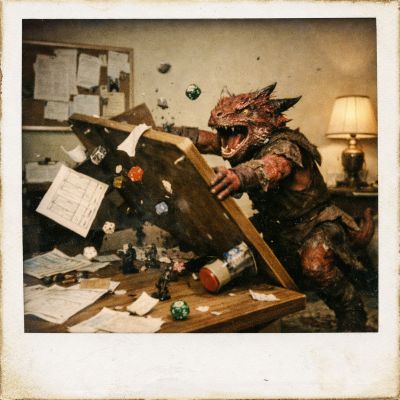
Kobold flipping gaming table in a rage

At some point in every long running campaign, bad behaviour at the table happens. A player goes rogue. Not in the charming backstab-the-dragon way. But in the rules-lawyering, spotlight-hogging, eye-rolling, group-fracturing way. The table energy shifts. Shared fun begins to ebb.

If you run games long enough, you will face this moment. If you lead people long enough, you will too.

The parallels between managing bad behaviour at a roleplaying table and leading a team in the workplace are surprisingly tight. Both require the courage to act before the whole party wipes. Here are three stages to handle it, whether you are behind the DM screen or at the head of a meeting table.

Stage One: The Quiet Word by the Campfire

In the Dungeons & Dragons Player’s Handbook, there is an implicit social contract. The game assumes cooperation. It assumes you are not actively trying to ruin the experience for others. When a player starts derailing sessions, dominating decisions, or treating fellow players like NPCs, your first move cannot be a thunderbolt from the heavens.

It is a quiet conversation. Private. Calm. Specific.

  • “Hey, I’ve noticed you’re interrupting others a lot during planning scenes.” This is preventing them from getting involved.
  • “I’ve seen some frustration when rulings don’t go your way.” This slows down play and creates a bit of a weird atmosphere with myself and the other players.

This is not an accusation. It is feedback. You are describing behaviour and explaining impact.

At the gaming table, most problems live in the land of misunderstanding. Someone may not realise they are hogging spotlight. Someone may think the aggressive banter is funny when others find it draining.

The same is true in the workplace. As a leader, stage one is informal and early. You do not wait for the team to fracture. You address behaviour before it calcifies into culture. Make your expectations clear. The impact must be understood and the request for change cannot be ambiguous.

Most people, when treated like adults, respond like adults.

Stage Two: The Formal Warning Scroll

If behaviour continues after the informal chat , you have to escalate. At the table, this might mean a more direct conversation.

  • “We spoke about this last month. It’s still happening. If it continues, you may not be able to stay in this campaign.”

Now the stakes are visible.

In a group where you are all friends this can be a difficult conversation to navigate. But it doesn’t have to be confrontational. Reiterate the way the group likes to play and that the problem players style is different and not gelling.

In leadership, this is where structure matters. Documentation. Formal performance conversations. Clear consequences. Alignment with policy. Compliance with employment law. You are no longer just nudging behaviour. You are protecting the team.

In both spaces, the key elements are:

  • Clear examples of behaviour
  • Clear expectations going forward
  • Clear consequences if change does not occur
  • A genuine opportunity to improve

You cant escape the fact that this stage is uncomfortable. It requires backbone. Leaders often avoid it because they fear conflict. But avoidance is not kindness. It is deferred damage. Every time you fail to address ongoing bad behaviour, you send a signal to the rest of the group that this behaviour is is acceptable.

And that signal causes more damage than you would imagine.

Stage Three: Removing the Player from the Table

Sometimes, despite every effort, the behaviour does not change. At a gaming table, the final step is simple in principle, but very difficult in practice:

You ask them to leave the campaign. You do not do it lightly. Keep emotion out of it. Do it because the health of the group matters more than the comfort of one individual. Ultimately, it is a leadership decision.

In the workplace, this stage becomes formal performance management that may result in termination. This must comply with employment law, company policy, and procedural fairness. There must be evidence, the employee must have an opportunity to respond. There must be consistency.

But the principle remains the same. A team cannot thrive if one person consistently erodes trust, morale, or performance.

Letting someone go is not failure if you have:

  • Communicated clearly
  • Provided support
  • Given reasonable opportunity to change
  • Acted fairly and consistently

Sometimes the most responsible act of leadership is protecting the many.

The Deeper Lesson

Whether you are running a dungeon or running a department, leadership is not about avoiding conflict. It is about stewarding the experience. In a roleplaying game, you are safeguarding fun, safety, and shared storytelling. While in the workplace, you are safeguarding culture, productivity, and psychological safety.

Both require:

  • Early intervention
  • Honest conversations
  • Escalation when necessary
  • Courage to act

Ignore bad behaviour at the table long enough and it becomes the campaign setting. Unchecked and your game will stop being fun, players will leave and it will eventually implode. Ultimately, following the adage that no D&D is better than bad D&D.

Address the behaviour with clarity and fairness, and you show your players that they are important and that the game matters.

Quick Note: checking bad behaviour at the table doesn’t have to rest on the shoulders of the DM. Rather it can be dealt with by any player. Remember, having fun is a shared responsibility.

I Don’t Like Phones: Why I Ditched Them from D&D

phone on fire

I don’t like phones at the game table.

There. I’ve said it. Phones are a distraction, they fracture attention, and they undermine the very thing that, to my mind, makes tabletop roleplaying special: a group of people actively engaging with each other.

Dungeons & Dragons is not a single player experience with occasional multiplayer cutscenes. It is a shared act of imagination, built moment by moment through conversation, reactions, and collective focus. Phones pull at all three.

Attention Is the Real Resource

Every D&D table runs on attention. When everyone is present, listening, and responding, the game hums. Scenes flow. Jokes land. Tension builds. When phones come out, that attention leaks away.

A quick glance becomes a scroll. A scroll becomes checking messages. Suddenly someone needs the last thirty seconds repeated, or misses a crucial choice, or reacts half a beat too late. Multiply that by a few players and the game starts to feel sluggish, disjointed, and oddly flat.

It Feels Like Disengagement Because It Is

One of the hardest parts of running a game is reading the table. Are players interested? Confused? Excited? Bored? Phones muddy those signals. When a player is staring at a screen while someone else is roleplaying a heartfelt moment, it sends a message whether they intend it or not.

That message is: this isn’t worth my full attention.

Even if the player insists they are listening, the social signal remains. It affects the confidence of quieter players. It undercuts dramatic moments. Collaboration feels lopsided, like some people are rowing while others are checking notifications.

D&D is a conversation. Looking at your phone while someone is speaking in a normal conversation would be rude. The table should be no different.

Immersion Is Fragile

Roleplaying lives in a delicate space. One moment you’re a desperate adventurer descending into the darkened chasm with nothing but a sword and your trusty companions. The next moment a buzzing phone reminds you about tomorrow’s meeting or a meme you saw earlier. The spell breaks instantly.

Once immersion cracks, it takes effort to rebuild. Phones make that crack wider and more frequent. They anchor players back in the real world when the whole point of gathering is to step somewhere else together for a few hours.

This Is About Respect, Not Control

Banning phones is not about authority or nostalgia or pretending it’s 1985. It’s about respecting the time and effort everyone brings to the table.

The DM prepares.
Players show up.
Stories are built together.

Asking for phones to stay off the table is a way of saying: this time matters. These people matter. What we are creating together deserves our attention.

Presence Is the Point

At its best, D&D is rare in modern life. A group of people, in the same room, focused on each other, telling a story in real time. That kind of presence is increasingly hard to find and incredibly valuable.

So yes, I don’t like phones at the D&D table. Not because I hate technology, but because I love what happens when everyone is truly there.

Not having fun at the D&D Table? No Worries

halfling not having fun with D&D

Dungeons & Dragons is built on fun—shared fun, collective fun, the kind of fun that turns into stories retold for years. But even the best table can have off nights. And sometimes, it goes deeper than that. Maybe the party dynamics have shifted, the story isn’t grabbing you, or perhaps you’re feeling sidelined. Maybe you’ve just had a rough week and the excitement isn’t sparking the way it normally does.

Here’s the thing: it’s okay not to be having fun. It happens to every player sooner or later. What matters is how you navigate that feeling—because D&D, at its heart, is a collaborative space, and collaboration thrives on communication.

Below are some practical steps to take if you find yourself staring at your character sheet thinking, “Why isn’t this working for me anymore?”

Take a Moment to Reflect on What’s Off

Before jumping into action, pause and ask yourself a few gentle questions:

  • Am I tired, stressed, or distracted from real life?
  • Is it the session that’s not fun, or the campaign as a whole?
  • Do I feel included and heard at the table?
  • Is my character still interesting to play?
  • Has the tone of the campaign drifted away from what I enjoy?

Sometimes the source is external—work pressure, family situations, burnout. Sometimes it’s internal to the game. Knowing which is which helps you decide your next step.

Talk to Your Dungeon Master (Honestly and Kindly)

A good DM isn’t just a storyteller—they’re a facilitator of fun. If something is missing for you, they genuinely want to know.

You don’t need to deliver a full critique; something simple works perfectly:

  • “Hey, I’m feeling a little left out recently. Can we find a way for my character to be more involved?”
  • “I think I’m not connecting with the story arc—could we explore something tied to my background?”
  • “I’m finding the tone more serious/silly than I expected. Any chance we can adjust the dial a bit?”

Most DMs will respond with enthusiasm and relief. But, they can’t fix what they don’t know.

Check In With the Group

Sometimes the issue isn’t DM-related at all—it’s table culture, pacing, or energy. You might notice:

  • A couple of players dominating the spotlight
  • Constant interruptions or side conversations
  • Clashing play styles (tactical vs. narrative, silly vs. serious, etc.)
  • The group drifting into habits that don’t work for you

A quick group conversation—maybe at the end of a session—can reset expectations and reaffirm what everyone enjoys. This is the tabletop version of team alignment in the workplace: shared goals, shared norms, shared fun.

Change Up Your Character

If the game itself is great but your character isn’t clicking anymore, don’t be afraid to pivot. You can:

  • Re-spec or rebuild your character
  • Introduce a new character entirely
  • Ask for a story moment that reinvigorates your current one (a rival, a revelation, a magic item, a moral dilemma)

Sometimes a fresh perspective is all it takes. D&D is a playground—go play.

Consider Taking a Short Break

It’s 100% valid to step back temporarily.

If you’re overwhelmed or burnt out, you might just need a pause. This doesn’t mean quitting; it just means recognising your limits. D&D, like any hobby, should feel energising more often than it feels draining.

Talk to your group and work out a graceful in-story reason your character disappears briefly. You’ll likely return refreshed and excited.

If It Really Isn’t Working… It’s Okay to Step Away

This is the hardest option, but sometimes it’s the right one.

Not every table is the right table for every player. If the tone, style, or personalities don’t mesh with what you need, you’re allowed to bow out—kindly, respectfully, and without guilt.

Leaving a game doesn’t mean you’ve failed. In fact, it means you’re choosing joy and respecting both your own time and the group’s.

Remember Why You Play

At its core, D&D is about:

  • Collaboration
  • Creativity
  • Connection
  • Escapism
  • Shared stories

If you’re missing any of these, it’s worth taking steps to find them again. Your fun matters. Your presence at the table matters. And you deserve a gaming experience that lifts you up.

Whether it’s a small tweak, a conversation, a character change, or a new table entirely—there is always a path back to joy.

Remember that the aim of D&D isn’t just to play. It’s to play together. And sometimes, playing together means speaking up so everyone—including you—can have the fun we’re all here for.

When People Disagree — Lessons from Leadership and the DM’s Chair

an orc and a wizard shouting at each other in disagreement

No matter how experienced you are, there’s one truth every leader (and every Dungeon Master) has to face: people won’t always agree with you. It might be a team member who challenges a decision you’ve made, or a player who doesn’t like the way a campaign is going. Disagreement is inevitable — but it isn’t necessarily a bad thing. In fact, learning how to handle it well is one of the most important skills a leader or DM can develop.

Of course, the goal isn’t to avoid disagreement. It’s to create an environment at work or at the gaming table, where people can disagree safely and constructively, without damaging trust or momentum.

Let’s look at how that plays out in both leadership and Dungeons & Dragons.

Leadership: Turning Disagreement into Growth

When someone disagrees with you as a leader, your instinct might be to defend your decision or to convince them you’re right. After all, you’ve probably spent time thinking through your reasoning and believe it’s the best course.

But disagreement isn’t opposition — it’s information. It’s a sign that someone cares enough to speak up, and that’s worth paying attention to.

Good leaders understand that healthy conflict strengthens teams. It surfaces blind spots, tests assumptions, and builds buy-in when handled respectfully. The key is to stay curious instead of defensive.

Some things to consider when someone disagrees:

  • Pause and listen. Don’t rush to explain. Let them talk, and make sure they feel heard.
  • Seek to understand the “why.” Is it about the decision itself, the process, or how it impacts them personally?
  • Acknowledge what’s valid. You don’t have to agree entirely to recognise a good point.
  • Decide and explain. If you still believe your decision is right, explain your reasoning transparently. People can handle “no” much better than silence or inconsistency.

Handled this way, disagreement becomes part of a healthy culture of trust — where people feel safe to challenge ideas without fear of reprisal. That’s the kind of culture where real innovation happens.

At the D&D Table: Disagreement Behind the Screen

If you’ve ever been a DM, you’ll know that players disagree with you from time to time — and that’s okay. It might be about how a rule is interpreted, a story decision, or a choice you’ve made for an NPC.

Just like in leadership, how you respond sets the tone.

A defensive DM can make players feel shut down. But a DM who listens, stays open, and keeps the focus on shared fun can turn disagreement into collaboration.

Here are a few ways to keep things healthy when conflict arises at the table:

  • Remember the goal: shared fun. The rules and the story are tools to help everyone have fun — not weapons to win arguments.
  • Listen before ruling. Let players make their case. Sometimes they’re right, or at least have a fair point you hadn’t considered.
  • Make a call, but explain it. The DM’s decision is final in the moment, but explaining your reasoning builds trust.
  • Revisit later if needed. If something still feels unresolved, talk about it after the session when emotions have cooled.

I’m very collaborative as a DM and if someone questions a ruling we discuss it openly at the table. If it’s going to slow down gameplay, I sometimes make a ruling at the time with the proviso that we look up what we need to after the session and make a decision then.

Common Ground: Leadership and DMing

The parallels between leadership and being a DM are striking when it comes to handling disagreement. Both roles put you in a position of authority, but both work best when that authority is rooted in trust, not control.

In both spaces:

  • Disagreement shows engagement — people care enough to speak up.
  • Listening builds credibility far more than arguing.
  • Transparency about your reasoning helps others understand and respect your decisions.
  • Humility — admitting when you got it wrong — earns lasting respect.

Disagreement handled well doesn’t weaken your authority. It strengthens it. It shows confidence, empathy, and maturity.

The Takeaway

Whether you’re leading a project team or running a D&D campaign, disagreement is part of the journey. It can be uncomfortable, sure — but it’s also where growth happens.

As a leader, your job isn’t to eliminate conflict, but to model how to handle it well. As a DM, your goal isn’t to control every outcome, but to guide the story collaboratively.

In both cases, the secret is simple: listen deeply, decide clearly, and care genuinely. When people see that you value their input — even when you disagree — they’re far more likely to trust your leadership and follow your lead into the next big adventure.

Because whether it’s in the boardroom or at the gaming table, leadership isn’t about always being right. It’s about creating the kind of space where everyone feels they belong, even when they don’t all agree.