The Lost Temple: An Adventure in Collaboration

I’ve been working on the idea of a roleplaying game that can be used for leadership development for a while now. My first attempts can be found in my Play2Lead ruleset. During playtesting the rules definitely work as intended. Now all that is needed are some scenarios that focus on specific leadership lessons. There are so many themes to choose from it was difficult to work out which to use. However, the more I thought about it the more collaboration bubbled to the surface. Every successful team, business and leader thrive on collaboration. Therefore this adventure scenario focuses on exactly that.

Design Principles

For a game to work in the leadership development setting I believe it should attempt to fit within the following principles:

  • Easily identifiable. Players who don’t like or understand fantasy should be able to relate to the setting and themes of the adventure
  • Playable in a lunch break. Maximum play time of 1.5 hours, though ideally within 1 hour
  • Playable for 4-6 participants excluding the gamemaster
  • Have a clear objective
  • Start in the action immediately
  • Apply pressure throughout, forcing fast tense decision making
  • Focus heavily on the leadership lesson. In this instance “collaboration”.

Given the short playing time I have designed the scenario around the following timeline:

  • Introduction, explanation of rules and choosing of roles – 10 mins
  • Encounter 1 – straight into the action – 15 mins
  • Encounter 2 – problem solving – 15 mins
  • Encounter 3 – explosive finale – 15 mins
  • Wrap up and debrief – 10-20mins

Adventure Introduction

In the heart of the dense jungle lies the ruins of an ancient temple, rumored to hold untold riches and artifacts of great power. However, the temple is also said to be filled with traps and puzzles designed to test the wit and cooperation of those who dare to enter.

A group of treasure hunters have funded an expedition to the temple in the hope of uncovering it’s wonders to share with the world. The architects of this ancient place were cunning beyond measure, and the team will soon discover that their greatest challenge will be working together to make it out alive.

For inspiration think Indiana Jones, Tomb Raider, Unchartered and Jungle Cruise.

Player Set Up with Collaboration in Mind

Using the Play2Lead ruleset all players need is an occupation. For this adventure they can choose from:

  • Archaeologist – professor of the ancient world. Equipped with a lantern. Read hieroglyphics, understand artefacts, high level of knowledge
  • Climber – working at heights professional. Equipped with a 50m rope. Climbing, ropework, high level of agility
  • Engineer – technical specialist. Equipped with a shovel and axe. Construction, demolition, high level of practical know how
  • Navigator – directional expert. Equipped with a compass. Map and compass skills, unerring sense of direction
  • Pilot – helicopter pilot. Equipped with a lantern. Piloting vehicles of all types, radio use, electronics master
  • Expedition Leader (optional) – no specialist skills. Equipped with a knife. Must facilitate the team working together

To speed things up have a character sheet for each character type ready to go.

#1 Collapsing Chamber

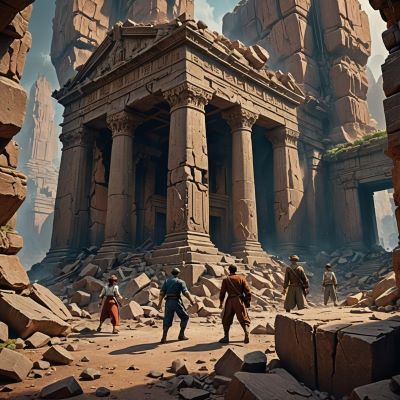
We begin in the treasure room of the Lost Temple. A chamber adorned with intricate carvings, hieroglyphics and ancient relics. Piles of gold and gems lie strewn along the walls. Timber shelves lie broken on the floor. On a roughly hewn plinth sits the fabled statue of the gods glinting in the torchlight. Pick a player at random. That characters hand has just closed around the ancient artefact. Suddenly, they trigger a hidden mechanism, causing the chamber to shake violently as the ceiling starts to collapse. Large stone blocks begin to fall from above, blocking the exit. Gold coins rain from the ceiling filling the chamber and restricting movement.

Challenge: The party must quickly assess the situation and find a way to escape before they’re crushed by falling debris.

Solution: A hidden lever is located up one of the walls. Reading the hieroglyphics will point out it’s location. Otherwise careful observation might allow it to be found. Pulling the lever stops the collapse and reveals a new passage to safety. Alternatively, the party could use their strength and agility to dodge falling rocks and clear a path to the exit.

Remember this is a high pressure situation. Make players take Exhaustion (Play2Lead) or other Pressure Tests if using another system to ratchet up the tension. Don’t give the players too much time to plan. If an individual is taking too much time skip them and move on. Pushing the time threat is a critical part of this encounter.

#2 River Rapids

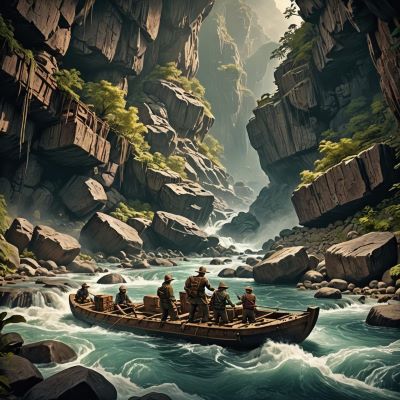
Exiting the collapsing chamber, the group of adventurers find themselves in a vast underground river that flows through the heart of the temple. The river’s currents are swift and treacherous, and the only means of escape seems to be an old rickety raft tethered to the shore.

Challenge: Maneuvering the raft through the river’s rapids while avoiding jagged rocks and hidden dangers.

Solution: The party must work together first to make the raft river worthy. Not doing this will give it a chance to break up halfway through the encounter. Secondly, to navigate the river, using their skills to steer the raft safely. The river will fork. The navigator will be able to tell which way to go. Alternatively there is a fresher breeze coming from the right channel. Along the way, they encounter a series of jagged rocks that threaten to damage and capsize the raft.

Reward player ingenuity here. What will they use to steer the raft? How will they make it safe to use?

#3 Guardian’s Gauntlet

The river throws the group from a low waterfall into a pool below. The bright sunlight of the jungle pool meets them as they find themselves out of the temple. However, as they swim to the side something slides against the leg of one of the swimmers. They are not alone.

Within the pool lives a formidable guardian—a massive, serpentine creature with gleaming scales and razor-sharp fangs. Blocking their path, the guardian seems intent on preventing anyone from leaving the temple alive. It will attempt to encircle the character that is most alone and attempt drown it. One bite from this creature will kill a character outright. This should be played as a deadly, exciting grand finale to the adventure.

Challenge: Defeating or evading the guardian while making a desperate dash for freedom.

Solution: The party must use their wits to outmaneuver the guardian, perhaps by exploiting its weaknesses or finding a way to distract it long enough to slip past. Alternatively, they could way to incapacitate it temporarily, allowing them to make their escape without resorting to violence.

Heighten the terror by having the creature signal it’s presence. Slithering past a leg. Ripples on the water. A flick of a slimy, scaly tail. When the creature reveals itself play up the danger, the toothy maw, the crazed eyes. Make sure the payers know that their characters are in trouble.

Once again reward out of the box thinking and collaboration. How will the team distract or defeat the creature together. This is not something they can win alone.

Collaboration Debrief

Did the players escape unscathed? While the adventure is over, the experience is not. Now is the time to get your players reflecting upon their experience. Ask some or all of the following questions to draw out the discussion.

  • Where did you as a team collaborate well?
  • Did you utilize everyone’s skills?
  • How could you have integrated collaboration better?
  • Is there anything you would have done better?

Following the debrief it’s also worth asking your players for feedback. Did they enjoy the experience and was there anything that could have been done better?

Final Thoughts on an Adventure in Collaboration

This adventure aims to be a fast, exciting experience that fosters collaboration between the players. A chance to debrief afterwards gives attendees a chance to reflect on their experience and what went well and what didn’t.

I envisage this as a useful experience for a cohort of a future leaders training course. Run this experience at the beginning of the course. Then, follow up with a similar experience at the end and see how they have grown as leaders. Has their level of collaboration increased?

Alternatively it could be used as a way help a newly forming team. A chance to get to know each other in a fun experience as well as reflect on how they might work together moving forward. Other uses might be as a way to introduce new people to world of rpgs. A small commitment of time as a way to dip their toes into this exciting medium.

I hope this simple scenario opens your eyes to what can be done with a short, simple adventure. Where do you think it could be used?

A pdf of this adventure with character sheets can be found at the Play to Lead downloads page.

Victory without Violence – Taking the Combat Out Of Dungeon & Dragons

Today’s article is a guest post by the talented Craig Robertson, focused on scenarios that might be more appropriate to the workplace.

Dungeons and Dragons has a long and bloody history, full of epic battles and crushing defeats. Since its creation in the 1970’s, billions of orcs, goblins, and kobolds have died at the hands of brave and/or foolhardy adventurers. And the carnage goes both ways. Old-school gamers such as myself fondly remember the heroic demise of beloved characters, not to mention the occasional dreaded TPK (total party kill).

This makes sense when you look at the literary and gaming inspirations from which Dave
Arneson and Gary Gygax drew when creating D&D. On the literary side, D&D grew out of the heroic mythology of the ancient Babylonians, Greeks, Romans, Celts, and other cultures. In these traditions, a hero such as Hercules, King Arthur, or Beowulf faced mortal danger with sword (or club or axe) in hand. In fact, some weapons are as famous as the heroes who bore them, such as Arthur’s Excalibur or Thor’s Mjölnir. As for its gaming roots, D&D started out as an extension of a medieval wargame ruleset called Chainmail. Since then, the attack roll has been a core mechanic of most roleplaying games, and even now, most RPG rulebooks feature full chapters devoted to combat and weaponry.

Why Limit Violence in D&D?

However, in a workplace setting, there are good reasons to limit violence or even remove it
altogether from the game. First, many players (and organizations) may have moral or philosophical objections to using force to solve problems. Second, some of your players may have endured traumatic experiences that involve violence. These people may have been refugees, combat veterans, or victims of crime or abuse. Finally, the unfettered use of violence in many roleplaying games doesn’t correspond to the types of solutions available to corporate problem-solvers. In fact, unfettered violence is not even available to military personnel, who have to work within the rules of engagement. In my experience, most HR departments strongly discourage bringing flamethrowers and battleaxes to business meetings.

On the other hand, there are positive reasons to encourage nonviolent approaches to
challenges. First, peaceful solutions often work out better in the long run, enabling rivals and opponents to eventually find common ground. Secondly, those solutions are often rooted in or lead to a deeper understanding of the root causes of the problem. Finally, the use of force isn’t particularly creative in itself, and the added challenge of finding a nonviolent solution just makes the game more fun.

Baking Peaceful Solutions into your Game

The simplest solution to this dilemma is to just ban violence at the table. However, there is a
better option: Build nonviolent solutions directly into the scenario. A creative GM has several options for removing combat from a scenario, including using the physical environment as the primary adversary, making combat detrimental to mission success, and creating situations in which a peaceful solution is inherently necessary.

Dungeons and Dragons does not have to be combat focused, why not bake in some peaceful solutions.

Struggling against a hostile environment:

Shipwrecks, plane crashes, and sudden storms are staples of literature and films such as Alive or The Poseidon Adventure. Another type of hostile environment can be manmade, such as toxic spills or nuclear meltdowns. Finally, the D&D staple of dungeon traps and hazards also falls into this category. The Death Star trash compactor in Star Wars: A New Hope is a perfect example of a dungeon trap. You can try these scenarios:

  • An alpine glacier begins growing at an unnatural pace, threatening a small mountain village. The players must negotiate the shifting, treacherous ice as they travel to perform the ritual that will restore the glacier to its original state.
  • A scientific research station has begun to descend into the lower layers of a gas giant. So far, the hull is managing to maintain its integrity, but for how long?
  • The barrier between faerie and the mundane world is beginning to thin, bending the rules of reality around the players. They must struggle to maintain their sanity as the work to strengthen the barrier and return each world to its rightful place.

Violence will make things worse:

Perhaps using force may be possible, but circumstances or mission parameters make it a counterproductive choice. For instance, a patron or employer may require that the mission be completed without causing injury or damage to bystanders or the environment. In other cases, such as espionage or infiltration, the ruckus caused by a firefight or melee will lead to discovery and the failure of the mission. Some scenarios could include:

  • A benevolent ruling family has been deposed and imprisoned after a coup. The players are hired to rescue them, but since the family still loves their nation and people, they reject any effort that may hurt or kill any of their former subjects.
  • “The Company” hires the party to recover an automated mining base which has been taken over by a rogue AI. However, since the Company has invested considerable sums into the base, the players are forbidden to do anything which may cause damage to the base or its equipment.
  • During a scientific expedition, a gargantuan creature swallows the players. They have a limited time to escape the belly of the beast before being slowly and painfully digested. Unfortunately for the party, the creature is unique or endangered and killing it would be an ecological tragedy.

Violence is not a viable option:

Some problems inherently preclude a forceful solution. This includes investigations, diplomatic missions, first-contact scenarios, and any other situation that requires persuasion as a key skill set. Try the following as examples:

  • The players are selected as neutral brokers during a tense border dispute. In order to earn the trust of the rival nations, they must complete a series of challenges to prove their strength, intelligence, and character.
  • The party encounters a destructive poltergeist. Since they lack the ability to physically affect or harm the intangible haunt, they must rely on investigation and persuasion to discover what the doomed soul needs in order to move on to its final rest.
  • The players must infiltrate a crime syndicate’s secure computer system to disrupt an imminent cyberattack. Since all the action is remote, the players’ skills are front and center.

Reducing the lethality of D&D games at work can be a challenge, but it’s a good way to test
your creativity. However, increased player engagement and direct, real world problem-solving applications will make it worth the effort.

Craig Robertson is a technical writer and former Chief Game Developer for 1A Games. He has been playing and running D&DTraveller, and other RPGs since the early 80’s. His chief export is opinions, of which he has many.

Thanks to Craig for such a thoughtful article. If any of our readers would like to submit an article feel free to reach out via the usual channels.

Survive the Sinking Submarine: Ultimate Hell Week Scenario

My last post explored using roleplaying games like Dungeons and Dragons to create a Hell Week scenario experience for your staff. With the aim of creating a bonding experience for teams, leaders and new starters. In this post I aim to develop a scenario/event that you could use to create this type of experience.

Event Goals

Before we start, it is essential to understand the goals of the event and work out from there. This event is designed to be run for groups of new leaders in an organization. These are high performing individuals tipped for future leadership positions or newly promoted into one.

The goal of the event is to foster a sense of team and belonging amongst the future leadership of the business. This will achieved through overcoming shared adversity.

Overview of the Hell Week Scenario

In an effort to keep the hell week scenario outside of the lived experience of the cohort but allowing for high pressure the scenario will focus on escaping from a submarine. Participants will be allocated different roles/skillsets and work together to escape. A series of tasks requiring multiple skillsets will need to be prioritized and completed against time pressures. Additionally, surprise events throughout the scenario will add additional pressure, upsetting any planning. Adaptability and teamwork will be essential in beating the scenario.

In addition, each participant will have six endurance points that are lost if tasks are failed. They can also be traded in to help improve the likelihood of success. However, when the last point is lost the player is out of the scenario.

The player briefing might look something like the following:

Congratulations on joining our team! We believe in hands-on training to prepare you for real-world challenges ahead. In this immersive training scenario, you will find yourself a crew member of a sinking research submarine. Your mission is to work together to overcome a series of challenges and escape before it’s too late. Remember, teamwork, communication, and quick thinking are essential. Good luck!

Duration: 2 hours

Location: Office setting or conference center. Smaller rooms preferred.

Lighting and sound effects can really enhance the immersion

Required Props and Setup to Enhance Immersion

As discussed in my last post immersion is really important. Of course, you don’t need a full on mock up of a submarine. But there are some simple things you can do to help create a sense of place out with the normal office environment.

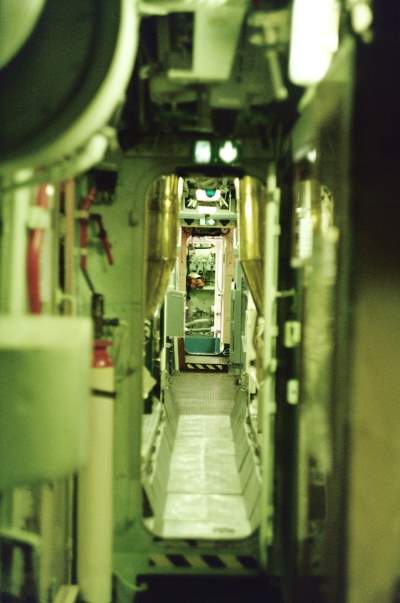
  1. Submarine Environment: Create a makeshift submarine environment by shifting tables and chairs into a series of spaces along a thin column Alternatively, set up in a corridor to give an improved sense of the enclosed space. Additionally, turn off overhead lights and use desk lights with blue/green lighting gels to mimic the underwater setting. Having a red alarm light will definitely add to the sense of urgency when it goes off.
  2. Sound Effects: Use a portable speaker to play submarine sounds, alarms, and underwater noises. This can be used as a timed track signaling surprise events and highlighting the sense of urgency.
  3. Props:
    • Flashlights
    • Walkie-talkies or two-way radios
    • Gauges to indicate hull integrity and oxygen levels
    • Life vests
    • Clipboards with task instructions
    • Stopwatch
    • Nautical maps and charts
    • First-aid kit
    • Ropes and carabiners
    • Puzzles or challenges related to navigation and communication
  4. Instructor/Facilitator: You will need someone to facilitate the scenario and provide guidance when necessary.
Keeping to schedule is key in running an event like this

Training Scenario Schedule

Below is a proposed schedule of the hell week scenario.

  1. Briefing (15 minutes):
    • Gather all participants and explain the scenario.
    • Emphasize the importance of teamwork, quick decision-making, and effective communication.
    • Assign roles to each participant (e.g., captain, engineer, navigator, medic, radio operator etc) and distribute their respective skills and tasks.
  2. Submersion and Initial Challenges (20 minutes):
    • Participants enter the makeshift submarine (clearly demarcated).
    • Turn on the sound effects to create an immersive atmosphere.
    • The submarine begins “sinking.” Water and pressure-related challenges arise.
    • Participants must address immediate issues like water leakage, pressure indicators, and stabilizing the vessel. Limited resources, must prioritize tasks.
  3. Navigation and Communication (20 minutes):
    • Provide a nautical map with coordinates.
    • Participants must collaborate to determine their location and chart a course to safety.
    • Encourage the use of walkie-talkies for communication between navigation and the steering team.
  4. Obstacle Challenge (15 minutes):
    • Present a challenge that requires participants to work together to overcome an obstacle (e.g., blocked hatch or damaged equipment).
    • They must use ropes, carabiners, and problem-solving skills to succeed.
  5. Medical Emergency (10 minutes):
    • Simulate a crew member’s injury.
    • The medic must provide first aid while others maintain the vessel and continue with the mission.
  6. Countdown to Escape (20 minutes):
    • Introduce a time constraint and associated red lights and klaxon.
    • Announce that the submarine’s condition is deteriorating rapidly.
    • Participants must complete their tasks and navigate to the surface before it’s too late.
  7. Debriefing (20 minutes):
    • After the scenario, gather the team and discuss their experiences.
    • Encourage feedback, focusing on what went well and what could be improved.
    • Highlight the importance of adaptability, teamwork, and problem-solving under pressure.
  8. Final Remarks (10 minutes):
    • Conclude the training with a reminder of key takeaways.
    • Reiterate the importance of quick thinking, clear communication, and collaboration in real-life situations.

Further Work

While I have listed each of the tasks above in a linear series, it would be better to have tasks overlapping. Teams must then prioritize tasks. Remember, failed tasks remove endurance points from participants, adding additional pressure. Endurance points can also be traded for clues and assistance.

Perhaps you can restrict the number of people in each section of the submarine and create time penalties for movement between the sections. This would emphasize the use of walkie talkies for communication. It would also highlight the need for clear and concise communication between different sections of the submarine.

Each task needs more work around the detail, but I think this gives the picture of how an event like this might work. I for one would love to experience it. Part escape room, part rpg, part leadership learning experience. For me it ticks all the boxes.

What do you think? Would this hell week scenario work? Is there anything you would add? Have you attended something similar?

Hell Week! Use Games to Create High Performing Teams

In leadership development, creating cohesive teams and fostering a sense of shared experience is vital. One unconventional yet effective approach is to draw inspiration from the intense special forces training programs, such as the SAS or the Navy SEALs’ Hell Week. By using roleplaying games like Dungeons and Dragons (D&D), we can provide a unique and immersive environment for future leaders to bond, develop teamwork skills, and earn their place within the team. This post explores how RPGs can replicate the essence of a Hell Week, offering a challenging and rewarding experience that builds resilience, camaraderie, and a sense of accomplishment. But, without the physical demands or shouting…

The Power of Immersive Experiences

Roleplaying games provide a powerful platform for creating immersive experiences. Through the vivid storytelling, players can step into the shoes of characters facing formidable challenges. Just like the aspiring Navy SEALs during Hell Week. By setting the stage with a compelling narrative and challenging quests, RPGs enable participants to engage deeply and emotionally. In turn, fostering a sense of shared struggle and accomplishment.

There needs to be difficult odds, time pressure an engaging story forcing quick decision making. The pacing must be fast and action packed with some downtime to let the participants catch their breath.

The location is also important, props, reduced lighting, atmospheric music and other sound effects can really help create that feeling of immersion. Ultimately, immersion will make sure that this event will be remembered for a long time to come.

Experiences like these can really solidify a sense of team

Teamwork and Cooperation

In both Hell Week and RPGs, teamwork and cooperation are essential for success. In replicating the intensity of Hell Week, players must rely on one another’s strengths, communicate effectively, and make collective decisions. Each participant has a unique role to play, just like in a SEAL team. As such, they must learn to trust and support each other to overcome the obstacles they face. This shared experience builds strong bonds and encourages participants to view their colleagues as indispensable teammates.

When designing this type of event it must be impossible to complete the tasks alone. Rather coordinated effort, where communication, teamwork and leadership come to the fore.

Embracing Challenges and Resilience

Hell Weeks are characterized by their demanding nature and the need for resilience. Without it you will not make it. In the gaming world, players encounter various obstacles, puzzles, and adversaries that require strategic thinking, adaptability, and determination to overcome. Rather than focusing on endurance, mental resilience should be challenged. Despite their obviously physical demands, Hell Week also challenges aspiring SEALs mentally, and emotionally.

By replicating these challenges within an RPG setting, participants can experience a similar sense of perseverance, pushing their limits, and developing a resilient mindset that will serve them well as future leaders.

Overcoming adversity together creates a real sense of accomplishment

Accomplishment and Validation

One of the most rewarding aspects of Hell Week is the feeling of accomplishment and validation that comes with completing it. Similarly, an RPG designed around this concept can provide participants with a tangible sense of achievement. By setting clear goals, tracking progress, and acknowledging milestones, participants can feel a genuine sense of pride and validation when they successfully navigate the challenges presented within the game. This sense of earned accomplishment enhances their self-confidence and strengthens their belief in their abilities as leaders.

Final Thoughts

Of course, we can never replicate the Navy SEAL Hell Week. This is a process that has been refined over years, unique to the physical and mental demands of a very specialist job. However, aspiring towards a Hell Week-like experience using roleplaying games offers a unique and effective way to foster teamwork. As well as building resilience, and creating a shared sense of accomplishment among future leaders. By immersing participants in a challenging and immersive RPG campaign or event, we can provide them with the opportunity to overcome obstacles, rely on their teammates, and earn their place in the team. Through this experience, they develop essential leadership skills, forge lasting bonds, and emerge as stronger, more confident leaders ready to take on real-world challenges.

Imagine your tight knit team in five years time, reminiscing about their “Hell Week” experience and welcoming new staff members going through the same experience. A powerful vision.

In my next post I will look at creating an example scenario to show how these aspirations could be applied to a real world experience.

Have you ever experienced an event where your team and staff were a more cohesive group afterwards?

Developing a Powerful Learning RPG with Cthulhu Dark and Those Dark Places

Role-playing games (RPGs) have long been celebrated for their ability to immerse players in rich narratives and challenging scenarios. Beyond their entertainment value, RPGs can also serve as powerful tools for learning and personal development. It is my aim to create a roleplaying game that can help facilitate powerful learning experiences. I have set out a series of principles that I consider critical to playing the game in this context.

In this article, I look at two rulesets that I think can be used in developing a learning RPG where player decision making is key. I believe that Cthulhu Dark and Those Dark Places, can be effectively harnessed into a ruleset for a learning-focused RPG experience.

Cthulhu Dark

Cthulhu Dark, designed by Graham Walmsley, is a minimalist RPG system that thrives on atmospheric horror and player-driven storytelling. While the game is known for its Lovecraftian themes, its simplicity and focus on narrative make it a versatile tool for educational settings. The core mechanic revolves around rolling one to three six-sided dice to determine success or failure. Additionally, characters have only one stat. This streamlined approach encourages players to immerse themselves in the story, fostering creative thinking and collaborative problem-solving skills.

This game has a brilliant insight mechanic. As characters are exposed to the horrors of the scenario it slowly builds. Until the characters have seen too much and break. While this works really well for the horror theme it may need alteration when developing a learning RPG. Changing it from insight to exhaustion would allow you to cover a wider variety of genres and scenarios.

You can read a more in depth review of this fantastic game here.

Those Dark Places

Those Dark Places, created by Jonathan Hicks, is a science fiction RPG system that invites players to explore the mysteries of the cosmos. My favourite movie of all time, Alien is a core inspiration here. It emphasizes the survival of a team in an unforgiving environment, fostering teamwork, critical thinking, and decision-making skills. By presenting players with complex challenges and dilemmas, Those Dark Places prompts them to weigh the consequences of their choices, fostering a deep sense of responsibility and strategic thinking.

Of course, the game system is also very rules-lite. Utilizing six sided dice over four attributes. It also has a great stress mechanic that builds over time as the characters experience high pressure situations.

You can find a more detailed review of this awesome game here.

Using These Games

Integrating Cthulhu Dark and Those Dark Places into an experiential learning setting yields numerous benefits. Firstly, these games encourage active participation and engagement, fostering a love for learning and exploration. Dice rolling in both games are kept to a minimum. Meaning decision making and player actions have significantly more weight. The collaborative nature of RPGs also promotes teamwork and effective communication skills, as players must work together to overcome obstacles and solve problems. Additionally, neither game has the level/experience constructs of Dungeons & Dragons. The open-ended nature of these systems stimulates creativity and imagination, allowing players to think outside the box and develop innovative solutions.

Use When Developing a Learning RPG

Utilizing Cthulhu Dark and Those Dark Places as learning tools, educators can adapt the game mechanics to suit specific educational goals. For example, scenarios based in reality can be easily reimagined in the Cthulhu Dark system. Focusing on participant decisions and collaboration. Those Dark Places might be more applicable to simulate problem-solving, using skills to solve hypothetical challenges.

Of the two I think that Cthulhu Dark will form the mainstay of my future learning-rpg ruleset. It is highly versatile, focuses on player decision making and ramps up pressure with its insight mechanic. While scenarios will require careful tweaking, the core of the rules will not. Additionally it is the easier to teach players who are completely new to the concept of roleplaying.

Safety and Ethical Considerations

You may have noticed that the two gaming systems chosen both have a horror theme. This is not intentional. Perhaps the horror genre lends itself to more narrative focused gameplay. Of course, it is not my intent to include horror elements into the learning-focused scenarios, instead focusing on more grounded high pressure scenarios.

Remember, when utilizing RPGs as learning tools, it is crucial to establish a safe and inclusive environment for all participants. Emphasize the importance of respect, consent, and cooperation among players. Ensure that sensitive topics are approached with care, and provide opportunities for reflection and discussion after each session to process the emotional impact of the game.

Final Thoughts On Use as a Learning RPG

Cthulhu Dark and Those Dark Places are not only captivating RPG systems for entertainment but also effective tools for fostering learning and personal development. By leveraging their narrative-driven mechanics, we can create engaging and immersive experiences that promote critical thinking, problem-solving, teamwork, and creativity. Both would make a great learning RPG in their own right.

Using these game mechanics we can create unique and exciting ways to engage learners and expand their horizons beyond traditional training methods. Over the coming weeks I intend to pull together a simple ruleset that will let us explore experiential leadership and team learning through the poser of RPGs.