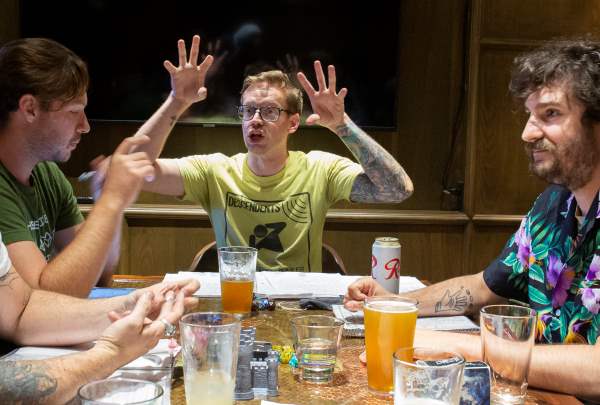
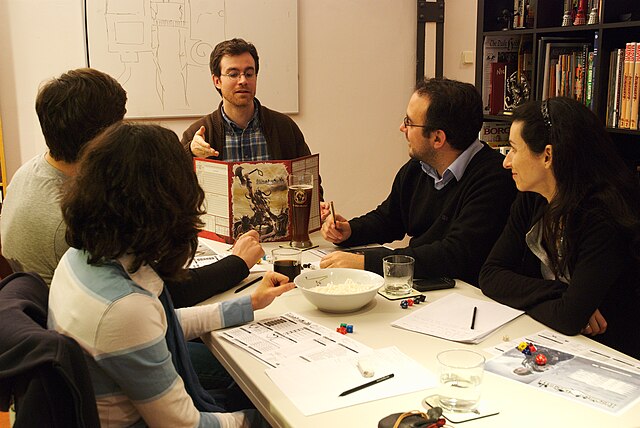
Is it Hard to be a Dungeon Master?

Being a Dungeon Master takes a lot of hard work and practice to get the hang of it. So, if you’re a little nervous about taking on this role, try having a practice run. You could write up a short adventure of your own or try running the beginner’s set published by the makers of D&D, The Lost Mines of Phandelver.

Embarking on the journey of becoming a Dungeon Master (DM) takes you into a world of creativity, strategy, and storytelling. Whether you’re a seasoned player or a newcomer to tabletop roleplaying games, taking on the role of the DM can be both exhilarating and daunting. However, the question remains: Is it hard to be a Dungeon Master? Let’s delve into this subject and explore some tips for running a game, even in the unconventional setting of the workplace.

The Challenges of Being a Dungeon Master

Being a DM comes with its unique set of challenges that may intimidate even the most seasoned players. Here are some common hurdles you might encounter:

1. Crafting a Compelling Narrative:

Creating a captivating storyline that keeps your players engaged can be a daunting task. Balancing intrigue, suspense, and player agency requires careful planning and improvisation skills. A good way to start is to keep it simple. A basic easy to follow set up with some fun villains can keep that first session straight forward to run. Additionally, limiting plot complexity allows the players to jump right in tot he action.

2. Managing Player Dynamics:

Each player brings their own personality, playstyle, and expectations to the table. It can be challenging to ensure that everyone feels included and has the opportunity to shine without overshadowing others. One very easy way to achieve this is to move the action from player to player around the table. Making sure no-one gets missed and lettign everyone have regular moments in the spotlight.

3. Rules Mastery:

While it’s essential to understand the rules of the game system you’re playing, being a DM often means making quick decisions on the fly. Striking a balance between adhering to the rules and keeping the game flowing smoothly is key. If the rules feel too complex choose a game with a simpler, pared down ruleset

4. Creative Problem-Solving:

Players are notorious for thinking outside the box, which means you’ll often encounter unexpected scenarios. As a DM, you must be ready to adapt and improvise to keep the game moving forward. As mentioned above, keeping the narrative simple at first gives you more space to improvise around unexpected player solutions. In fact, when I plan a game I set up the scenario premise without considering exactly how the players will actually succeed. This prevents wasting time on excessive planning and keeps the game exciting for me, as the gameplay evolves before my eyes.
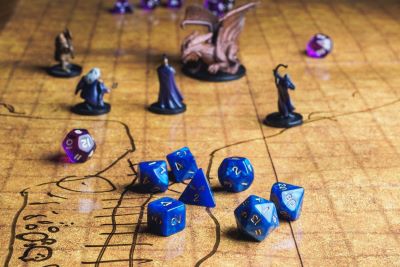
Is it hard to run D&D games at work?

Tips for Running a Game at Work

This wouldn’t be DnD at Work without incorporating some element of work related shenanigans. Running a game session in a workplace setting presents its own set of challenges and opportunities. Here are some tips to help you navigate this unique environment:

1. Establish Clear Expectations:

Before diving into the game, communicate with your colleagues about the tone, frequency, and expectations for the sessions. Make sure everyone is on the same page regarding time commitments and player conduct.

2. Keep Sessions Short and Manageable:

Given the busy schedules of most workplaces, it’s essential to keep game sessions concise and focused. Aim for sessions that fit within a lunch break or after-hours time slot to avoid disrupting productivity. Running a couple of encounters over an hour at lunch can be a great way to make sure it doesn’t disrupt the actual work that needs to get done.

3. Foster Collaboration and Teamwork:

Use the game as an opportunity to strengthen bonds and encourage teamwork among your colleagues. Emphasize the importance of cooperation and problem-solving within the context of the game, mirroring real-world workplace dynamics.

4. Be Flexible and Adaptive:

Understand that work-related interruptions or scheduling conflicts may arise unexpectedly. Be flexible and willing to adjust session times or accommodate changes to ensure everyone can participate without feeling overwhelmed.

5. Emphasize Fun and Relaxation:

While RPGs can be intense and immersive, don’t lose sight of the primary goal: having fun! Encourage laughter, creativity, and imaginative storytelling to create a positive and enjoyable experience for everyone involved.

Final Thoughts

Being a Dungeon Master certainly comes with its share of challenges, but with careful planning, adaptability, and a sprinkle of creativity, it’s a role that anyone can excel in. Whether you’re running a game with friends or colleagues in a workplace setting, the key is to foster collaboration, communication, and above all, fun. So gather your party, roll some dice, and embark on an unforgettable adventure together!

Remember, you’ll never get good at it if you never try.

The Lost Temple: An Adventure in Collaboration

I’ve been working on the idea of a roleplaying game that can be used for leadership development for a while now. My first attempts can be found in my Play2Lead ruleset. During playtesting the rules definitely work as intended. Now all that is needed are some scenarios that focus on specific leadership lessons. There are so many themes to choose from it was difficult to work out which to use. However, the more I thought about it the more collaboration bubbled to the surface. Every successful team, business and leader thrive on collaboration. Therefore this adventure scenario focuses on exactly that.

Design Principles

For a game to work in the leadership development setting I believe it should attempt to fit within the following principles:

  • Easily identifiable. Players who don’t like or understand fantasy should be able to relate to the setting and themes of the adventure
  • Playable in a lunch break. Maximum play time of 1.5 hours, though ideally within 1 hour
  • Playable for 4-6 participants excluding the gamemaster
  • Have a clear objective
  • Start in the action immediately
  • Apply pressure throughout, forcing fast tense decision making
  • Focus heavily on the leadership lesson. In this instance “collaboration”.

Given the short playing time I have designed the scenario around the following timeline:

  • Introduction, explanation of rules and choosing of roles – 10 mins
  • Encounter 1 – straight into the action – 15 mins
  • Encounter 2 – problem solving – 15 mins
  • Encounter 3 – explosive finale – 15 mins
  • Wrap up and debrief – 10-20mins

Adventure Introduction

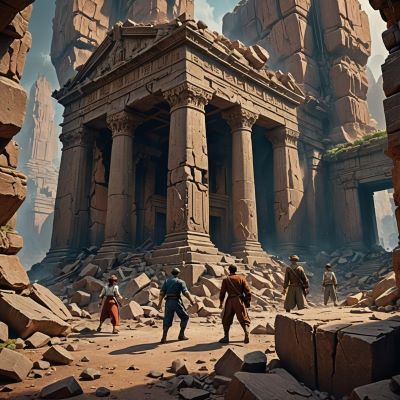
In the heart of the dense jungle lies the ruins of an ancient temple, rumored to hold untold riches and artifacts of great power. However, the temple is also said to be filled with traps and puzzles designed to test the wit and cooperation of those who dare to enter.

A group of treasure hunters have funded an expedition to the temple in the hope of uncovering it’s wonders to share with the world. The architects of this ancient place were cunning beyond measure, and the team will soon discover that their greatest challenge will be working together to make it out alive.

For inspiration think Indiana Jones, Tomb Raider, Unchartered and Jungle Cruise.

Player Set Up with Collaboration in Mind

Using the Play2Lead ruleset all players need is an occupation. For this adventure they can choose from:

  • Archaeologist – professor of the ancient world. Equipped with a lantern. Read hieroglyphics, understand artefacts, high level of knowledge
  • Climber – working at heights professional. Equipped with a 50m rope. Climbing, ropework, high level of agility
  • Engineer – technical specialist. Equipped with a shovel and axe. Construction, demolition, high level of practical know how
  • Navigator – directional expert. Equipped with a compass. Map and compass skills, unerring sense of direction
  • Pilot – helicopter pilot. Equipped with a lantern. Piloting vehicles of all types, radio use, electronics master
  • Expedition Leader (optional) – no specialist skills. Equipped with a knife. Must facilitate the team working together

To speed things up have a character sheet for each character type ready to go.

#1 Collapsing Chamber

We begin in the treasure room of the Lost Temple. A chamber adorned with intricate carvings, hieroglyphics and ancient relics. Piles of gold and gems lie strewn along the walls. Timber shelves lie broken on the floor. On a roughly hewn plinth sits the fabled statue of the gods glinting in the torchlight. Pick a player at random. That characters hand has just closed around the ancient artefact. Suddenly, they trigger a hidden mechanism, causing the chamber to shake violently as the ceiling starts to collapse. Large stone blocks begin to fall from above, blocking the exit. Gold coins rain from the ceiling filling the chamber and restricting movement.

Challenge: The party must quickly assess the situation and find a way to escape before they’re crushed by falling debris.

Solution: A hidden lever is located up one of the walls. Reading the hieroglyphics will point out it’s location. Otherwise careful observation might allow it to be found. Pulling the lever stops the collapse and reveals a new passage to safety. Alternatively, the party could use their strength and agility to dodge falling rocks and clear a path to the exit.

Remember this is a high pressure situation. Make players take Exhaustion (Play2Lead) or other Pressure Tests if using another system to ratchet up the tension. Don’t give the players too much time to plan. If an individual is taking too much time skip them and move on. Pushing the time threat is a critical part of this encounter.

#2 River Rapids

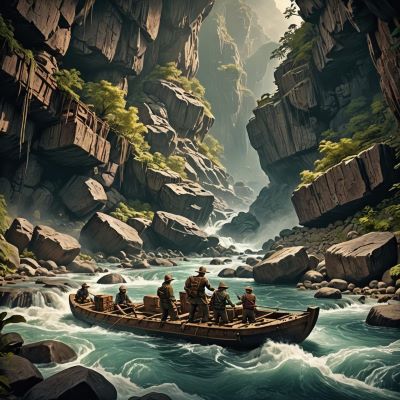
Exiting the collapsing chamber, the group of adventurers find themselves in a vast underground river that flows through the heart of the temple. The river’s currents are swift and treacherous, and the only means of escape seems to be an old rickety raft tethered to the shore.

Challenge: Maneuvering the raft through the river’s rapids while avoiding jagged rocks and hidden dangers.

Solution: The party must work together first to make the raft river worthy. Not doing this will give it a chance to break up halfway through the encounter. Secondly, to navigate the river, using their skills to steer the raft safely. The river will fork. The navigator will be able to tell which way to go. Alternatively there is a fresher breeze coming from the right channel. Along the way, they encounter a series of jagged rocks that threaten to damage and capsize the raft.

Reward player ingenuity here. What will they use to steer the raft? How will they make it safe to use?

#3 Guardian’s Gauntlet

The river throws the group from a low waterfall into a pool below. The bright sunlight of the jungle pool meets them as they find themselves out of the temple. However, as they swim to the side something slides against the leg of one of the swimmers. They are not alone.

Within the pool lives a formidable guardian—a massive, serpentine creature with gleaming scales and razor-sharp fangs. Blocking their path, the guardian seems intent on preventing anyone from leaving the temple alive. It will attempt to encircle the character that is most alone and attempt drown it. One bite from this creature will kill a character outright. This should be played as a deadly, exciting grand finale to the adventure.

Challenge: Defeating or evading the guardian while making a desperate dash for freedom.

Solution: The party must use their wits to outmaneuver the guardian, perhaps by exploiting its weaknesses or finding a way to distract it long enough to slip past. Alternatively, they could way to incapacitate it temporarily, allowing them to make their escape without resorting to violence.

Heighten the terror by having the creature signal it’s presence. Slithering past a leg. Ripples on the water. A flick of a slimy, scaly tail. When the creature reveals itself play up the danger, the toothy maw, the crazed eyes. Make sure the payers know that their characters are in trouble.

Once again reward out of the box thinking and collaboration. How will the team distract or defeat the creature together. This is not something they can win alone.

Collaboration Debrief

Did the players escape unscathed? While the adventure is over, the experience is not. Now is the time to get your players reflecting upon their experience. Ask some or all of the following questions to draw out the discussion.

  • Where did you as a team collaborate well?
  • Did you utilize everyone’s skills?
  • How could you have integrated collaboration better?
  • Is there anything you would have done better?

Following the debrief it’s also worth asking your players for feedback. Did they enjoy the experience and was there anything that could have been done better?

Final Thoughts on an Adventure in Collaboration

This adventure aims to be a fast, exciting experience that fosters collaboration between the players. A chance to debrief afterwards gives attendees a chance to reflect on their experience and what went well and what didn’t.

I envisage this as a useful experience for a cohort of a future leaders training course. Run this experience at the beginning of the course. Then, follow up with a similar experience at the end and see how they have grown as leaders. Has their level of collaboration increased?

Alternatively it could be used as a way help a newly forming team. A chance to get to know each other in a fun experience as well as reflect on how they might work together moving forward. Other uses might be as a way to introduce new people to world of rpgs. A small commitment of time as a way to dip their toes into this exciting medium.

I hope this simple scenario opens your eyes to what can be done with a short, simple adventure. Where do you think it could be used?

A pdf of this adventure with character sheets can be found at the Play to Lead downloads page.

Exploring Dynamics in Uncertainty: A Wargame Experience

April saw me attend MartyCon 2024, where I ran a miniatures wargame intended to test players resolve under uncertain conditions. As leaders in the real world we deal with a distinct lack of information about our competitors motives and objectives. This uncertainty leads to difficult decision making and stress. My players came from all walks of life including engineers, teachers, ex soldiers and bankers. All were thrust into a scenario of limited information where quick decision making was needed to win the game. In this article I describe the game set up and play before looking at three leadership lessons we can draw from the experience.

The Set Up

I designed the game using the Space Weirdos ruleset with players commanding one of six factions battling it out under a giant factory complex set in the underbelly of the Warhammer 40,000 universe. Each player had a different primary and secondary objective. These ranged from hunting a demon infused artefact, starting a rebellion and assassinating a rival leader. Below is a summary of each group:

  • Inquisition/Sisters of Battle: A formidable force dedicated to rooting out heresy and chaos, armed with faith and righteous fury.
  • Enforcers: Tasked with maintaining order and eliminating gang activity, these elite warriors are the enforcers of Imperial law.
  • Honor Guard Kill Team: The personal guard of the Imperial Governor, wielding the authority to bring the Mining Guild. They also had a side mission to get rid of the Governors future Son in Law.
  • Acolytes of the Red Mist: A mysterious order shrouded in secrecy, rumored to be on the brink of completing an elaborate ritual with unknown consequences.
  • Mining Guild: Hard-bitten workers pushed to the brink of rebellion by mistreatment, seeking to assert their rights amid the chaos of civil unrest.
  • Scissor Sisters: An influential crime syndicate capitalizing on the turmoil, maneuvering in the shadows to exploit opportunities for profit and power.

Each players team comprised four miniatures with different weapons and abilities. But so many that the game became overwhelming.

I took the role of gamemaster to keep play moving, answering rules queries and making sure everyone was having fun. Of course, this was key in keeping the game running smoothly and allowing for players to try things outside of the normal ruleset.

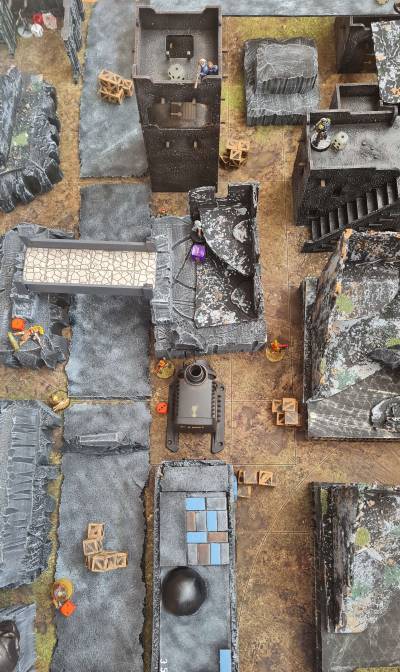
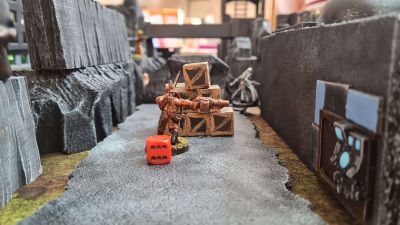
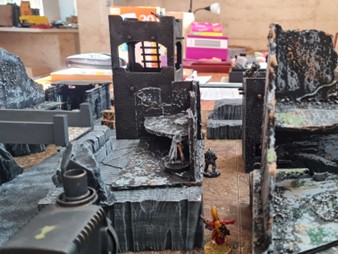
Part of the battlefield with four factions visible

Space Weirdos

I chose the Space Weirdos ruleset intentionally during my planning of the experience. First, it is very simple, but with enough variety in character skills and weapons to keep things interesting. Secondly, players take turns moving one miniature each. This, and the fact that players can interrupt each others goes with actions made sure that no players were left out twiddling their thumbs. Lastly, movement was completed using a 6 inch stick removing the cumbersomeness and clutter of tape measures.

Everyone around the table picked the rules up easily. This is high praise indeed as most hadn’t played a wargame before. I cant recognize this game enough. In fact, I know my friends and I will be playing this ruleset again in the near future.

Adding Uncertainty

Having read their briefs, each player knew their main objective and main adversary. They also had notes on potential allies. Consequently, there was a base line of understanding around the situation. Encouraging players to communicate by secret notes added extra spice. Creating and breaking alliances as needed. Communications lit up within the first minute of the game, with notes flying between all participants. I quickly ran out of post-it notes and players turned to texting one another.

Now the waters were truly muddied. Who to trust. How to win your objective and how to illicit help in doing so was no longer a straight forward concern.

Game Action

We played for two and half action filled hours. Alliances were made. Motives were guessed at. The ensuing firefight unleashing chaos. Feedback from the players showed how difficult they found working with such unknowns. Enjoyable, but difficult.

One player, found himself getting frustrated at another player, perceived to be a neutral party who seemed to be targeting him. Afterwards it dawned on him that the targeting was the result of an unknown objective. He was of course completely right about that.

The player who eventually won, was double crossed, lost most of their team members, but stayed focused on their objective to pull a win on the very last turn.

Often wargames can turn into straight forward affairs. Not this one. Everyone was second guessing each other right until the end. The debrief at the end created more than a few ah ha moments as pieces of the puzzle fell into place.

Given all this uncertainty experienced by the players, what lessons can we learn from the scenario?

The action from a models perspective

Lesson 1: Flexibility and Collaboration

The game’s setup, designed to pit players against each other amidst uncertainty, showcased the importance of flexibility and collaboration in leadership. One of the players, embodying these traits, adeptly negotiated alliances and adapted his strategy on the fly to help achieve his objective. His willingness to collaborate with unexpected allies underscored the power of flexibility in leadership, demonstrating the value of adaptability in the face of adversity.

Lesson 2: Trust, Betrayal, and the Art of Managing Expectations

As players delved into the fray, trust, betrayal, and the delicate art of managing expectations emerged as crucial leadership lessons. The player running the Sisters of Battle/Inquisition faction, initially sought alliances based on his knowledge of the Warhammer 40,000 universe. However, when his allies turned on each other and betrayal ran rampant, he found himself isolated and betrayed. His assumptions very nearly cost him the game. This experience highlighted the importance of managing expectations and understanding the fluid nature of alliances in leadership scenarios.

More action as the mining guilder sprints for the vox cast station (their primary objective)

Lesson 3: Effective Communication and Information Management in the Face of Adversity

Against the backdrop of clandestine dealings and covert alliances, effective communication and information management emerged as critical leadership skills. Players communicated covertly through notes and smartphones, forming secret alliances and plotting betrayals. This emphasis on information management underscored the importance of access to key intelligence and the ability to convey messages discretely in leadership scenarios, especially amidst the chaos of conflict.

Final Thoughts on Uncertainty

In conclusion, I believe this experience moved beyond that of a simple game. Instead serving as fertile ground for exploring leadership dynamics. Leading the different factions, players not only battled for victory but also honed their leadership skills in the crucible of conflict amidst uncertainty.

I will be sure to use this type of game to explore other leadership themes in the future.

A Weekend of Gaming, Friendship, and Leadership Development

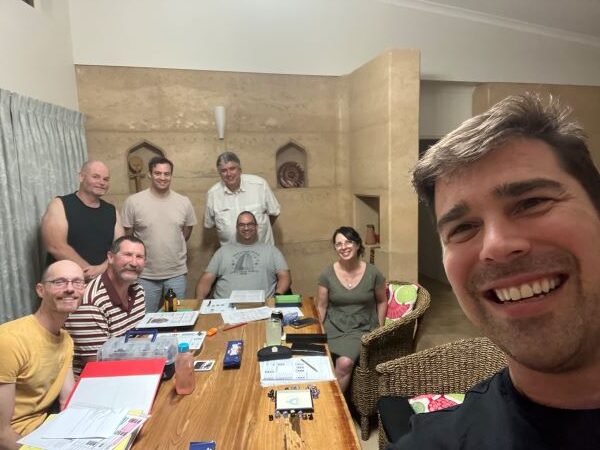
Last month, twelve of my friends gathered for MartyCon 2024. This weekend gaming extravaganza transcended mere entertainment to become an immersive experience in camaraderie and even leadership development. MartyCon, named in honor of its founder Marty, brought together enthusiasts of various games for a weekend of epic adventures.

What was MartyCon?

Attendees were spoiled for choice with a diverse array of gaming sessions to participate in. There was something for everyone. From classic RPGs in the vein of Dungeons & Dragons to intricate miniature battles set in fantastical worlds. Attendees had the freedom to pick and choose which games they wanted to partake in. Giving each participant an experience tailored to their interests and time commitment.

What made the MartyCon weekend truly special was the blend of competitive and collaborative games. In one session, players found themselves thrust into a game where each had secret objectives. This forced them to form alliances, make calculated moves, and pursue objectives with limited information. The dynamic nature of this game fostered intense strategizing and negotiation among players, leading to memorable moments of triumph and betrayal.

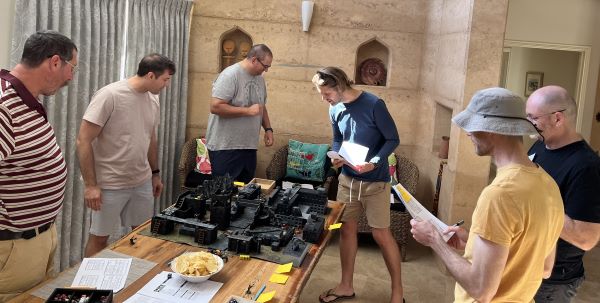
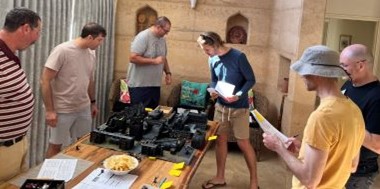
Serious strategizing.

Another session involved players trying to escape a mining planet in the midst of a revolt. Although the games master used the horror RPG Those Dark Places, he also had us all out of our seats hunting the grounds of our accommodation. Hidden QR codes then led us towards building lego models under extreme time pressure. Failure meant our characters would be left to rot on a hostile planet. Interestingly, no one took the lead. Instead, with a clear goal in mind (escaping the planet), the participants all worked together seamlessly to build our escape craft.

A different game was based in Dolmenwood a fantasy world based on the folklore of the British Isles. One of the things that made this game so unique was the lethality of the system. Characters could die with ease. After a near death experience at the hands of an ogre the players started to work more closely together. Utilizing skills and tactics to uncover the mystery and defeat the big bad and his zombie pets. (That’s a story for another time).

MartyCon, a Blueprint for Leadership Development?

The parallels between the gaming experience at MartyCon and leadership development are striking. Much like in a leadership scenario, participants had to navigate complex social dynamics, forge alliances, and make decisions with incomplete information. Of course, the game where players had secret objectives particularly mirrored real-life leadership challenges. Where individuals must balance their own objectives with the needs of the group.

Imagine a day where different game types could be utilized to cultivate various leadership skills. Picture networking with your leadership cohort, immersing yourselves in different gaming scenarios, and using each experience as an opportunity to learn and grow. Through gaming, participants could sharpen their communication, negotiation, and decision-making skills—essential qualities for effective leadership.

Moreover, the MartyCon weekend provided a platform for attendees to build meaningful connections with their peers. Just as in a professional setting, collaboration and teamwork were essential for success in many of the games. Participants had the chance to work together, strategize, and celebrate victories as a cohesive unit. Ultimately, these shared experiences fostered bonds that transcended the gaming table, laying the foundation for lasting friendships and professional relationships.

Ambush, betrayal? All of the above!

Final Thoughts on the MartyCon Weekend

Traditional methods of leadership development often rely on lectures and simulations, but MartyCon demonstrates the power of experiential learning through gaming. By immersing participants in dynamic, challenging scenarios, gaming can serve as a catalyst for personal and professional growth.

As MartyCon 2024 came to a close, attendees departed with fond memories of epic battles, thrilling adventures, and new friendships. Yet, perhaps more importantly, they left with valuable lessons in leadership, collaboration, and adaptability. MartyCon stands as a testament to the transformative potential of gaming—a realm where fantasy and reality converge, and where leaders are forged through adventure.

Massive thanks to everyone who organized, ran games and participated. I cant wait for MartyCon 2025!

The Dungeon Master’s Guide to Running Awesome Meetings

It was pointed out me the other day that playing a game of Dungeons and Dragons (D&D) is a great way to get you running awesome meetings at work. As you’ll read, the parallels are uncanny. In this post, we’ll delve into how the practical aspects of running a D&D session can be translated into effective meeting management techniques that lead to effective and productive workplace gatherings.

Preparation is Key

In D&D, a well-prepared Dungeon Master (DM) ensures a smooth and engaging gameplay experience for the players. The same concept applies to running meetings. As such, proper preparation is the foundation of a successful meeting.

Here’s how D&D-inspired preparation can help:

a) Define clear objectives: Just as a DM sets the adventure’s goals and objectives, you should establish clear meeting objectives. What do you want to achieve? What are the key takeaways?

b) Create an agenda: Much like outlining the session’s storyline, create a detailed agenda with time allocations for each agenda item. Stick to it to maintain focus and efficiency.

c) Know your audience: In D&D, the DM tailors the game to the players’ preferences. Similarly, understand your meeting participants’ needs and tailor the content to make it relevant and engaging for them.

Encouraging participation is important for both D&D and workplace meetings

Engage and Empower Participants

D&D’s collaborative nature promotes engagement and empowerment among players. The most memorable games are when the players take center stage and have agency in the outcome of the adventure. In your meetings, the same principles can foster participation and decision-making.

Consider these practical approaches:

a) Encourage participation: Similar to players actively engaging in the game world, create opportunities for participants to contribute during the meeting. Encourage open discussions, question-and-answer sessions, and feedback.

b) Delegate responsibilities: In D&D, party members have specific roles. In meetings, assign roles or responsibilities to participants to make them feel invested and accountable for the meeting’s success. For instance, designate a timekeeper, note-taker, or discussion leader.

c) Empower decision-making: Just as players make crucial in-game decisions, allow participants to have a say in important matters during the meeting. Encourage consensus-building and gather input to arrive at well-informed decisions.

Adaptability in D&D directly correlates to being flexible in meetings

Adapt and Manage the Flow

In D&D, the game’s flow can change dynamically based on players’ choices. Adapting to these changes is a vital DM skill. In meetings, the ability to manage the flow and adapt to unexpected developments is equally essential.

Practical applications include:

a) Stay flexible: Just as a DM adapts to players’ choices, be flexible during the meeting. If the discussion veers off track or a new issue arises, address it without derailing the entire meeting.

b) Time management: Keep a close eye on time, much like a DM managing a gaming session’s pacing. Ensure that discussions don’t overrun, and use time management techniques to keep the meeting on schedule.

c) Summarize and document: After a D&D session, the DM often summarizes the events and updates the campaign notes. Similarly, at the end of a meeting, recap key points, decisions, and action items, and ensure these are documented and distributed to participants.

Final Thoughts on Running Awesome Meetings

Dungeons and Dragons offers practical insights for running awesome meetings at work. By applying D&D-inspired principles like thorough preparation, engaging and empowering participants, and adaptability in managing the flow, you can elevate your meeting management skills to facilitate more productive and efficient workplace gatherings. So, embrace the Dungeon Master within you, and lead your team through epic meetings that achieve their objectives and keep everyone engaged and motivated.